
Skip to content
Thirstier News November 5, 2026
Home
Thirstier News
  • ABC Live
  • Al Jazeera
  • CBS Live
  • Contact
  • France 24
  • Live News
  • NBC Live
Popular Tags
  • YouTube
  • U.S. News
  • World News
  • MS NOW
  • PBS NewsHour
  • Al Jazeera English
  • DW News
Science & Space — NASA — News, Missions & Technology

Building Foresight for Earth Science, featuring Lindsey Jacobson

Published August 26, 2026 · 5 min read
· By Thirstier News

NASA’s Earth-observing satellite missions track dozens of features of a changing planet — aerosols, sea levels, land cover, cloud cover — over years and decades. Sustaining that record for the scientific and operational communities who depend on it requires more than engineering talent. It requires planning for an uncertain future: anticipating where a mission delay or on-orbit event might create a gap in the data those communities rely on.

Lindsey Jacobson’s work helps NASA anticipate those disruptions before they happen and gives senior leaders options for managing them.
A Pathways intern in engineering, Jacobson supports NASA’s Earth Science Division through the NASA Earth Science Strategic Integration Environment (NESSIE) team within the Systems Analysis and Concepts Directorate (SACD) at NASA’s Langley Research Center in Hampton, Virginia.

NASA’s Pathways program connects undergraduate and graduate students with NASA centers through internships that, with satisfactory performance, can lead to full-time civil service positions. Jacobson has returned to NASA Langley every summer since 2022, splitting her time between the center and finishing her mechanical engineering dissertation at North Carolina State University.

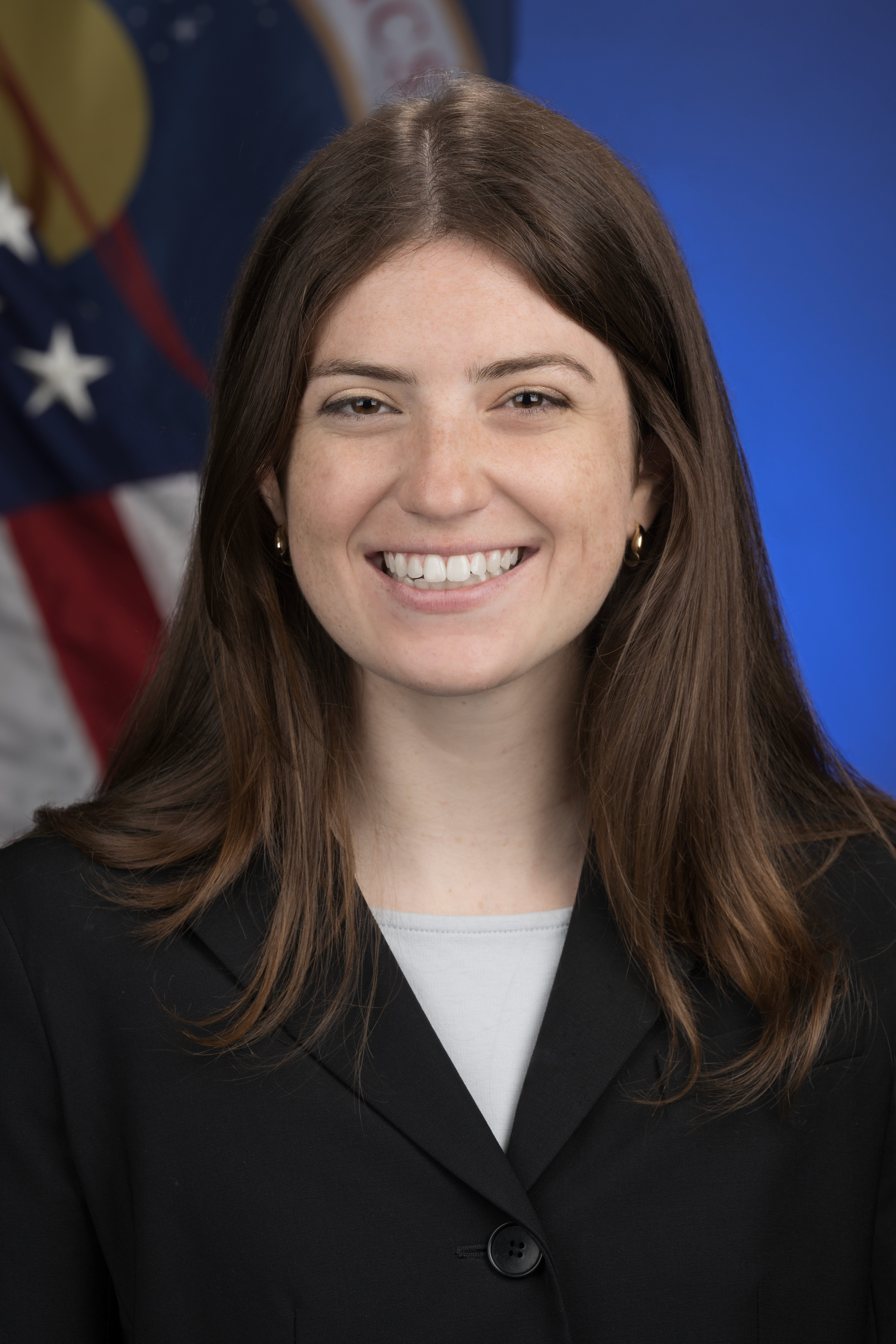
Lindsey Jacobson, Pathways Intern
Credit: NASA


“The way we do Earth science is changing.“


The Problem Space

Jacobson and the NESSIE team support the Earth science satellite portfolio — dozens of missions, each measuring specific features of the planet, from clouds to sea surface temperature to land use. The goal is providing end user communities with the data products they depend on. The challenge is the unknown.

This image depicts a full view of the Earth, taken by the Geostationary Operational Environment Satellite (GOES-8), a satellite that was in service from 1994-2004. It was owned and operated by the National Oceanic and Atmospheric Administration (NOAA) and provided the kind of continuous monitoring necessary for intensive data analysis.
Credit: NASA

“There’s uncertainty about mission lifetimes and what could happen on orbit, and about schedules,” Jacobson explains. The team’s work gives NASA’s senior leadership a way to navigate that uncertainty: understanding where a gap in coverage might emerge and identifying options to mitigate or hedge against it. By providing alternative pathways for meeting end-user needs, this work supports senior leaders in managing a complex, interdependent portfolio.

Writing the Code

Within that effort, Jacobson’s focus is building analysis tools that give the team what she calls a “foresight ability.”

“It’s the ability to anticipate different things that might happen — changes that might occur across the portfolio of Earth-observing missions — and to have strategies in mind for how to respond, so we can keep delivering data to end users,” she says.

Not every change is bad news. Missions sometimes operate well beyond their planned lifespan, creating room to extend their value. But whether an adjustment is welcome or not, the principle is the same: know the options before anything happens.

Jacobson compares it to preparing for hurricane season. “You get the storm shutters, you buy the sandbags, and you have them pre-positioned,” she says. “Then when the warning comes, you’re not scrambling, and you’re not at risk of the store selling out. You already have what you need in place.” NESSIE’s work follows the same logic for the Earth-observing portfolio by understanding ahead of time what a disruption might mean and having a set of responses ready before anything happens.

“We proactively suggest the strategies and alternatives that could be enacted if there’s a change,” Jacobson says. “We do that ahead of time, so people understand what options might exist.”

Her approach carries echoes of her graduate research, which examines how complex systems — infrastructure that can’t simply be torn down and rebuilt, like the electric grid — must evolve deliberately instead. “We designed a grid, and now we live with that grid forever,” she says. “We can’t tear it down and build a new one. What we can do is modify, expand, and improve upon what we have.” It’s the same instinct for working with what exists, rather than starting from scratch, that shapes how she approaches her work at NASA.

Keeping Pace

Engineers arriving at NASA for the first time might expect the hardest part of the job to be technical. Jacobson found something else: the landscape itself is what demands the most adaptability.

“The way we do Earth science is changing,” she says. Commercial companies are increasingly contributing data alongside government agencies. New space agencies are entering the field. Innovative technologies and architectures are emerging all the time. Keeping pace with that shift — understanding how NASA’s own capabilities are evolving and how to best serve the communities that depend on the data — is as much a part of the job as any calculation.

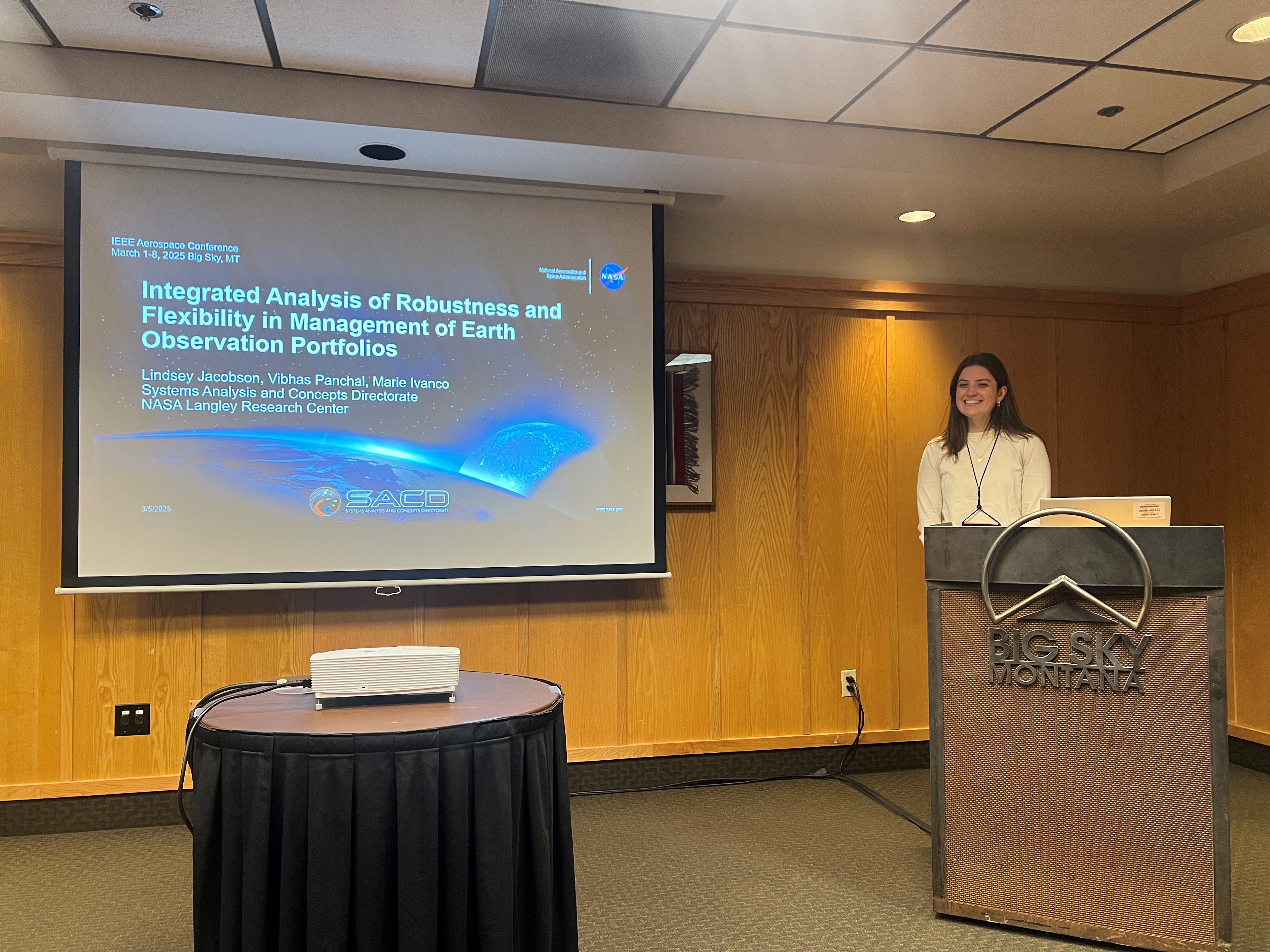
Jacobson presenting NESSIE’s work on managing portfolios of Earth-observing missions to meet science needs despite uncertainties in mission scheduling and lifetimes, Institute of Electrical and Electronics Engineers (IEEE) Aerospace Conference, 2025.
Credit: NASA

Some of that adaptability shows up in smaller ways too, like the growing role of AI tools in her team’s own workflow. “Langley has done a lot of firsts,” Jacobson says, echoing something she heard recently from Trina Dyal, NASA Langley’s director, at an intern event. “And we want to continue to be the first. That means learning new things and figuring out how to bring them into how we work.”

On Jacobson’s Sci-Fi Shelf

The Sirens of Titan by Kurt Vonnegut

Jacobson received this novel in high school, let it sit on her shelf for years, and finally picked it up during the pandemic.

“It was very special. It touches a lot on the meaning of life, and that connects to some of the reasons I was motivated by space in the first place. The idea that space exploration can bring humanity together. That cosmic perspective.”


Part of the Systems Analysis and Concepts Directorate at NASA’s Langley Research Center.
Learn more about our work by visiting our website.


Source: NASA

Filed under: Science & Space — NASA — News, Missions & Technology

Post navigation

Previous: 5 Facts – The Future of UN Peace Operations
Next: Beyond music: Dolly Parton’s lifesaving gift to science | DW News

More from Science & Space — NASA — News, Missions & Technology

Science & Space — NASA — News, Missions & Technology

3D 67P

Published October 17, 2026 · 2 min read
Science & Space — NASA — News, Missions & Technology

NASA Names Stephen Cash Marshall Space Flight Center Director

Published October 16, 2026 · 4 min read
Science & Space — NASA — News, Missions & Technology

I Am Artemis: Allison Mjoen

Published October 16, 2026 · 3 min read
Science & Space — NASA — News, Missions & Technology

Chasing the International Space Station

Published October 16, 2026 · 2 min read
Science & Space — NASA — News, Missions & Technology

Isaias Dims the Gulf Coast

Published October 16, 2026 · 5 min read
Science & Space — NASA — News, Missions & Technology

NASA to Help Unlock Mysteries of Mars’ Moons in Upcoming Mission

Published October 15, 2026 · 4 min read
Science & Space — NASA — News, Missions & Technology

NASA Satellites Observe Historic 2026 El Niño

Published October 15, 2026 · 6 min read
Science & Space — NASA — News, Missions & Technology

Power Up: Roll Out Solar Arrays Boost Space Station Power Supply

Published October 15, 2026 · 2 min read
Science & Space — NASA — News, Missions & Technology

NASA Welcomes All Ages, Experience Levels for Space Apps Challenge

Published October 15, 2026 · 4 min read
Science & Space — NASA — News, Missions & Technology

The Milky Way over Manhattan

Published October 15, 2026 · 2 min read
Science & Space — NASA — News, Missions & Technology

NASA to Host News Conference Previewing US Spacewalks 100, 101

Published October 14, 2026 · 2 min read
Science & Space — NASA — News, Missions & Technology

NASA Astronauts to Answer Questions from Florida Students

Published October 14, 2026 · 2 min read
Science & Space — NASA — News, Missions & Technology

NASA’s Chandra Breaks Down ‘Treble Clef’s’ Galaxy Cluster Collision

Published October 14, 2026 · 5 min read
Science & Space — NASA — News, Missions & Technology

Mars and the Beehive Under an Aurora

Published October 14, 2026 · 2 min read
Science & Space — NASA — News, Missions & Technology

NASA Names Astronaut Christina Koch Acting Deputy Chief Engineer

Published October 13, 2026 · 4 min read
Science & Space — NASA — News, Missions & Technology

TB 26-08 Complex Modes in Lightly Damped Structural Systems: A Two-Mode Interaction Perspective

Published October 13, 2026 · 2 min read
Science & Space — NASA — News, Missions & Technology

NASA JPL Testing Readies Voyager Technologies Lander for Moon Mission

Published October 13, 2026 · 5 min read
Science & Space — NASA — News, Missions & Technology

NASA Science, Cargo Launch on 35th SpaceX Resupply Mission to Station

Published October 13, 2026 · 3 min read
Science & Space — NASA — News, Missions & Technology

Desert Stairway to Heaven

Published October 13, 2026 · 2 min read
Science & Space — NASA — News, Missions & Technology

An Impact Structure With Legs

Published October 13, 2026 · 2 min read
Science & Space — NASA — News, Missions & Technology

NASA’s SpaceX CRS-35 Mission to Launch Health Research

Published October 12, 2026 · 3 min read
Science & Space — NASA — News, Missions & Technology

Jupiter and the Moons

Published October 12, 2026 · 2 min read
Science & Space — NASA — News, Missions & Technology

Antarctic Sea Ice Grows to Its 2026 Maximum

Published October 12, 2026 · 3 min read
Science & Space — NASA — News, Missions & Technology

Ice Fishing for Cosmic Neutrinos

Published October 11, 2026 · 2 min read
Science & Space — NASA — News, Missions & Technology

Lunar Farside

Published October 10, 2026 · 1 min read
Science & Space — NASA — News, Missions & Technology

NASA Seeks US Industry Plans for Commercial Space Stations

Published October 9, 2026 · 2 min read
Science & Space — NASA — News, Missions & Technology

NASA Demonstrates Next-Generation Heat Shield Technologies

Published October 9, 2026 · 4 min read
Science & Space — NASA — News, Missions & Technology

Stickney Crater

Published October 9, 2026 · 2 min read
Science & Space — NASA — News, Missions & Technology

Floodwaters Overwhelm Thailand

Published October 9, 2026 · 3 min read
Science & Space — NASA — News, Missions & Technology

NASA Briefing to Highlight Contributions to Martian Moons Mission

Published October 8, 2026 · 2 min read
Science & Space — NASA — News, Missions & Technology

NASA Announces Bold Science Initiatives for America’s Golden Age Summit

Published October 8, 2026 · 2 min read
Science & Space — NASA — News, Missions & Technology

NASA’s SpaceX Crew‑12 Splashes Down, Sets Briefing to Discuss Mission

Published October 8, 2026 · 4 min read
Science & Space — NASA — News, Missions & Technology

NASA, Energy Department Advance New Era of Nuclear-Powered Exploration

Published October 8, 2026 · 4 min read
Science & Space — NASA — News, Missions & Technology

The Saturn System Smörgåsbord

Published October 8, 2026 · 2 min read
Science & Space — NASA — News, Missions & Technology

Fighting Drought in Texas Cotton Country

Published October 8, 2026 · 7 min read
Science & Space — NASA — News, Missions & Technology

NASA Sets Coverage for SpaceX 35th Station Resupply Launch, Arrival

Published October 7, 2026 · 4 min read
Science & Space — NASA — News, Missions & Technology

NASA’s SpaceX 35th Commercial Resupply Mission Overview

Published October 7, 2026 · 4 min read
Science & Space — NASA — News, Missions & Technology

Supernova Remnant Pa 30

Published October 7, 2026 · 2 min read
Science & Space — NASA — News, Missions & Technology

Arctic Sea Ice Shrinks to Its 2026 Minimum

Published October 7, 2026 · 4 min read
Science & Space — NASA — News, Missions & Technology

NASA to Cover Northrop Grumman CRS-24 Spacecraft Departure

Published October 6, 2026 · 2 min read

Search

Recent Posts
  • Why Trump’s midterm blues mean short-term gain, long-term pain for China
  • Shipping crews caught in the crossfire of the Hormuz conflict | DW News
  • LIVE: French students, workers, pensioners protest in Marseille
  • LIVE: Protests in France as trade unions hold nationwide strikes
  • Joshua Wong’s friend says jailed Hong Kong activist reading books, learning guitar inside prison
  • Blue wave sets up possible IMPEACHMENT of Trump’s attorney general, Todd Blanche
  • Over 300,000 tarantulas seized in Peru | DW News
  • The Last Word with Lawrence O’Donnell – Nov. 4 | Audio Only
  • Vance blames Iran war for GOP midterms loss, Trump brags about WH ballroom | MS NOW Highlights
  • Hope and faith in the American dream behind blue surge in Latino vote in Texas
Categories
  • Florida (110)
    • Jacksonville (20)
    • Miami (62)
    • Orlando (17)
    • Tampa (11)
  • Health (1)
  • New York (69)
    • New York City (69)
  • Science (85)
    • Health & Medical Research (10)
    • U.S. Geological Survey (18)
    • U.S. National Science Foundation (57)
  • Science & Space (364)
    • NASA — Centers & Facilities (82)
    • NASA — JPL & Near-Earth Objects (4)
    • NASA — News, Missions & Technology (242)
    • NASA — Photos & Visual Records (36)
  • Trump (1146)
  • U.S. Civil Service (245)
    • Cabinet — Department of Agriculture (8)
    • Independent Agencies — Commodity Futures Trading Commission (19)
    • Independent Agencies — Consumer Financial Protection Bureau (12)
    • Independent Agencies — Consumer Product Safety Commission (32)
    • Independent Agencies — Equal Employment Opportunity Commission (64)
    • Independent Agencies — Federal Reserve Board (1)
    • Independent Agencies — Federal Trade Commission (46)
    • Independent Agencies — National Labor Relations Board (22)
    • Independent Agencies — Securities and Exchange Commission (41)
  • U.S. Government (11)
    • DOJ — National (8)
    • DOJ — U.S. Attorneys (10)
    • GAO — News & Analysis (43)
    • GAO — Reports & Decisions (158)
    • Department of Justice (10)
    • Government Accountability Office (1)
  • U.S. News (2483)
  • U.S. Veterans (255)
    • Benefits (25)
    • Disabled Veterans (10)
    • Employment (10)
    • Health & Care (64)
    • News (146)
  • Washington (233)
    • Washington (87)
      • Seattle (57)
      • Spokane (30)
  • World News (1942)

Recent Comments

No recent comments.

Archives
  • November 2026 (218)
  • October 2026 (1794)
  • September 2026 (2072)
  • August 2026 (1879)
  • July 2026 (17)
  • June 2026 (8)
  • May 2026 (1)
  • April 2026 (6)
  • March 2026 (1)
  • January 2026 (3)
  • December 2025 (1)
  • November 2025 (1)

Thirstier News is a service of Thirstier, a DBA of Immix Tachyon Synergy Network LLC.

© 2026 Thirstier. Thirstier Theme is an original theme from Thirstier.