
Written by Athanasios (Thanos) Klidaras, Ph.D. candidate at Purdue UniversityÂ
Sept. 21, 2026
After a long hiatus, the Perseverance rover updates page is back. A lot has happened on Mars in the meantime, and with regular updates now resuming, there is plenty to catch up on â Perseverance has been busy. The rover has spent 2026 exploring the âLac de Charmesâ area, an area of valleys and ridges west of the Jezero crater rim that represent a âwild west frontierâ for the mission. The rocks in this area are among the oldest Perseverance has encountered. They formed when Mars was still a young planet bombarded by asteroid impacts, long before the sedimentary rocks inside Jezero crater formed in rivers and lakes. They therefore could teach us much about the earliest era of Martian history â and, more broadly, how rocky planets evolved during the tumultuous early history of our solar system.Â
The science team decided to thoroughly explore this ancient and intriguing terrain first, before deciding which rocks to sample. If you take a look at the roverâs location map, youâll see that Perseverance has followed a looping path winding between interesting outcrops, helping scientists build up an understanding of how âLac de Charmesâ formed. In this time, Perseverance has created a total of 13 abrasion patches on rocks that caught the teamâs attention, providing a feast of scientific data. So far, investigations suggest that many appear to have formed from cooled lava or magma (igneous rocks), as well as others that formed in the aftermath of a violent impact (impactite rocks) â and some that show evidence for both processes. Exploration has been boosted by a new algorithm that makes clever use of a processor originally used to communicate with the Ingenuity helicopter to achieve longer and more accurate drives.Â
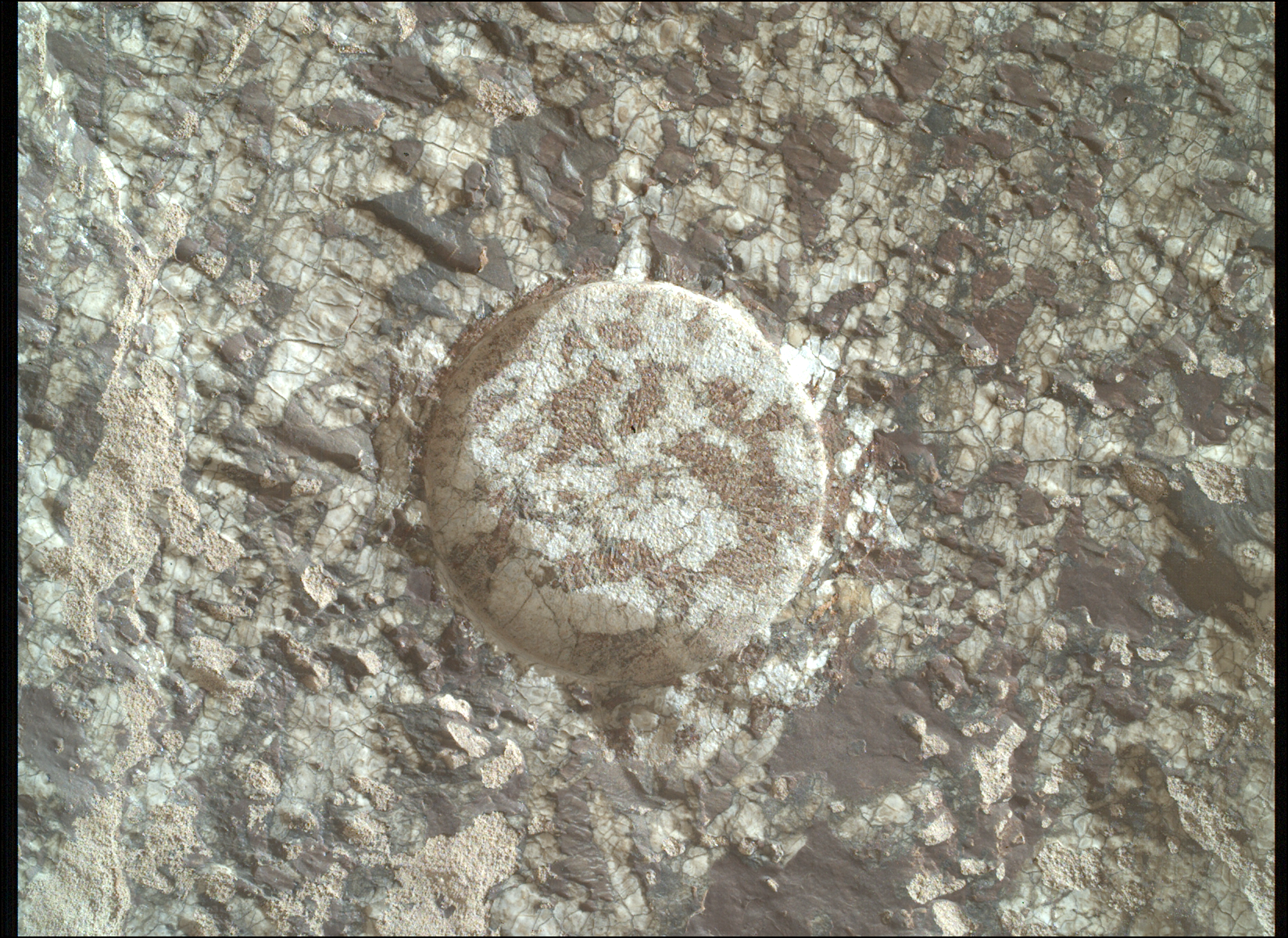
Perseveranceâs exploration of the âLac de Charmesâ region is now nearing its end, but the discoveries certainly havenât stopped. Recently, the science team sent the rover towards an area nicknamed âIdubi,â where hundreds of light-toned boulders were spotted from a distance. âIdubiâ has proven to be a scientific bonanza, where rocks of varying texture and composition are concentrated. When Perseverance investigated one of these light-toned boulders, an abrasion patch fittingly named âBadger Peakâ revealed a spectacular light-and-dark texture (shown in the image above) unlike any the rover has seen before. An attempt to sample this boulder was unsuccessful due to its high hardness, so the team is now searching elsewhere for a similar rock to sample. In the meantime, Perseverance has stopped to investigate an interesting outcrop nearby named âGardenia,â which could be a breccia â a rock that is itself comprised of fragments of many older rocks. This week, the rover will attempt an abrasion to give the science team a detailed look. Even after months of exploring Lac de Charmes, the team continues to be surprised, and with Perseverance preparing to move onward once again, there should be no shortage of new stories to share here.Â
Source: NASA