
Skip to content
Thirstier News September 16, 2026
Home
Thirstier News
  • ABC Live
  • Al Jazeera
  • CBS Live
  • Contact
  • France 24
  • Live News
  • NBC Live
Popular Tags
  • YouTube
  • U.S. News
  • World News
  • MS NOW
  • PBS NewsHour
  • Al Jazeera English
  • DW News
Science & Space — NASA — News, Missions & Technology

NASA Awards More Moon Base Science, Previews New Opportunities

Published August 3, 2026 · 5 min read
· By Thirstier News

Lauren E. Low

Jun 30, 2026
RELEASE26-053

NASA Headquarters

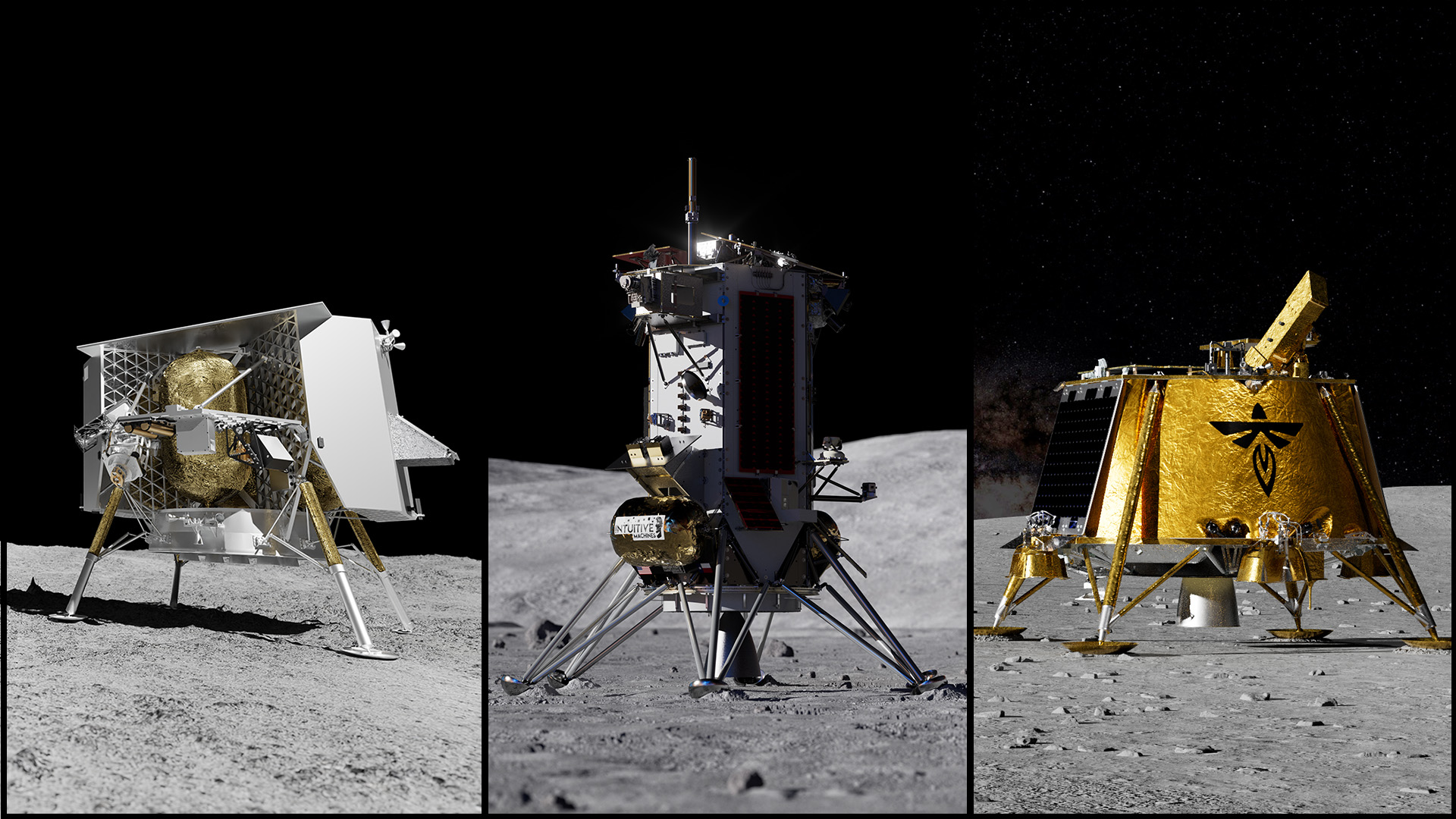
Three artist renderings depict commercial lunar landers from Astrobotic, Intuitive Machines, and Firefly on the Moon. NASA announced June 30 the landers will deliver more NASA science investigations and technology demonstrations to the lunar surface for NASA’s Moon Base Program.
Credit: Astrobotic/Intuitive Machines/Firefly

Editor’s note: This release was updated on June 30, 2026, to clarify the engineering development version for the PROMISE rover.

NASA announced Tuesday the selection of three companies to land four new missions on the Moon in late 2028 as part of the agency’s Moon Base Program. Astrobotic, Firefly Aerospace, and Intuitive Machines will deliver NASA science payloads to the lunar surface as the agency builds the first outpost on another celestial world.

“These new awards to our commercial partners, totaling nearly $600 million to land more missions on the Moon with science payloads, demonstrate our commitment to accelerating our effort to build a long-term presence on the lunar surface, and give us more opportunity to develop the skills we need to prosper there,” said Lori Glaze, associate administrator for the Human Spaceflight Mission Directorate at NASA Headquarters in Washington.

Astrobotic is awarded $297.9 million total for two deliveries, as well as Firefly Aerospace $144.2 million and Intuitive Machines $148.3 million for one delivery each as part of the agency’s CLPS (Commercial Lunar Payload Services) initiative, a backbone of the Moon Base. Each will use updated versions of already-flown lander designs to enable NASA’s increased mission cadence.

“We’re building a proving ground for Moon Base operations,” said Ryan Stephan, NASA’s Moon Base acting director of cargo landers. “Accelerating our Moon mission ordering cadence and launch opportunities enable us to move quickly to learn, iterate, and improve.”

With 17 lunar surface deliveries across multiple providers, NASA also announced new opportunities for American industry to contribute to the Moon Base. The agency is considering plans to send to the Moon, PROMISE (Polar Rover for Observation, Mapping, and In-Situ Exploration), a hybrid engineering development version of the Mars Perseverance and Curiosity rovers. Agency experts will define potential opportunities for PROMISE to characterize the lunar surface, subsurface, and prospect for resources.

In addition, NASA plans to solicit proposals in the coming months for lunar landers to deliver a power and avionics technology demonstration, another science manifest, and a South Pole optical imager. NASA also will share an open solicitation for Moon Base technology demonstrations and seek a lunar communication and navigation relay constellation to enable improved communication between Moon Base elements and Earth.

The awards announced June 30 will play a critical role in establishing the infrastructure for lunar surface operations. The companies are responsible for initiating and executing procurements, providing an assessment of a similar previous lunar lander, and incorporating lessons learned to improve the overall mission reliability.  

Each delivery will carry three NASA payloads to the lunar surface:

  • Stereo Camera for Lunar Plume Surface Studies (SCALPSS): An array of four cameras that uses a technique called stereo photogrammetry to produce a 3D view of the impact of an engine’s exhaust plume on lunar dust as the lander descends on the Moon’s surface. Collecting data from a variety of engine sizes, propellants, and landing locations, these high-resolution stereo images will aid in creating models to predict lunar dust erosion and ejecta characteristics, playing a vital role as bigger, heavier spacecraft and hardware are delivered to the Moon near each other.
  • Laser Retroreflector Array (LRA): Reflects laser beams transmitted by Moon orbiters or landing spacecraft to help them determine their orbit position or navigate to the surface. A small cookie-sized device made of eight quartz corner-cube prisms set into a dome-shaped aluminum frame, the array is passive, requiring no power or maintenance. These arrays have flown on previous CLPS landers and international lunar landers and will continue to be used to build a network of permanent location markers on the Moon for future exploration.
  • Linear Energy Transfer Spectrometer (LETS): Helps to better understand the radiation environment from a variety of lunar transit approaches and at different locations on the lunar surface. Derived from heritage hardware, this radiation monitor uses a tiny, advanced silicon detector to measure the energy carried by incoming space radiation. It will provide information about how strong radiation is and what kind of radiation is hitting the lunar surface, and provides the kind of detailed radiation data NASA needs to design safer missions, protect astronauts, and plan long‑duration exploration.

The agency also is reviewing options for these landers to deliver potential additional payloads to the Moon.

“By flying the same science instruments on multiple landers, we will better understand potential hazards during landing and build out a global network of environmental data and location markers on the Moon,” said Joel Kearns, deputy associate administrator for exploration, Science Mission Directorate, NASA Headquarters. “It’s akin to having weather stations in different locations on Earth. These three payloads are flight-proven and their data is critical to supporting safe human exploration of the lunar surface.”

NASA is advancing development of the Moon Base, a long-term lunar exploration and infrastructure initiative designed to enable sustained human presence and expanded scientific and commercial activity on the lunar surface.

As part of the Golden Age of innovation and exploration, NASA will send astronauts on increasingly difficult missions to explore more of the Moon for scientific discovery, economic benefits, and to build on our foundation for the first crewed missions to Mars.

For more information about NASA’s Moon Base plans, visit:

https://www.nasa.gov/moonbase

-end-

Rachel Kraft / Molly Wasser
Headquarters, Washington
202-358-1600
rachel.h.kraft@nasa.gov / molly.l.wasser@nasa.gov

Ivry Artis / Kenna Pell
Johnson Space Center, Houston
281-483-5111
ivry.w.artis@nasa.gov / kenna.m.pell@nasa.gov

Share

Details

Last Updated

Jun 30, 2026

Location
NASA Headquarters

Related Terms

  • Moon Base
  • Commercial Lunar Payload Services (CLPS)
  • Science Mission Directorate

Source: Artemis – NASA

Source: Artemis – NASA.

Filed under: Science & Space — NASA — News, Missions & Technology

Post navigation

Previous: NASA Invites Media to Serbia Artemis Accords Signing Ceremony
Next: NASA Announces Winners for 2026 Human Lander Challenge

More from Science & Space — NASA — News, Missions & Technology

Science & Space — NASA — News, Missions & Technology

NASA Ames Stars of the Month: September 2026

Published September 15, 2026 · 3 min read
Science & Space — NASA — News, Missions & Technology

NASA Invites Media to International Observe the Moon Night

Published September 15, 2026 · 2 min read
Science & Space — NASA — News, Missions & Technology

Celebrate International Observe the Moon Night with NASA

Published September 15, 2026 · 3 min read
Science & Space — NASA — News, Missions & Technology

A Daytime Eclipse: Moon Occults Venus

Published September 15, 2026 · 2 min read
Science & Space — NASA — News, Missions & Technology

New Crops, Health Research Proposals to Help NASA Advance Exploration

Published September 14, 2026 · 3 min read
Science & Space — NASA — News, Missions & Technology

NASA Welcomes Djibouti as Newest Artemis Accords Signatory  

Published September 14, 2026 · 3 min read
Science & Space — NASA — News, Missions & Technology

Summer Training: Catching Up With NASA’s Astronaut Candidates

Published September 14, 2026 · 4 min read
Science & Space — NASA — News, Missions & Technology

Where Your Elements Came From

Published September 14, 2026 · 2 min read
Science & Space — NASA — News, Missions & Technology

Comet NEOWISE Rising Over the Adriatic Sea

Published September 13, 2026 · 2 min read
Science & Space — NASA — News, Missions & Technology

Help Refine Data from Space Telescopes with Artifact InSPECtor

Published September 11, 2026 · 3 min read
Science & Space — NASA — News, Missions & Technology

NASA’s SpaceX Crew-12 to Discuss Station Mission, Upcoming Return

Published September 11, 2026 · 2 min read
Science & Space — NASA — News, Missions & Technology

NASA Boosts Open Science, Data Sharing with Artemis Accords

Published September 11, 2026 · 4 min read
Science & Space — NASA — News, Missions & Technology

M83: The Southern Pinwheel

Published September 11, 2026 · 2 min read
Science & Space — NASA — News, Missions & Technology

NASA Answers President’s Call to Establish United States Space Academy

Published September 10, 2026 · 3 min read
Science & Space — NASA — News, Missions & Technology

NASA’s Life-Saving Technology Where Cell Signals Can’t Go

Published September 10, 2026 · 3 min read
Science & Space — NASA — News, Missions & Technology

NASA, NFL Team Up to Showcase Space, Aeronautics Innovation

Published September 10, 2026 · 2 min read
Science & Space — NASA — News, Missions & Technology

LDN 1295: The Giraffe Nebula

Published September 10, 2026 · 2 min read
Science & Space — NASA — News, Missions & Technology

NASA Adds Relativity Space’s Terran R to Launch Services Contract

Published September 9, 2026 · 2 min read
Science & Space — NASA — News, Missions & Technology

NASA’s Chandra Unveils Mysterious X-Ray Objects

Published September 9, 2026 · 5 min read
Science & Space — NASA — News, Missions & Technology

NASA Names Two Artemis II Astronauts to Emeritus Program

Published September 9, 2026 · 4 min read
Science & Space — NASA — News, Missions & Technology

Curiosity Blog, Sols 4995-5001: 5,000 (Martian) Days on Mars

Published September 9, 2026 · 4 min read
Science & Space — NASA — News, Missions & Technology

From the Corps to the Cosmos, featuring Jaden Caradine

Published September 8, 2026 · 7 min read
Science & Space — NASA — News, Missions & Technology

NASA Calls for Proposals to Accelerate Lunar Surface Technologies 

Published September 8, 2026 · 2 min read
Science & Space — NASA — News, Missions & Technology

NASA Technique for Manipulating Satellite Photos Now Reveals Ancient Images  

Published September 8, 2026 · 3 min read
Science & Space — NASA — News, Missions & Technology

Hubble: Decagon Around Saturn’s South Pole

Published September 8, 2026 · 2 min read
Science & Space — NASA — News, Missions & Technology

The Otherworldly Geology of Vasquez Rocks

Published September 8, 2026 · 4 min read
Science & Space — NASA — News, Missions & Technology

The Pelican Nebula in Gas, Dust, and Stars

Published September 7, 2026 · 2 min read
Science & Space — NASA — News, Missions & Technology

Chasing the Moon’s Shadow

Published September 5, 2026 · 2 min read
Science & Space — NASA — News, Missions & Technology

NASA Hosts Virtual Artemis Webinar for Blind, Low-Vision Community

Published September 4, 2026 · 2 min read
Science & Space — NASA — News, Missions & Technology

Nā ʻUhane Māhoe Huki Pū i ke Ola

Published September 4, 2026 · 2 min read
Science & Space — NASA — News, Missions & Technology

A Trio of Tropical Cyclones in the Pacific

Published September 4, 2026 · 3 min read
Science & Space — NASA — News, Missions & Technology

NASA to Cover Progress 96 Spacecraft Launch, Docking

Published September 3, 2026 · 2 min read
Science & Space — NASA — News, Missions & Technology

Curiosity Blog, Sols 4988-4994: More New Tricks for an Old Dog

Published September 3, 2026 · 3 min read
Science & Space — NASA — News, Missions & Technology

NASA’s Hubble Spies Superbubble Scene

Published September 3, 2026 · 3 min read
Science & Space — NASA — News, Missions & Technology

The Eclipse and the Stork

Published September 3, 2026 · 2 min read
Science & Space — NASA — News, Missions & Technology

Peatland Fires Darken Skies in Indonesia

Published September 3, 2026 · 6 min read
Science & Space — NASA — News, Missions & Technology

NASA Revamps Challenge Linking Community College Studies to Aerospace Careers

Published September 2, 2026 · 4 min read
Science & Space — NASA — News, Missions & Technology

NASA’s Hubble Tracks New Decagon Encircling Saturn’s South Pole

Published September 2, 2026 · 5 min read
Science & Space — NASA — News, Missions & Technology

NASA Selects Blue Origin as Mars Telecommunications Network Provider

Published September 1, 2026 · 2 min read
Science & Space — NASA — News, Missions & Technology

What’s Up: September 2026 Skywatching Tips from NASA

Published September 1, 2026 · 3 min read

Search

Recent Posts
  • Gasoline and diesel prices soar in Germany | DW News
  • NASA Ames Stars of the Month: September 2026
  • Merz pledges fast fuel price relief for Germans | DW News
  • More ‘BAD S**T WILL HAPPEN’ if we don’t act: Naomi Klein & Astra Taylor EXPOSE ‘End Times Fascism’
  • ‘I have questions…’: Nicolle reacts to Kash Patel’s WEIRD defense of creepy new policy
  • CO Dem running for Congress: ‘They are ripping apart the American dream’
  • ‘The FBI would be investigating!’: Fmr. CIA officer exposes SEVERITY of Jared Kushner’s meddling
  • Booker FLAMES Kash Patel: ‘You are a MOCKERY!’
  • Senators HAMMER Kash Patel on FBI departures, Epstein probes, leadership | MS NOW Highlights
  • ‘NOT the people I interviewed’: Trump DEJECTED after conservative Supreme Court rules against him
Categories
  • Florida (110)
    • Jacksonville (20)
    • Miami (62)
    • Orlando (17)
    • Tampa (11)
  • Health (1)
  • New York (69)
    • New York City (69)
  • Science (65)
    • Health & Medical Research (10)
    • U.S. Geological Survey (16)
    • U.S. National Science Foundation (39)
  • Science & Space (206)
    • NASA — Centers & Facilities (57)
    • NASA — JPL & Near-Earth Objects (4)
    • NASA — News, Missions & Technology (114)
    • NASA — Photos & Visual Records (31)
  • Trump (478)
  • U.S. Civil Service (160)
    • Cabinet — Department of Agriculture (8)
    • Independent Agencies — Commodity Futures Trading Commission (17)
    • Independent Agencies — Consumer Financial Protection Bureau (10)
    • Independent Agencies — Consumer Product Safety Commission (22)
    • Independent Agencies — Equal Employment Opportunity Commission (32)
    • Independent Agencies — Federal Reserve Board (1)
    • Independent Agencies — Federal Trade Commission (26)
    • Independent Agencies — National Labor Relations Board (20)
    • Independent Agencies — Securities and Exchange Commission (24)
  • U.S. Government (11)
    • DOJ — National (7)
    • DOJ — U.S. Attorneys (5)
    • GAO — News & Analysis (27)
    • GAO — Reports & Decisions (88)
    • Department of Justice (10)
    • Government Accountability Office (1)
  • U.S. News (994)
  • U.S. Veterans (163)
    • Benefits (23)
    • Disabled Veterans (10)
    • Employment (10)
    • Health & Care (41)
    • News (79)
  • Washington (171)
    • Washington (87)
      • Seattle (57)
      • Spokane (30)
  • World News (800)

Recent Comments

No recent comments.

Archives
  • September 2026 (957)
  • August 2026 (1879)
  • July 2026 (15)
  • June 2026 (7)
  • May 2026 (1)
  • April 2026 (4)
  • March 2026 (1)
  • January 2026 (3)
  • November 2025 (1)
  • August 2025 (1)
  • July 2025 (1)
  • April 2025 (2)

Thirstier News is a service of Thirstier, a DBA of Immix Tachyon Synergy Network LLC.

© 2026 Thirstier. Thirstier Theme is an original theme from Thirstier.