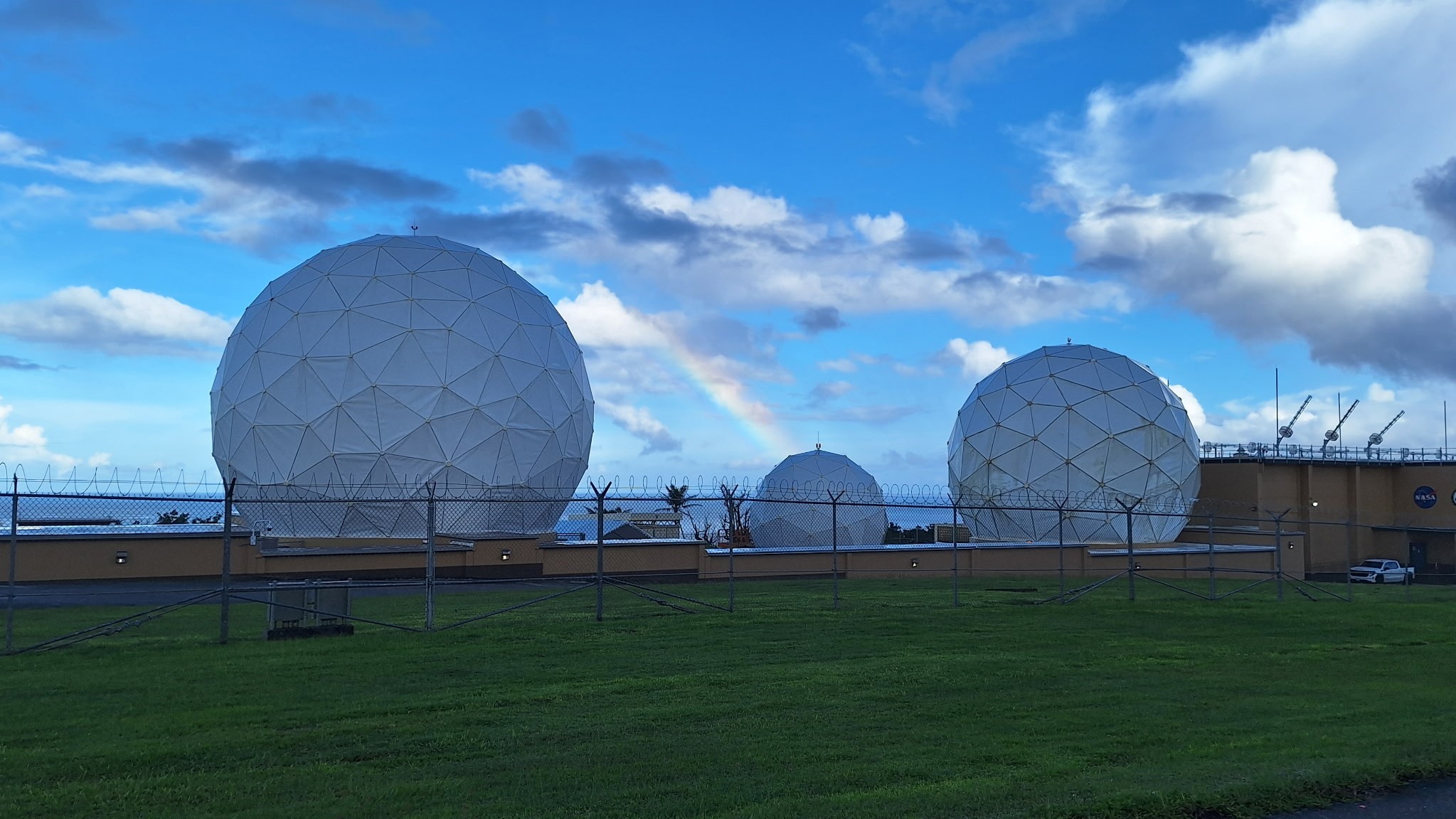

NASA celebrated the full restoration of its Guam Remote Station with a ribbon-cutting on Sept. 10, closing out more than three years of recovery after Super Typhoon Mawar devastated the site in 2023. Engineers from across the agency completed the final and most complex step of the rebuild on July 1, when they returned the stationâs central antenna to service.
For nearly three decades, the Guam Remote Station has been one of three ground stations supporting NASAâs Tracking and Data Relay Satellites, or TDRS, a critical part of the Near Space Network. From 22,000 miles above Earth, the relays link spacecraft in low Earth orbit with the ground, allowing flight controllers to communicate with astronauts, command spacecraft, and receive mission data. The Guam station alone closes the âZone of Exclusion,â a stretch of orbit beyond the relaysâ line of sight. Without it, the International Space Station can lose contact with Earth for up to 20 minutes of every 90-minute orbit, an unacceptable risk for crewed missions.
On May 24, 2023, the Category 4 super typhoon struck Guam with 185 mph winds and more than 28 inches of rain, destroying two 16.5-meter antennas and damaging an 11-meter north antenna and the Inter Facility Link building at NASAâs station. The Zone of Exclusion reopened for the first time since 1998, cutting TDRS coverage to about 85% of a spacecraftâs orbit.
NASA made emergency repairs to the least-damaged antenna and borrowed two mobile terminals from the U.S. Army to expand coverage. The patchwork restored partial service within months, in time for a November 2023 spacewalk.
In early 2025, Congress dedicated disaster-relief funding to rebuild the ground station and harden the network against future storms. Construction began that summer and finished in summer 2026, when the rebuilt central antenna rejoined TDRS operations and the Zone of Exclusion closed once more. The same appropriation funded critical upgrades at three additional Near Space Network ground stations.
The return to service of the Guam Remote Stationâs central antenna represents far more than the restoration of a critical piece of infrastructure â it is a testament to the dedication, resilience, and ingenuity of the people who made it possible.
Jena Garrahy
SCaN Deputy Program Manager for Network Operations
At the ribbon-cutting, representatives from NASAâs SCaN (Space Communications and Navigation) Division joined the stationâs workforce and local leaders to mark the central antennaâs return to service. The Guam team, which led debris removal, site security, and on-island recovery, was recognized for its  work to keep NASA connected to its missions through the outage and rebuild. A companion ceremony at NASAâs White Sands Complex in Las Cruces, New Mexico, honored the engineers and specialists across SCaN who supported the recovery off island.
âThe return to service of the Guam Remote Stationâs central antenna represents far more than the restoration of a critical piece of infrastructure â it is a testament to the dedication, resilience, and ingenuity of the people who made it possible,â said Jena Garrahy, Deputy Program Manager for Network Operations. âThrough long days, challenging conditions, and unexpected obstacles, this team remained focused on the missions that depend on these critical assets every day.â
The Near Space Network is funded by SCaN, a division of NASAâs Research and Technology Mission Directorate, at the agencyâs Headquarters in Washington. The network is operated out of NASAâs Goddard Space Flight Center in Greenbelt, Maryland. Repairs of the Guam Remote Station were managed out of NASAâs Glenn Research Center in Cleveland.
Source: NASA