
Skip to content
Thirstier News November 5, 2026
Home
Thirstier News
  • ABC Live
  • Al Jazeera
  • CBS Live
  • Contact
  • France 24
  • Live News
  • NBC Live
Popular Tags
  • YouTube
  • U.S. News
  • World News
  • MS NOW
  • PBS NewsHour
  • Al Jazeera English
  • DW News
Science & Space — NASA — News, Missions & Technology

NASA-JAXA XRISM Mission Sees Pulsar Gathering Companion’s ‘Wind’

Published September 18, 2026 · 5 min read
· By Thirstier News

Using data from the Japan-led XRISM (X-ray Imaging and Spectroscopy Mission) observatory, astronomers have directly observed a giant star’s outflow, called a stellar wind, being captured by its compact companion and providing the power source for strong X-ray flares. The research is part of NASA’s exploration of the extreme universe to better understand how the cosmos works.
 
“We’ve never before seen clear indications of wind plasma falling onto a compact object,” said Roi Rahin, a researcher at UMBC (University of Maryland, Baltimore County) and NASA’s Goddard Space Flight Center in Greenbelt, Maryland. “We can now test our understanding of these processes in much greater detail.”
 
A paper describing the findings published Friday in the journal Science Advances.
 
The target system is BP Crucis, a high-mass X-ray binary located about 13,000 light-years away in the southern constellation Crux. The primary star, known as Wray 977, is a blue hypergiant about 40 times the Sun’s mass and 60 times its size. It’s so big, hot, and luminous that ionized gas constantly streams away from it, a phenomenon astronomers call a stellar wind.

This artist’s concept of the BP Crucis system follows the pulsar on a passage through the dense stream of plasma flowing from its companion, a blue hypergiant 40 times the Sun’s mass. During each four-day passage, the pulsar’s X-ray brightness flares as it pulls in some of the gas. At first, the gas forms a messy, turbulent accretion disk around the pulsar, and plasma spirals down to it. But as the pulsar moves deeper into the stream, there’s not enough angular momentum to support the disk, and it breaks up. At this point, plasma falls straight onto the pulsar. Later, as the pulsar near the end of its passage, a messy accretion disk rebuilds, this time spinning in the opposite direction of the earlier disk due to the stream’s flow.
NASA’s Goddard Space Flight Center/Conceptual Image Laboratory

Download high-resolution video and images from NASA’s Scientific Visualization Studio

The supergiant’s companion is a tiny-but-mighty neutron star called GX 301-2. The crushed core of a star that long ago exploded as a supernova, it packs more than the Sun’s mass into a ball roughly 12 miles (20 kilometers) across. Rotating every 11 minutes, it sweeps an X-ray beam toward Earth, which classifies it as a pulsar.   
 
Twice during the pulsar’s 41.5-day orbit, near its closest and farthest points from the primary star, strong X-ray flares occur for several days. Astronomers think the pulsar’s gravitational influence on the star creates an especially dense stream of plasma. Flares occur when the pulsar traverses this stream and captures some of its matter. The strongest eruptions happen closer to the star, where the stream is denser. 
 
The researchers targeted the system with XRISM on Feb. 1, 2025, observing it for about 16 hours near the end of one of these stronger flares. The observatory’s Resolve instrument, jointly developed by NASA and JAXA (Japan Aerospace Exploration Agency), captured highly detailed X-ray spectra, revealing rapidly changing emission and absorption lines. In particular, absorption lines from highly ionized iron revealed the speed and direction of plasma relatively close to the pulsar. 

Watch to learn about spectroscopy, the dance between matter and light, and how NASA missions using it help scientists answer big questions about our universe. 
NASA’s Goddard Space Flight Center

Download high-resolution video from NASA’s Scientific Visualization Studio

When Rahin first saw these spectra, he realized he hadn’t seen anything like them before. He scoured the scientific literature for similar observations and came up empty-handed.

“It was clear that these observations were groundbreaking, but at the same time this meant the analysis had to be especially detailed,” said Nazma Islam, a co-author formerly at UMBC and NASA Goddard and now an assistant professor at Manipal Centre for Natural Sciences, India. “We could see how the dense stream of plasma acts very close to the neutron star.”

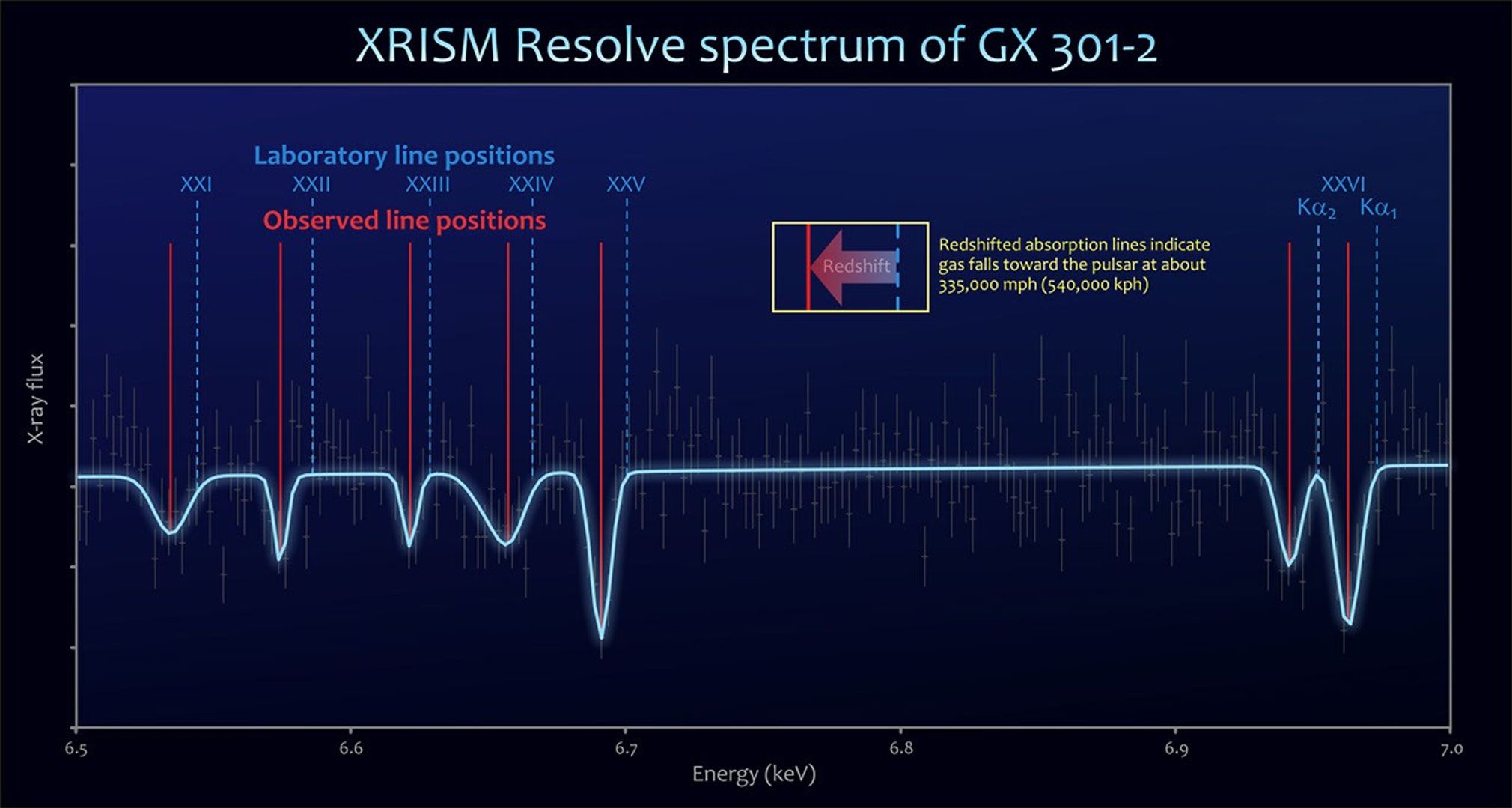
The Resolve instrument aboard the NASA-JAXA XRISM observatory captured this high-resolution X-ray spectrum of BP Crucis. Prominent iron absorption lines (dashed) have shifted to lower energies (red lines), which indicates both the direction and velocity of the gas. The observations indicate the gas is moving toward the pulsar at about 335,000 mph (540,000 kph). Data and error bars are shown in gray, with a model spectrum in light blue. Roman numerals indicate the ionization state of iron atoms (the number of electrons they’ve lost to produce each spectral line).
NASA’s Goddard Space Flight Center, JAXA/NASA, Rahin et al. 2026

Rahin and his team show that the iron absorption lines they observed are displaced to lower energies than they would be if measured in a laboratory. This displacement, called a redshift, indicates motion away from the observer, which means the gas is flowing toward the pulsar. The extent of the redshift indicates the plasma’s velocity. The team’s analysis indicates gas is racing toward the pulsar at speeds of around 335,000 mph (540,000 kph).
 
Here’s what the researchers think is going on: As the pulsar enters the stream, it sweeps up gas into a thick, messy, turbulent disk. This gas spirals down to the pulsar, heats up, and emits X-rays to power the flares.
 
As the pulsar pushes farther into the stream, the turbulent disk breaks down. Astronomers suspect that as the pulsar moves more directly into the flow, the stream no longer has the angular momentum required to maintain the disk. Once the disk dissipates, plasma flows directly onto the neutron star. Observations with XRISM occurred near the end of this phase.

Then, as the pulsar nears the end of the stream, a messy disk briefly returns, this time spinning in the opposite direction. And then it, too, disappears as the pulsar exits. In all, the pulsar takes about four days to transit the stream.

“The BP Crucis system is an ideal laboratory for studying wind-fed pulsar accretion, and XRISM’s sensitive, high-resolution Resolve spectrometer is an ideal instrument for advancing our understanding of the processes involved,” said Brian Williams, the mission’s project scientist at NASA Goddard.  

To learn more about the XRISM mission, visit:

https://nasa.gov/xrism

@NASAUniverse

@NASAUniverse

@NASAUniverse


Source: NASA

Filed under: Science & Space — NASA — News, Missions & Technology

Post navigation

Previous: Trump administration faces second lawsuit to block ICE agents at polls
Next: UNGA 81 Statistics, SDG Moment & other topics – Daily Press Briefing (18 Sept 2026) | United Nations

More from Science & Space — NASA — News, Missions & Technology

Science & Space — NASA — News, Missions & Technology

3D 67P

Published October 17, 2026 · 2 min read
Science & Space — NASA — News, Missions & Technology

NASA Names Stephen Cash Marshall Space Flight Center Director

Published October 16, 2026 · 4 min read
Science & Space — NASA — News, Missions & Technology

I Am Artemis: Allison Mjoen

Published October 16, 2026 · 3 min read
Science & Space — NASA — News, Missions & Technology

Chasing the International Space Station

Published October 16, 2026 · 2 min read
Science & Space — NASA — News, Missions & Technology

Isaias Dims the Gulf Coast

Published October 16, 2026 · 5 min read
Science & Space — NASA — News, Missions & Technology

NASA to Help Unlock Mysteries of Mars’ Moons in Upcoming Mission

Published October 15, 2026 · 4 min read
Science & Space — NASA — News, Missions & Technology

NASA Satellites Observe Historic 2026 El Niño

Published October 15, 2026 · 6 min read
Science & Space — NASA — News, Missions & Technology

Power Up: Roll Out Solar Arrays Boost Space Station Power Supply

Published October 15, 2026 · 2 min read
Science & Space — NASA — News, Missions & Technology

NASA Welcomes All Ages, Experience Levels for Space Apps Challenge

Published October 15, 2026 · 4 min read
Science & Space — NASA — News, Missions & Technology

The Milky Way over Manhattan

Published October 15, 2026 · 2 min read
Science & Space — NASA — News, Missions & Technology

NASA to Host News Conference Previewing US Spacewalks 100, 101

Published October 14, 2026 · 2 min read
Science & Space — NASA — News, Missions & Technology

NASA Astronauts to Answer Questions from Florida Students

Published October 14, 2026 · 2 min read
Science & Space — NASA — News, Missions & Technology

NASA’s Chandra Breaks Down ‘Treble Clef’s’ Galaxy Cluster Collision

Published October 14, 2026 · 5 min read
Science & Space — NASA — News, Missions & Technology

Mars and the Beehive Under an Aurora

Published October 14, 2026 · 2 min read
Science & Space — NASA — News, Missions & Technology

NASA Names Astronaut Christina Koch Acting Deputy Chief Engineer

Published October 13, 2026 · 4 min read
Science & Space — NASA — News, Missions & Technology

TB 26-08 Complex Modes in Lightly Damped Structural Systems: A Two-Mode Interaction Perspective

Published October 13, 2026 · 2 min read
Science & Space — NASA — News, Missions & Technology

NASA JPL Testing Readies Voyager Technologies Lander for Moon Mission

Published October 13, 2026 · 5 min read
Science & Space — NASA — News, Missions & Technology

NASA Science, Cargo Launch on 35th SpaceX Resupply Mission to Station

Published October 13, 2026 · 3 min read
Science & Space — NASA — News, Missions & Technology

Desert Stairway to Heaven

Published October 13, 2026 · 2 min read
Science & Space — NASA — News, Missions & Technology

An Impact Structure With Legs

Published October 13, 2026 · 2 min read
Science & Space — NASA — News, Missions & Technology

NASA’s SpaceX CRS-35 Mission to Launch Health Research

Published October 12, 2026 · 3 min read
Science & Space — NASA — News, Missions & Technology

Jupiter and the Moons

Published October 12, 2026 · 2 min read
Science & Space — NASA — News, Missions & Technology

Antarctic Sea Ice Grows to Its 2026 Maximum

Published October 12, 2026 · 3 min read
Science & Space — NASA — News, Missions & Technology

Ice Fishing for Cosmic Neutrinos

Published October 11, 2026 · 2 min read
Science & Space — NASA — News, Missions & Technology

Lunar Farside

Published October 10, 2026 · 1 min read
Science & Space — NASA — News, Missions & Technology

NASA Seeks US Industry Plans for Commercial Space Stations

Published October 9, 2026 · 2 min read
Science & Space — NASA — News, Missions & Technology

NASA Demonstrates Next-Generation Heat Shield Technologies

Published October 9, 2026 · 4 min read
Science & Space — NASA — News, Missions & Technology

Stickney Crater

Published October 9, 2026 · 2 min read
Science & Space — NASA — News, Missions & Technology

Floodwaters Overwhelm Thailand

Published October 9, 2026 · 3 min read
Science & Space — NASA — News, Missions & Technology

NASA Briefing to Highlight Contributions to Martian Moons Mission

Published October 8, 2026 · 2 min read
Science & Space — NASA — News, Missions & Technology

NASA Announces Bold Science Initiatives for America’s Golden Age Summit

Published October 8, 2026 · 2 min read
Science & Space — NASA — News, Missions & Technology

NASA’s SpaceX Crew‑12 Splashes Down, Sets Briefing to Discuss Mission

Published October 8, 2026 · 4 min read
Science & Space — NASA — News, Missions & Technology

NASA, Energy Department Advance New Era of Nuclear-Powered Exploration

Published October 8, 2026 · 4 min read
Science & Space — NASA — News, Missions & Technology

The Saturn System Smörgåsbord

Published October 8, 2026 · 2 min read
Science & Space — NASA — News, Missions & Technology

Fighting Drought in Texas Cotton Country

Published October 8, 2026 · 7 min read
Science & Space — NASA — News, Missions & Technology

NASA Sets Coverage for SpaceX 35th Station Resupply Launch, Arrival

Published October 7, 2026 · 4 min read
Science & Space — NASA — News, Missions & Technology

NASA’s SpaceX 35th Commercial Resupply Mission Overview

Published October 7, 2026 · 4 min read
Science & Space — NASA — News, Missions & Technology

Supernova Remnant Pa 30

Published October 7, 2026 · 2 min read
Science & Space — NASA — News, Missions & Technology

Arctic Sea Ice Shrinks to Its 2026 Minimum

Published October 7, 2026 · 4 min read
Science & Space — NASA — News, Missions & Technology

NASA to Cover Northrop Grumman CRS-24 Spacecraft Departure

Published October 6, 2026 · 2 min read

Search

Recent Posts
  • Why Trump’s midterm blues mean short-term gain, long-term pain for China
  • Shipping crews caught in the crossfire of the Hormuz conflict | DW News
  • LIVE: French students, workers, pensioners protest in Marseille
  • LIVE: Protests in France as trade unions hold nationwide strikes
  • Joshua Wong’s friend says jailed Hong Kong activist reading books, learning guitar inside prison
  • Blue wave sets up possible IMPEACHMENT of Trump’s attorney general, Todd Blanche
  • Over 300,000 tarantulas seized in Peru | DW News
  • The Last Word with Lawrence O’Donnell – Nov. 4 | Audio Only
  • Vance blames Iran war for GOP midterms loss, Trump brags about WH ballroom | MS NOW Highlights
  • Hope and faith in the American dream behind blue surge in Latino vote in Texas
Categories
  • Florida (110)
    • Jacksonville (20)
    • Miami (62)
    • Orlando (17)
    • Tampa (11)
  • Health (1)
  • New York (69)
    • New York City (69)
  • Science (85)
    • Health & Medical Research (10)
    • U.S. Geological Survey (18)
    • U.S. National Science Foundation (57)
  • Science & Space (364)
    • NASA — Centers & Facilities (82)
    • NASA — JPL & Near-Earth Objects (4)
    • NASA — News, Missions & Technology (242)
    • NASA — Photos & Visual Records (36)
  • Trump (1146)
  • U.S. Civil Service (245)
    • Cabinet — Department of Agriculture (8)
    • Independent Agencies — Commodity Futures Trading Commission (19)
    • Independent Agencies — Consumer Financial Protection Bureau (12)
    • Independent Agencies — Consumer Product Safety Commission (32)
    • Independent Agencies — Equal Employment Opportunity Commission (64)
    • Independent Agencies — Federal Reserve Board (1)
    • Independent Agencies — Federal Trade Commission (46)
    • Independent Agencies — National Labor Relations Board (22)
    • Independent Agencies — Securities and Exchange Commission (41)
  • U.S. Government (11)
    • DOJ — National (8)
    • DOJ — U.S. Attorneys (10)
    • GAO — News & Analysis (43)
    • GAO — Reports & Decisions (158)
    • Department of Justice (10)
    • Government Accountability Office (1)
  • U.S. News (2483)
  • U.S. Veterans (255)
    • Benefits (25)
    • Disabled Veterans (10)
    • Employment (10)
    • Health & Care (64)
    • News (146)
  • Washington (233)
    • Washington (87)
      • Seattle (57)
      • Spokane (30)
  • World News (1942)

Recent Comments

No recent comments.

Archives
  • November 2026 (218)
  • October 2026 (1794)
  • September 2026 (2072)
  • August 2026 (1879)
  • July 2026 (17)
  • June 2026 (8)
  • May 2026 (1)
  • April 2026 (6)
  • March 2026 (1)
  • January 2026 (3)
  • December 2025 (1)
  • November 2025 (1)

Thirstier News is a service of Thirstier, a DBA of Immix Tachyon Synergy Network LLC.

© 2026 Thirstier. Thirstier Theme is an original theme from Thirstier.