Skip to content
Thirstier News November 5, 2026
Home
Thirstier News
  • ABC Live
  • Al Jazeera
  • CBS Live
  • Contact
  • France 24
  • Live News
  • NBC Live
Popular Tags
  • YouTube
  • U.S. News
  • World News
  • MS NOW
  • PBS NewsHour
  • Al Jazeera English
  • DW News
Science & Space — NASA — News, Missions & Technology

NASA Shares Views of August Solar Eclipse from Ground, Air, Space

Published August 21, 2026 · 7 min read
· By Thirstier News
3 Min Read

NASA Shares Views of August Solar Eclipse from Ground, Air, Space

This composite image shows the progression of a total solar eclipse as the Sun sets over San Millán de los Caballeros, Spain, on Wednesday, Aug. 12, 2026.

Credits:
NASA/Bill Ingalls

Vanessa Thomas

Aug 21, 2026
Article

On Aug. 12, a total solar eclipse darkened skies over Greenland, Iceland, and Spain. As the Moon covered the Sun, it briefly revealed the Sun’s wispy outer atmosphere — the corona — to those in the path of totality who were lucky enough to have clear skies. NASA researchers and photographers were along the eclipse path to study the corona, capture the phenomenon, and observe how the eclipse affected our planet.

One NASA photographer in Spain captured the total solar eclipse as well as the partial phases before and after, until the Sun set below the horizon.

This composite image shows the progression of a total solar eclipse over a field of sunflowers in San Millán de los Caballeros, Spain, on Aug. 12, 2026. Credit: NASA/Bill Ingalls

The solar corona appears in this photograph of a total solar eclipse captured from San Millán de los Caballeros, Spain, on Aug. 12, 2026. Credit: NASA/Bill Ingalls

A solar prominence, a plume of electrically charged gas suspended above the Sun by strong magnetic forces, appears as a pink feature along the left edge of the eclipsed Sun in this photograph taken from San Millán de los Caballeros, Spain, on Aug. 12, 2026. Credit: NASA/Bill Ingalls

This composite image shows the progression of a total solar eclipse as the Sun sets in San Millán de los Caballeros, Spain, on Aug. 12, 2026. Credit: NASA/Bill Ingalls

In northern Maine, where only a partial eclipse was visible, another NASA photographer captured the International Space Station, with its crew of seven aboard, speeding past the partially eclipsed Sun.

In this image of a partial solar eclipse, which is veiled by clouds, the International Space Station, with a crew of seven aboard, appears in silhouette as it transits at roughly five miles per second on Aug. 12, 2026, as seen near Hodgdon, Maine. Aboard the station as part of Expedition 75 are NASA astronauts Jessica Meir, Anil Menon, and Jack Hathaway; ESA (European Space Agency) astronaut Sophie Adenot; and Roscosmos cosmonauts Pyotr Dubrov, Andrey Fedyaev, and Anna Kikina. Credit: NASA/Joel Kowsky

Twelve frames assembled in sequence show the International Space Station, with a crew of seven aboard, in silhouette as it transits the Sun at roughly five miles per second during a partial solar eclipse on Aug. 12, 2026, as seen near Hodgdon, Maine. Clouds partially obscure the view of the Sun. Aboard the station as part of Expedition 75 are NASA astronauts Jessica Meir, Anil Menon, and Jack Hathaway; ESA (European Space Agency) astronaut Sophie Adenot; and Roscosmos cosmonauts Pyotr Dubrov, Andrey Fedyaev, and Anna Kikina. Credit: NASA/Joel Kowsky

Meanwhile, from about 250 miles above the ground, a NASA astronaut aboard the International Space Station snapped a few photos of the partial eclipse from their perspective as well.

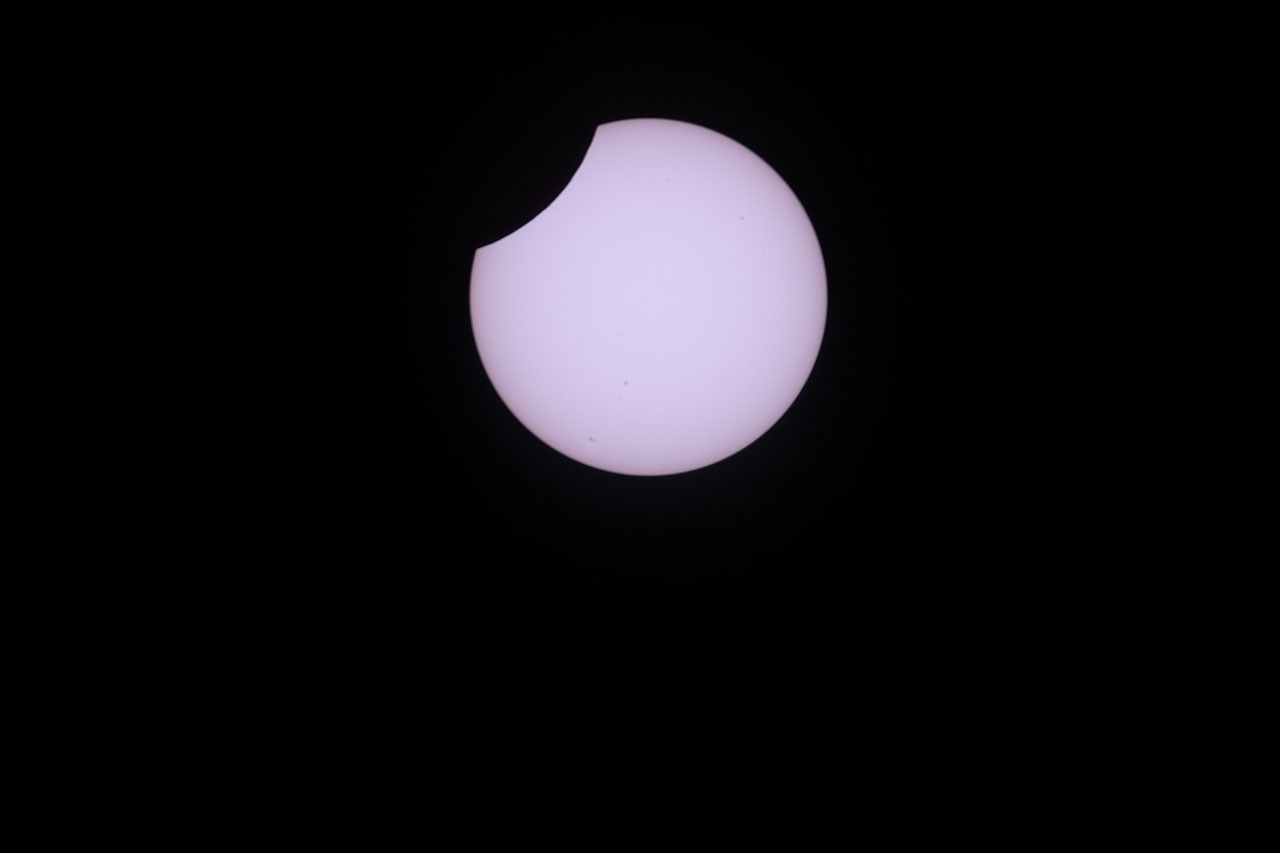
NASA astronaut Jessica Meir captured this photo of the partial solar eclipse from the International Space Station on Aug. 12, 2026, as the orbital outpost soared 262 miles above southern Quebec, Canada. From the station, the Moon covered about 18% of the Sun at the peak of the eclipse. Credit: NASA/Jessica Meir

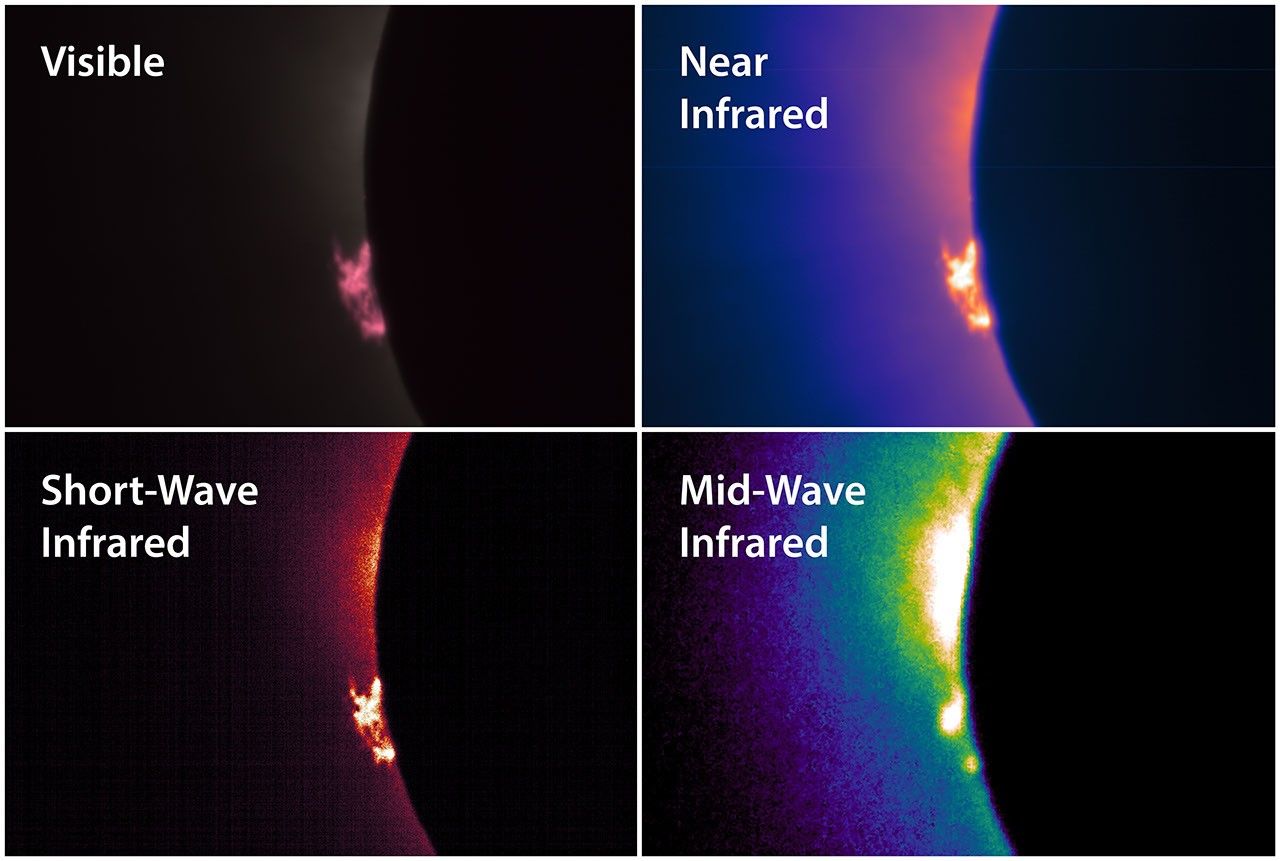
Between the ground and the space station, NASA pilots flew NASA’s WB-57F research jet at an altitude of 50,000 feet, passing through the eclipse’s shadow to lengthen their time in the eclipse. The jet carried a suite of cameras that captured high-resolution images of the corona and prominences, plumes of electrically charged gas rising off the Sun, in several different wavelengths of light.

To view this video please enable JavaScript, and consider upgrading to a web browser that
supports HTML5 video

The total solar eclipse on Aug. 12, 2026, was captured by a camera mounted inside the cockpit window of NASA’s WB-57F aircraft as it flew around 50,000 feet altitude off the coast of Iceland.
NASA
A suite of cameras installed on NASA’s WB-57F aircraft captured images of the solar corona and prominences in different wavelengths of visible and infrared light during the total solar eclipse on Aug. 12, 2026. A science team led by the Southwest Research Institute in Boulder, Colorado, will analyze the images to learn more about complex and dynamic features in the Sun’s outer atmosphere. Credit: NASA/SwRI/Will Ashfield

In both Iceland and Spain, teams of students participating in the NASA-funded Nationwide Eclipse Ballooning Project launched scientific balloons that carried instruments to capture images of the eclipse’s shadow and study the eclipse’s effects on our atmosphere. Even though clouds obscured the view of the eclipse from the ground in Iceland, the weather did not interfere with the balloon-borne instruments’ ability to gather information about how the brief loss of light and heat affected the lower atmosphere.

Students participating in the NASA-funded Nationwide Eclipse Ballooning Project prepare to launch a scientific balloon in Mosfellsbær, Iceland, during the total solar eclipse on Aug. 12, 2026. Credit: NASA/Abbey Interrante

To view this video please enable JavaScript, and consider upgrading to a web browser that
supports HTML5 video

The Moon’s shadow passes over the atmosphere during the total solar eclipse on Aug. 12, 2026. The video was taken by a camera carried by a scientific balloon launched from Spain by a student team from Montana State University participating in the NASA-funded Nationwide Eclipse Ballooning Project. The video captures about six minutes of time but is sped up to play at four times real speed. Passing through the foreground are some other science instruments carried by the same balloon.
Nationwide Eclipse Ballooning Project/Montana State University

Before the eclipse, scientists at Predictive Science Inc., with support from NASA grants and supercomputers, used observations of the Sun from NASA spacecraft and ground-based telescopes to predict what the corona would look like during the eclipse. Below, their corona prediction is compared to a composite image of the corona, which combines multiple images captured by the NASA-supported DEB Initiative project during the total eclipse near León, Spain.

prediction
image

This image shows a prediction from the morning of Aug. 12, 2026, of what the solar corona would look like to the human eye during the total solar eclipse that day.
Predictive Science Inc.

This processed, composite image of the corona combines multiple images captured near León, Spain, during the total solar eclipse on Aug. 12, 2026.
DEB Initiative Team/Zack Stockbridge


prediction

image

The left image shows a prediction from the morning of Aug. 12, 2026, of what the solar corona would look like to the human eye during the total solar eclipse that day. The right image is processed, composite image of the corona that combines multiple images captured near León, Spain, during the total solar eclipse on Aug. 12, 2026. Left image credit: Predictive Science Inc.; right image credit: DEB Initiative Team/Zack Stockbridge

Over the coming months, scientists will analyze the observations and images captured during the solar eclipse on Aug. 12 and present what they have learned about the Sun and its effects on our home planet. These observations will also help prepare science teams to investigate future solar eclipses, such as a much longer total solar eclipse that will be visible from southern Spain and northern Africa on Aug. 2, 2027.

Read more about NASA’s research during the eclipse and rewatch NASA’s eclipse broadcast to hear from some of the scientists and students who conducted the experiments.

About the Author

Vanessa Thomas

Vanessa Thomas is a science writer with the heliophysics communications team at NASA’s Goddard Space Flight Center in Greenbelt, Maryland.

Share

Details

Last Updated

Aug 21, 2026

Related Terms

  • Heliophysics
  • Eclipses
  • Solar Eclipses
  • The Sun
  • The Sun & Solar Physics

Explore More

5 min read

NASA’s COFFIES Uses AI to Predict Storm-Causing Active Regions on Sun 

Article


1 week ago

4 min read

NASA’s PUNCH Sharpens Solar Storm Forecasting in First Test

Article


2 weeks ago

4 min read

What’s Up: August 2026 Skywatching Tips from NASA

Article


3 weeks ago

Keep Exploring

Discover More Topics From NASA

Missions


Humans in Space


Climate Change


Solar System


Source: NASA

Source: NASA. Review credited third-party material before publication.

Filed under: Science & Space — NASA — News, Missions & Technology

Post navigation

Previous: Reservists, Guardsmen, learn about your VA benefits from online course
Next: Enjoy a better future as a VA gastroenterologist

More from Science & Space — NASA — News, Missions & Technology

Science & Space — NASA — News, Missions & Technology

3D 67P

Published October 17, 2026 · 2 min read
Science & Space — NASA — News, Missions & Technology

NASA Names Stephen Cash Marshall Space Flight Center Director

Published October 16, 2026 · 4 min read
Science & Space — NASA — News, Missions & Technology

I Am Artemis: Allison Mjoen

Published October 16, 2026 · 3 min read
Science & Space — NASA — News, Missions & Technology

Chasing the International Space Station

Published October 16, 2026 · 2 min read
Science & Space — NASA — News, Missions & Technology

Isaias Dims the Gulf Coast

Published October 16, 2026 · 5 min read
Science & Space — NASA — News, Missions & Technology

NASA to Help Unlock Mysteries of Mars’ Moons in Upcoming Mission

Published October 15, 2026 · 4 min read
Science & Space — NASA — News, Missions & Technology

NASA Satellites Observe Historic 2026 El Niño

Published October 15, 2026 · 6 min read
Science & Space — NASA — News, Missions & Technology

Power Up: Roll Out Solar Arrays Boost Space Station Power Supply

Published October 15, 2026 · 2 min read
Science & Space — NASA — News, Missions & Technology

NASA Welcomes All Ages, Experience Levels for Space Apps Challenge

Published October 15, 2026 · 4 min read
Science & Space — NASA — News, Missions & Technology

The Milky Way over Manhattan

Published October 15, 2026 · 2 min read
Science & Space — NASA — News, Missions & Technology

NASA to Host News Conference Previewing US Spacewalks 100, 101

Published October 14, 2026 · 2 min read
Science & Space — NASA — News, Missions & Technology

NASA Astronauts to Answer Questions from Florida Students

Published October 14, 2026 · 2 min read
Science & Space — NASA — News, Missions & Technology

NASA’s Chandra Breaks Down ‘Treble Clef’s’ Galaxy Cluster Collision

Published October 14, 2026 · 5 min read
Science & Space — NASA — News, Missions & Technology

Mars and the Beehive Under an Aurora

Published October 14, 2026 · 2 min read
Science & Space — NASA — News, Missions & Technology

NASA Names Astronaut Christina Koch Acting Deputy Chief Engineer

Published October 13, 2026 · 4 min read
Science & Space — NASA — News, Missions & Technology

TB 26-08 Complex Modes in Lightly Damped Structural Systems: A Two-Mode Interaction Perspective

Published October 13, 2026 · 2 min read
Science & Space — NASA — News, Missions & Technology

NASA JPL Testing Readies Voyager Technologies Lander for Moon Mission

Published October 13, 2026 · 5 min read
Science & Space — NASA — News, Missions & Technology

NASA Science, Cargo Launch on 35th SpaceX Resupply Mission to Station

Published October 13, 2026 · 3 min read
Science & Space — NASA — News, Missions & Technology

Desert Stairway to Heaven

Published October 13, 2026 · 2 min read
Science & Space — NASA — News, Missions & Technology

An Impact Structure With Legs

Published October 13, 2026 · 2 min read
Science & Space — NASA — News, Missions & Technology

NASA’s SpaceX CRS-35 Mission to Launch Health Research

Published October 12, 2026 · 3 min read
Science & Space — NASA — News, Missions & Technology

Jupiter and the Moons

Published October 12, 2026 · 2 min read
Science & Space — NASA — News, Missions & Technology

Antarctic Sea Ice Grows to Its 2026 Maximum

Published October 12, 2026 · 3 min read
Science & Space — NASA — News, Missions & Technology

Ice Fishing for Cosmic Neutrinos

Published October 11, 2026 · 2 min read
Science & Space — NASA — News, Missions & Technology

Lunar Farside

Published October 10, 2026 · 1 min read
Science & Space — NASA — News, Missions & Technology

NASA Seeks US Industry Plans for Commercial Space Stations

Published October 9, 2026 · 2 min read
Science & Space — NASA — News, Missions & Technology

NASA Demonstrates Next-Generation Heat Shield Technologies

Published October 9, 2026 · 4 min read
Science & Space — NASA — News, Missions & Technology

Stickney Crater

Published October 9, 2026 · 2 min read
Science & Space — NASA — News, Missions & Technology

Floodwaters Overwhelm Thailand

Published October 9, 2026 · 3 min read
Science & Space — NASA — News, Missions & Technology

NASA Briefing to Highlight Contributions to Martian Moons Mission

Published October 8, 2026 · 2 min read
Science & Space — NASA — News, Missions & Technology

NASA Announces Bold Science Initiatives for America’s Golden Age Summit

Published October 8, 2026 · 2 min read
Science & Space — NASA — News, Missions & Technology

NASA’s SpaceX Crew‑12 Splashes Down, Sets Briefing to Discuss Mission

Published October 8, 2026 · 4 min read
Science & Space — NASA — News, Missions & Technology

NASA, Energy Department Advance New Era of Nuclear-Powered Exploration

Published October 8, 2026 · 4 min read
Science & Space — NASA — News, Missions & Technology

The Saturn System Smörgåsbord

Published October 8, 2026 · 2 min read
Science & Space — NASA — News, Missions & Technology

Fighting Drought in Texas Cotton Country

Published October 8, 2026 · 7 min read
Science & Space — NASA — News, Missions & Technology

NASA Sets Coverage for SpaceX 35th Station Resupply Launch, Arrival

Published October 7, 2026 · 4 min read
Science & Space — NASA — News, Missions & Technology

NASA’s SpaceX 35th Commercial Resupply Mission Overview

Published October 7, 2026 · 4 min read
Science & Space — NASA — News, Missions & Technology

Supernova Remnant Pa 30

Published October 7, 2026 · 2 min read
Science & Space — NASA — News, Missions & Technology

Arctic Sea Ice Shrinks to Its 2026 Minimum

Published October 7, 2026 · 4 min read
Science & Space — NASA — News, Missions & Technology

NASA to Cover Northrop Grumman CRS-24 Spacecraft Departure

Published October 6, 2026 · 2 min read

Search

Recent Posts
  • Why Trump’s midterm blues mean short-term gain, long-term pain for China
  • Shipping crews caught in the crossfire of the Hormuz conflict | DW News
  • LIVE: French students, workers, pensioners protest in Marseille
  • LIVE: Protests in France as trade unions hold nationwide strikes
  • Joshua Wong’s friend says jailed Hong Kong activist reading books, learning guitar inside prison
  • Blue wave sets up possible IMPEACHMENT of Trump’s attorney general, Todd Blanche
  • Over 300,000 tarantulas seized in Peru | DW News
  • The Last Word with Lawrence O’Donnell – Nov. 4 | Audio Only
  • Vance blames Iran war for GOP midterms loss, Trump brags about WH ballroom | MS NOW Highlights
  • Hope and faith in the American dream behind blue surge in Latino vote in Texas
Categories
  • Florida (110)
    • Jacksonville (20)
    • Miami (62)
    • Orlando (17)
    • Tampa (11)
  • Health (1)
  • New York (69)
    • New York City (69)
  • Science (85)
    • Health & Medical Research (10)
    • U.S. Geological Survey (18)
    • U.S. National Science Foundation (57)
  • Science & Space (364)
    • NASA — Centers & Facilities (82)
    • NASA — JPL & Near-Earth Objects (4)
    • NASA — News, Missions & Technology (242)
    • NASA — Photos & Visual Records (36)
  • Trump (1146)
  • U.S. Civil Service (245)
    • Cabinet — Department of Agriculture (8)
    • Independent Agencies — Commodity Futures Trading Commission (19)
    • Independent Agencies — Consumer Financial Protection Bureau (12)
    • Independent Agencies — Consumer Product Safety Commission (32)
    • Independent Agencies — Equal Employment Opportunity Commission (64)
    • Independent Agencies — Federal Reserve Board (1)
    • Independent Agencies — Federal Trade Commission (46)
    • Independent Agencies — National Labor Relations Board (22)
    • Independent Agencies — Securities and Exchange Commission (41)
  • U.S. Government (11)
    • DOJ — National (8)
    • DOJ — U.S. Attorneys (10)
    • GAO — News & Analysis (43)
    • GAO — Reports & Decisions (158)
    • Department of Justice (10)
    • Government Accountability Office (1)
  • U.S. News (2483)
  • U.S. Veterans (255)
    • Benefits (25)
    • Disabled Veterans (10)
    • Employment (10)
    • Health & Care (64)
    • News (146)
  • Washington (233)
    • Washington (87)
      • Seattle (57)
      • Spokane (30)
  • World News (1942)

Recent Comments

No recent comments.

Archives
  • November 2026 (218)
  • October 2026 (1794)
  • September 2026 (2072)
  • August 2026 (1879)
  • July 2026 (17)
  • June 2026 (8)
  • May 2026 (1)
  • April 2026 (6)
  • March 2026 (1)
  • January 2026 (3)
  • December 2025 (1)
  • November 2025 (1)

Thirstier News is a service of Thirstier, a DBA of Immix Tachyon Synergy Network LLC.

© 2026 Thirstier. Thirstier Theme is an original theme from Thirstier.