
Skip to content
Thirstier News September 25, 2026
Home
Thirstier News
  • ABC Live
  • Al Jazeera
  • CBS Live
  • Contact
  • France 24
  • Live News
  • NBC Live
Popular Tags
  • YouTube
  • U.S. News
  • World News
  • MS NOW
  • PBS NewsHour
  • Al Jazeera English
  • DW News
Science — U.S. National Science Foundation

R&D Performance within Department of Defense Facilities Increased 16% while R&D within Civilian Federal Facilities Decreased 14% in FY 2025

Published September 25, 2026 · 15 min read
· By Thirstier News

R&D Performance within Department of Defense Facilities Increased 16% while R&D within Civilian Federal Facilities Decreased 14% in FY 2025

In FY 2025, federal agencies’ expenditures for research and experimental development (R&D) performed within federally owned and federally operated facilities totaled $52.9 billion, an increase of 7% in current dollars from $49.4 billion in FY 2024 (table 1).​All amounts in this report are shown in current dollars. These data include annual expenditures for R&D performed within federal facilities, which includes work performed by federal employees, military personnel, and onsite contractors.​While the Federal Facilities Survey data are collected as outlays, which are defined as the actual disbursement of cash, checks, and electronic transfers to execute previous obligations, the terms outlays and expenditures are used interchangeably in this report. A related measure, federal obligations for federally performed research, is reported in Federal Funds for Research and Development: Fiscal Years 2024–25: table 8. While similar, there are key differences between outlays and obligations. First, the funding obligated to federally performed research in a fiscal year is not necessarily the same as the expenditures in that fiscal year within all agencies. Obligations reflect the amount committed to R&D projects in that year, which could be spent over several subsequent years; outlays reflect only the funds spent on R&D conducted that year. Second, the Survey of Federal Funds for R&D collects obligations by type of recipient (federal, business, nonprofit, higher education, etc.). Any obligations for work under contract at a federal facility would be reported under federal obligations to businesses in the Survey of Federal Funds for R&D, but on the Federal Facilities Survey, they are considered part of the total of the R&D performed at federal facilities. Finally, the federally performed total by agency in the Survey of Federal Funds for R&D includes transfers to other agencies as well as administration costs for external R&D contracts. On the Federal Facilities Survey, transfers would be reported by the receiving agency for the year in which the funds were expended, and only costs related to R&D performance within the federal facility are reported. Note that this survey does not include the 41 designated federally funded research and development centers (FFRDCs), which are surveyed separately.​University-administered FFRDCs were included in the R&D data collection of higher education institutions since FY 1953, and the full population of FFRDCs was added to the standalone FFRDC R&D Survey in FY 2001. FFRDC R&D data can be found at: https://ncses.nsf.gov/surveys/ffrdc-research-development/.

Table ​1. Federal facility expenditures for R&D performed, by department or agency: FY 2024–25

Data

  • Download Excel

  • Download PDF

  • Share on X/Twitter
  • Share on Facebook
  • Share on LinkedIn
  • Send as Email
  • Copy Link
  • Download Excel

  • Download PDF

  • Share on X/Twitter
  • Share on Facebook
  • Share on LinkedIn
  • Send as Email
  • Copy Link

(Millions of dollars)

i = more than 50% of the estimate is imputed.

Note(s):

For a list of all departments, agencies, and underlying facilities included in the survey, see technical table A-1. Detail may not add to total due to rounding.

Source(s):

National Center for Science and Engineering Statistics, Federal Facilities Research and Development Survey.

The year-to-year increase in federal R&D performance is buoyed by a substantial increase in the Department of Defense (DOD) R&D compared to the non-DOD, or civilian, agencies’ R&D. For example, DOD expenditures for R&D performance within its own facilities increased 16%; from $35.0 billion in FY 2024 to $40.6 billion in FY 2025. During the same period, the sum of all civilian agencies’ R&D performance declined 14% from $14.3 billion to $12.3 billion, driven primarily by a $1 billion decline in R&D expenditures at the Department of Health and Human Services (HHS) and a $1.2 billion decline at the National Aeronautics and Space Administration (NASA). This InfoBrief provides additional details and context regarding the federal government’s R&D performance for FY 2025.

Data are from the latest cycle of the Federal Facilities Research and Development Survey (Federal Facilities Survey), sponsored by the National Center for Science and Engineering Statistics (NCSES) within the U.S. National Science Foundation.

Federal Facility Expenditures for R&D Performance

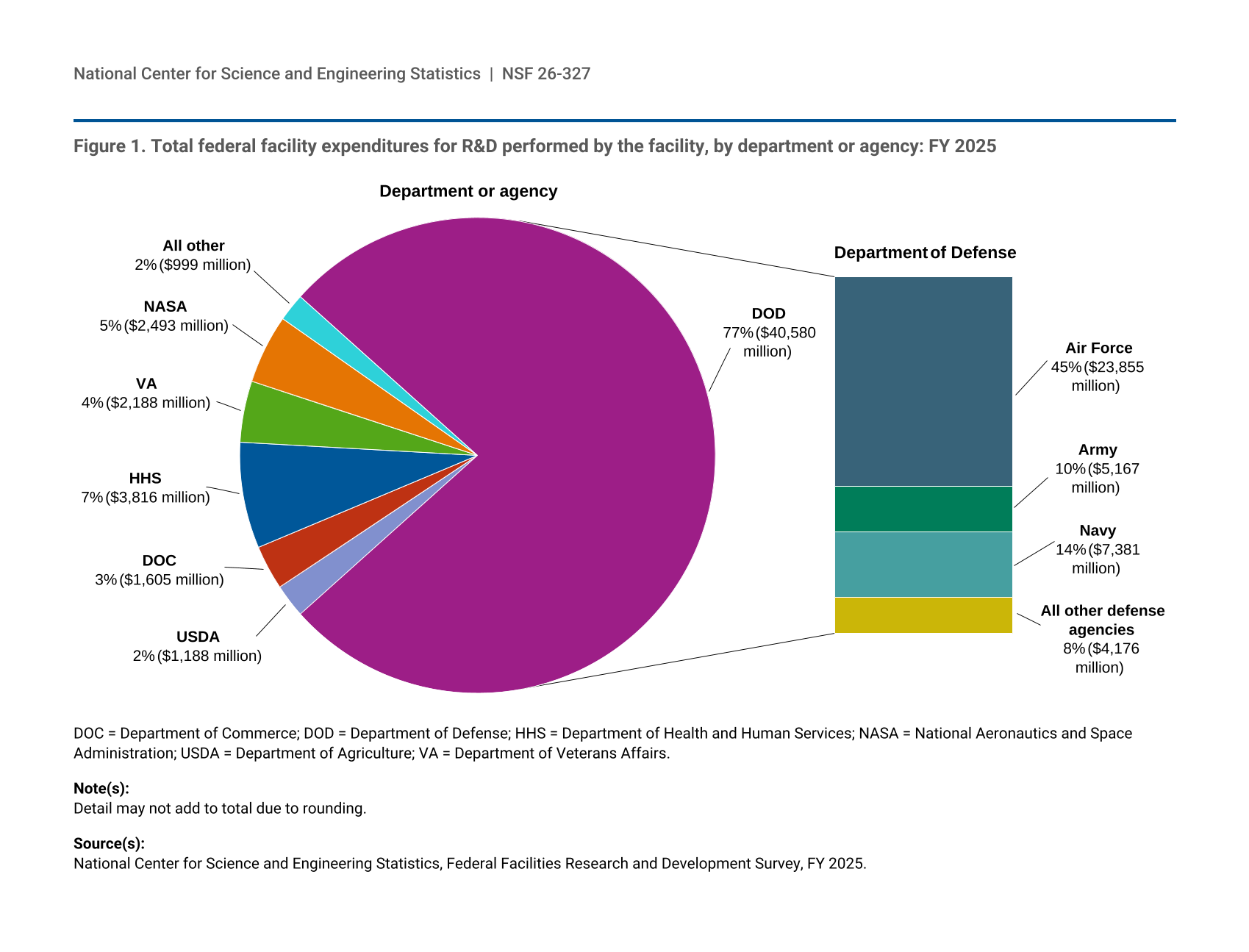
The federal government sector’s performance of R&D is highly concentrated among a handful of departments and agencies. DOD alone accounted for 77% of all federal R&D performance in FY 2025 (figure 1).​Although year-to-year trend data are presented in this report to the tenth place, data presented as a percentage share are rounded to whole-percents. Within DOD, the Air Force accounted for 45% of all federal R&D performance, and Army and Navy contributed 10% and 14%, respectively, all of which are larger shares of federal R&D performance than any single civilian department. HHS and NASA, the leading civilian agencies with federal facility R&D performance, accounted for 7% and 5%, respectively, of the federal total.

Figure ​1. Total federal facility expenditures for R&D performed by the facility, by department or agency: FY 2025

  • Download Excel

  • Download PDF

  • Download PNG

  • Share on X/Twitter
  • Share on Facebook
  • Share on LinkedIn
  • Send as Email
  • Copy Link
  • Download Excel

  • Download PDF

  • Download PNG

  • Share on X/Twitter
  • Share on Facebook
  • Share on LinkedIn
  • Send as Email
  • Copy Link

(Percent and millions of dollars)

DOC = Department of Commerce; DOD = Department of Defense; HHS = Department of Health and Human Services; NASA = National Aeronautics and Space Administration; USDA = Department of Agriculture; VA = Department of Veterans Affairs.

Note(s):

Detail may not add to total due to rounding.

Source(s):

National Center for Science and Engineering Statistics, Federal Facilities Research and Development Survey, FY 2025.

Since DOD expenditures for R&D performance are a substantial component of the federal portfolio, its increase of 16% has a significant effect on total federal R&D expenditures from FY 2024 to FY 2025. DOD’s increase is consistent with changes in DOD’s budget authority for research, development, test, and evaluation (RDT&E) programs from FY 2022 to FY 2023, which can take 1 to 3 years, or more, to make it from appropriation to expenditure.​Budget authority is the primary source of legal authorization to enter into obligations that will result in future outlays. Outlays, also referred to as expenditures, are disbursement of cash, checks, and electronic transfers to execute previous obligations. Although R&D is a subset of DOD’s total RDT&E funding, there are similarities in the trends between the budget authority for RDT&E and expenditures for R&D. For example, DOD’s budget authority for RDT&E funding increased 18% from FY 2022 to FY 2023.​For more data on DOD RDT&E budget authority, see Federal R&D Funding, by Budget Function: Fiscal Years 2022–24: table 6. DOD also had a 17% increase in RDT&E expenditures from $73.4 billion in FY 2024 to $85.9 billion in FY 2025.​For more data on DOD RDT&E expenditures, see the full set of data tables: table 2. The Congressional Budget Office (CBO) has also noted the purposes of the increases in DOD’s RDT&E account are to shift funding toward weapons systems for more conventional warfare.​Congressional Budget Office. 2023. Long-Term Implications of the 2024 Future Years Defense Program, p. 19. Available at https://www.cbo.gov/system/files/2023-10/59511-FYDP.pdf.

Type of R&D

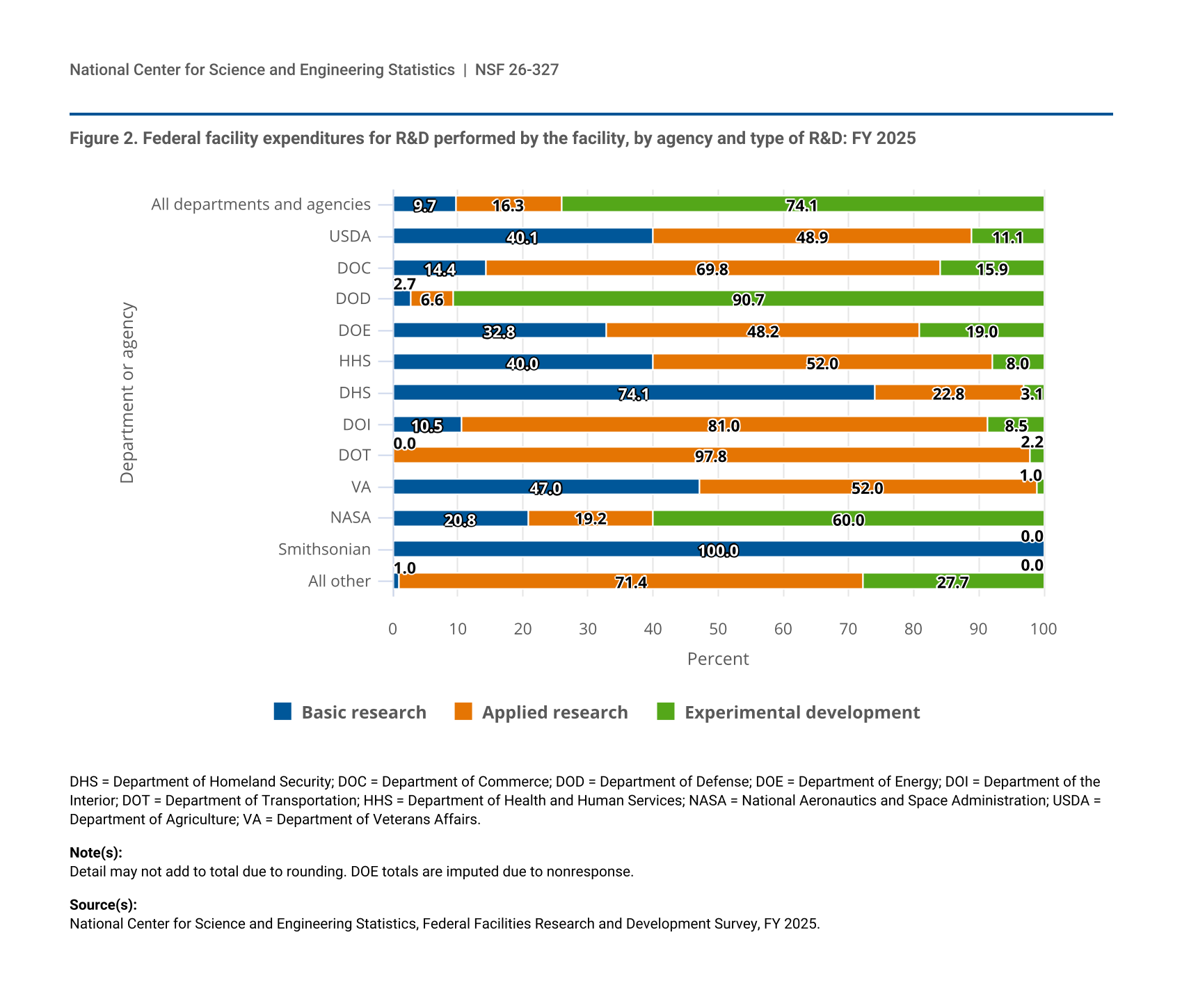
Across all federal facilities, most of the expenditures for R&D performed within the facilities was for experimental development (74%, or $39.2 billion) (figure 2).​See the Technical Notes to the FY 2025 data tables for the definitions of basic research, applied research, and experimental development that were provided to survey respondents.,​For more details on federal R&D performance by type of R&D, see the full set of data tables: table 8. Another 16% ($8.6 billion) was categorized as applied research, and nearly 10% ($5.1 billion) was for basic research.

Figure ​2. Federal facility expenditures for R&D performed by the facility, by agency and type of R&D: FY 2025

  • Download Excel

  • Download PDF

  • Download PNG

  • Share on X/Twitter
  • Share on Facebook
  • Share on LinkedIn
  • Send as Email
  • Copy Link
  • Download Excel

  • Download PDF

  • Download PNG

  • Share on X/Twitter
  • Share on Facebook
  • Share on LinkedIn
  • Send as Email
  • Copy Link

(Percent)

Department or agency Basic research Applied research Experimental development
All departments and agencies 9.7 16.3 74.1
USDA 40.1 48.9 11.1
DOC 14.4 69.8 15.9
DOD 2.7 6.6 90.7
DOE 32.8 48.2 19.0
HHS 40.0 52.0 8.0
DHS 74.1 22.8 3.1
DOI 10.5 81.0 8.5
DOT 0.0 97.8 2.2
VA 47.0 52.0 1.0
NASA 20.8 19.2 60.0
Smithsonian 100.0 0.0 0.0
All other 1.0 71.4 27.7

DHS = Department of Homeland Security; DOC = Department of Commerce; DOD = Department of Defense; DOE = Department of Energy; DOI = Department of the Interior; DOT = Department of Transportation; HHS = Department of Health and Human Services; NASA = National Aeronautics and Space Administration; USDA = Department of Agriculture; VA = Department of Veterans Affairs.

Note(s):

Detail may not add to total due to rounding. DOE totals are imputed due to nonresponse.

Source(s):

National Center for Science and Engineering Statistics, Federal Facilities Research and Development Survey, FY 2025.

This distribution of type of R&D activities varies considerably by agency. Just as DOD accounts for a large portion of the federal total for R&D performance, in FY 2025 DOD accounted for 94% ($36.8 billion of $39.2 billion) of all experimental development.​For more details on federal R&D performance by type of R&D, see the full set of data tables: table 8. The majority of the remaining civilian agencies reported most of their expenditures as applied research. Only two agencies reported basic research as their largest category: the Department of Homeland Security (74%, or $7.6 million of their $10.3 million total) and the Smithsonian with 100% of its $169 million as basic research.

Fields of R&D

The R&D performed within federal facilities spans all of the major fields of R&D. In FY 2025, engineering alone accounted for nearly 52% ($27.3 billion) of all federal R&D performance (table 2).​Engineering encompasses a wide array of work in subfields such as aerospace, biomedical, chemical, civil, environmental, electrical, computer, industrial, systems, mechanical, materials, and geological engineering. Biological, biomedical, and health sciences accounted for 13% ($6.9 billion). Within DOD facilities, most of the R&D was for engineering (63%, or $25.6 billion), and all other fields, meaning not classified in one of the listed fields, accounted for 26%, or $10.7 billion. Within civilian agency facilities, biological, biomedical, and health sciences R&D accounted for the largest share at 49% or $6.0 billion. Engineering was the second largest field of R&D performed by civilian agency facilities, accounting for 14% or $1.7 billion of their total R&D expenditures.

Table ​2. Federal facility expenditures for R&D performed by the facility, by R&D field and type of facility: FY 2025

Data

  • Download Excel

  • Download PDF

  • Share on X/Twitter
  • Share on Facebook
  • Share on LinkedIn
  • Send as Email
  • Copy Link
  • Download Excel

  • Download PDF

  • Share on X/Twitter
  • Share on Facebook
  • Share on LinkedIn
  • Send as Email
  • Copy Link

(Millions of dollars)

i = more than 50% of the estimate is imputed.

DOD = Department of Defense.

Note(s):

Detail may not add to total due to rounding.

Source(s):

National Center for Science and Engineering Statistics, Federal Facilities Research and Development Survey, FY 2025.

FY 2025 R&D Personnel

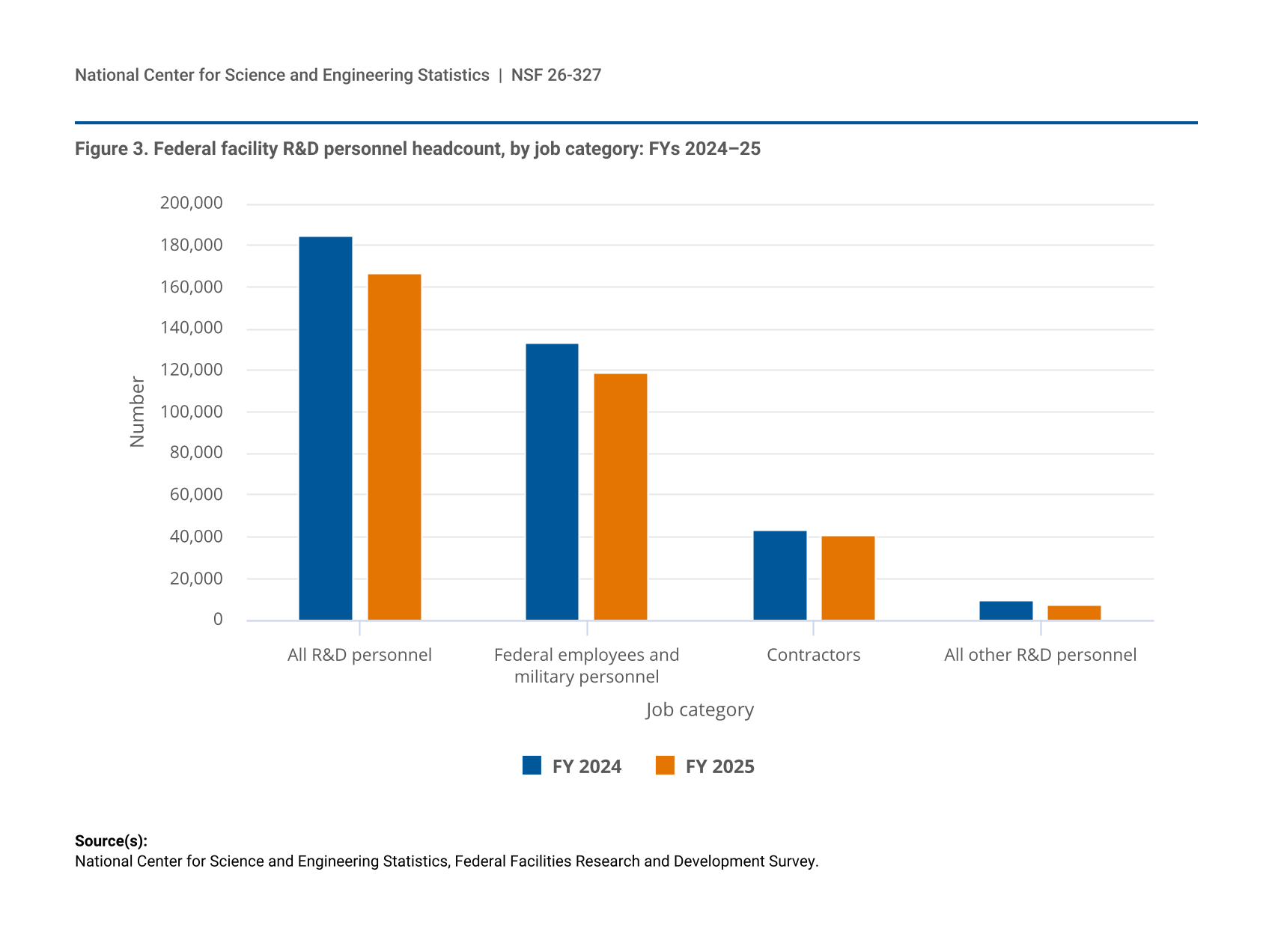
A total of 166,539 personnel were reported or estimated as working on R&D within federal facilities in FY 2025, a decline of 10% from the 184,899 personnel reported or estimated in FY 2024 (figure 3). Of the 166,539 R&D personnel in FY 2025, 71% or 119,034 were federal employees or military personnel.

Figure ​3. Federal facility R&D personnel headcount, by job category: FYs 2024–25

  • Download Excel

  • Download PDF

  • Download PNG

  • Share on X/Twitter
  • Share on Facebook
  • Share on LinkedIn
  • Send as Email
  • Copy Link
  • Download Excel

  • Download PDF

  • Download PNG

  • Share on X/Twitter
  • Share on Facebook
  • Share on LinkedIn
  • Send as Email
  • Copy Link

(Number)

Job category FY 2024 FY 2025
All R&D personnel 184,899 166,539
Federal employees and military personnel 132,804 119,034
Contractors 43,020 40,762
All other R&D personnel 9,075 6,743

Source(s):

National Center for Science and Engineering Statistics, Federal Facilities Research and Development Survey.

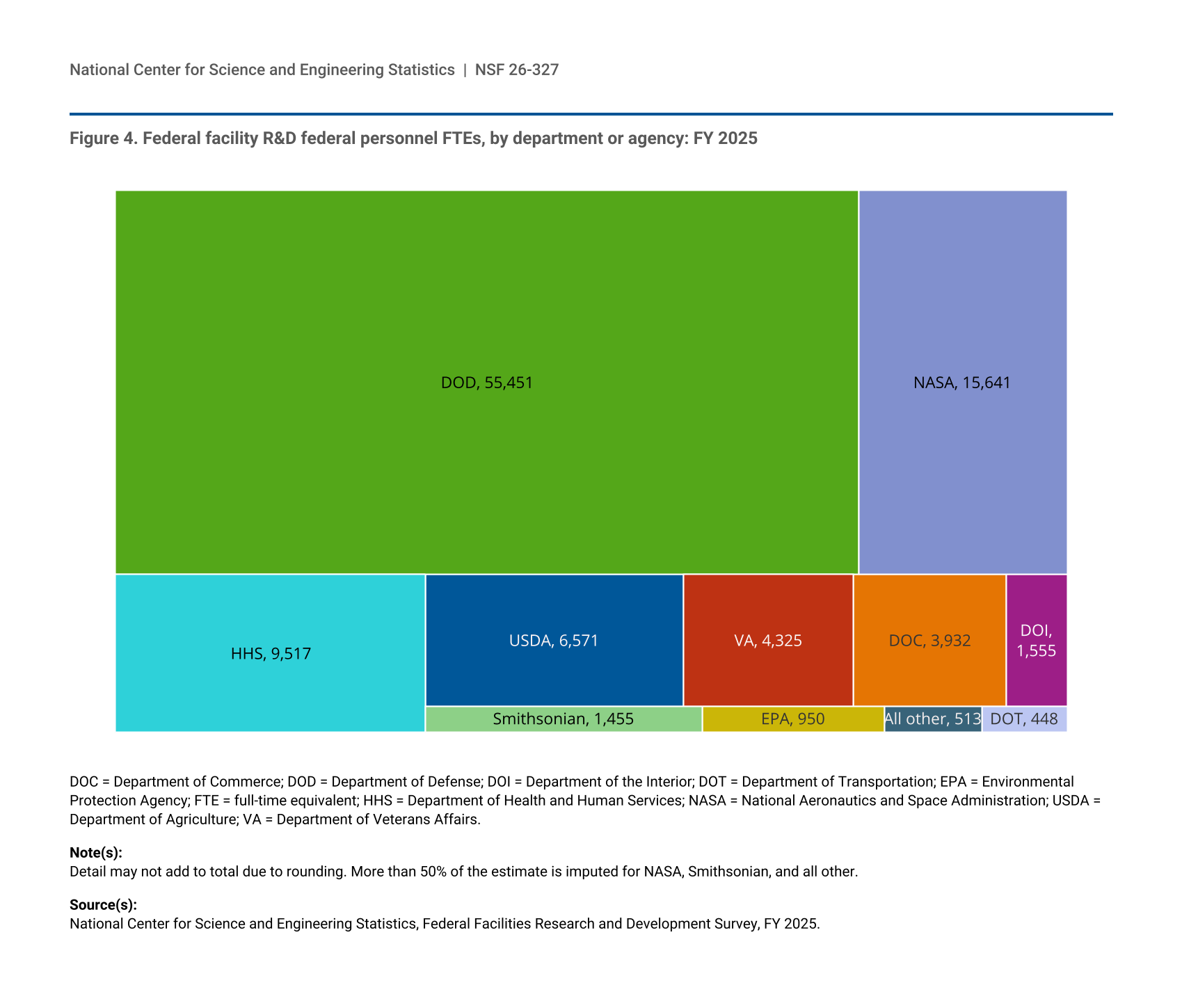
When total R&D personnel headcounts of federal employees are converted to full-time equivalents (FTEs), the total FTE of federal employees and military personnel working on R&D was 100,358 in FY 2025.​For more details on federal R&D personnel by full-time equivalents, see the full set of data tables: table 13 and table 15. DOD still leads all federal R&D facility FTEs, accounting for 55% of the federal FTE total (figure 4). NASA is the second leading agency, accounting for 16%. HHS and the Department of Agriculture accounted for 9% and 7%, respectively, of total R&D facility FTEs in FY 2025.

Figure ​4. Federal facility R&D federal personnel FTEs, by department or agency: FY 2025

  • Download Excel

  • Download PDF

  • Download PNG

  • Share on X/Twitter
  • Share on Facebook
  • Share on LinkedIn
  • Send as Email
  • Copy Link
  • Download Excel

  • Download PDF

  • Download PNG

  • Share on X/Twitter
  • Share on Facebook
  • Share on LinkedIn
  • Send as Email
  • Copy Link

(Number)

Department or agency All R&D FTEs
USDA 6,571
DOC 3,932
DOD 55,451
HHS 9,517
DOI 1,555
DOT 448
VA 4,325
EPA 950
NASA 15,641
Smithsonian 1,455
All other 513

DOC = Department of Commerce; DOD = Department of Defense; DOI = Department of the Interior; DOT = Department of Transportation; EPA = Environmental Protection Agency; FTE = full-time equivalent; HHS = Department of Health and Human Services; NASA = National Aeronautics and Space Administration; USDA = Department of Agriculture; VA = Department of Veterans Affairs.

Note(s):

Detail may not add to total due to rounding. More than 50% of the estimate is imputed for NASA, Smithsonian, and all other.

Source(s):

National Center for Science and Engineering Statistics, Federal Facilities Research and Development Survey, FY 2025.

Data Sources, Limitations, and Availability

Detailed tables showing these data by reporting facility are available at https://ncses.nsf.gov/surveys/federal-facilities-research-development/2025.

The survey was conducted from January 2026 through April 2026 as a census of the population of federally owned and operated facilities in the United States that performed R&D in FY 2025. The overall response rate was 96%. Imputation was performed to account for nonresponding facilities. The survey collected information on R&D expenditures by type of cost, type of R&D, source of funding, and field, as well as information on counts of R&D personnel.

A facility is defined as a unit within the agency that is responsible for performing R&D, generally with its own distinct budget and leadership. Because each agency has a different organizational structure, this unit of measurement may be a division, branch, center, laboratory, or other entity and may span multiple locations. Because of this, the total number of reporting units for the FY 2025 Federal Facilities Survey is 289, which represents the 443 research-performing federal facilities.

The fiscal year referred to throughout this report is the federal fiscal year (1 October 2024 to 30 September 2025). Data tables and detailed technical information are available at the FY 2025 Federal Facilities Survey page. For more information, please contact NCSES.

NCSES has reviewed this product for unauthorized disclosure of confidential information and approved its release (NCSES-DRN26-037).

Notes

1
All amounts in this report are shown in current dollars.

2
While the Federal Facilities Survey data are collected as outlays, which are defined as the actual disbursement of cash, checks, and electronic transfers to execute previous obligations, the terms outlays and expenditures are used interchangeably in this report. A related measure, federal obligations for federally performed research, is reported in Federal Funds for Research and Development: Fiscal Years 2024–25: table 8. While similar, there are key differences between outlays and obligations. First, the funding obligated to federally performed research in a fiscal year is not necessarily the same as the expenditures in that fiscal year within all agencies. Obligations reflect the amount committed to R&D projects in that year, which could be spent over several subsequent years; outlays reflect only the funds spent on R&D conducted that year. Second, the Survey of Federal Funds for R&D collects obligations by type of recipient (federal, business, nonprofit, higher education, etc.). Any obligations for work under contract at a federal facility would be reported under federal obligations to businesses in the Survey of Federal Funds for R&D, but on the Federal Facilities Survey, they are considered part of the total of the R&D performed at federal facilities. Finally, the federally performed total by agency in the Survey of Federal Funds for R&D includes transfers to other agencies as well as administration costs for external R&D contracts. On the Federal Facilities Survey, transfers would be reported by the receiving agency for the year in which the funds were expended, and only costs related to R&D performance within the federal facility are reported.

3
University-administered FFRDCs were included in the R&D data collection of higher education institutions since FY 1953, and the full population of FFRDCs was added to the standalone FFRDC R&D Survey in FY 2001. FFRDC R&D data can be found at: https://ncses.nsf.gov/surveys/ffrdc-research-development/.

4
Although year-to-year trend data are presented in this report to the tenth place, data presented as a percentage share are rounded to whole-percents.

5
Budget authority is the primary source of legal authorization to enter into obligations that will result in future outlays. Outlays, also referred to as expenditures, are disbursement of cash, checks, and electronic transfers to execute previous obligations.

6
For more data on DOD RDT&E budget authority, see Federal R&D Funding, by Budget Function: Fiscal Years 2022–24: table 6.

7
For more data on DOD RDT&E expenditures, see the full set of data tables: table 2.

8
Congressional Budget Office. 2023. Long-Term Implications of the 2024 Future Years Defense Program, p. 19. Available at https://www.cbo.gov/system/files/2023-10/59511-FYDP.pdf.

9
See the Technical Notes to the FY 2025 data tables for the definitions of basic research, applied research, and experimental development that were provided to survey respondents.

10
For more details on federal R&D performance by type of R&D, see the full set of data tables: table 8.

11
For more details on federal R&D performance by type of R&D, see the full set of data tables: table 8.

12
Engineering encompasses a wide array of work in subfields such as aerospace, biomedical, chemical, civil, environmental, electrical, computer, industrial, systems, mechanical, materials, and geological engineering.

13
For more details on federal R&D personnel by full-time equivalents, see the full set of data tables: table 13 and table 15.

Suggested Citation

National Center for Science and Engineering Statistics (NCSES). 2026. R&D Performance within Department of Defense Facilities Increased 16% while R&D within Civilian Federal Facilities Decreased 14% in FY 2025. NSF 26-327. Alexandria, VA: U.S. National Science Foundation. Available at https://ncses.nsf.gov/pubs/nsf26327.

Contact Us

National Center for Science and Engineering Statistics
Directorate for Social, Behavioral and Economic Sciences
U.S. National Science Foundation
Tel: (703) 292-8780
FIRS: (800) 877-8339
TDD: (800) 281-8749
E-mail: ncsesweb@nsf.gov


Source: RSS Feed

Filed under: Science — U.S. National Science Foundation

Post navigation

Previous: Federal Facilities Research and Development (FFRD) Survey2025

More from Science — U.S. National Science Foundation

Science — U.S. National Science Foundation

Federal Facilities Research and Development (FFRD) Survey2025

Published September 25, 2026 · 27 min read
Science — U.S. National Science Foundation

Occupational Health Program Manager, GS-0601-14 MP

Published September 18, 2026 · 4 min read
Science — U.S. National Science Foundation

NSF invests in translating low-dimensional semiconductor technologies to establish U.S. leadership in microelectronics

Published September 17, 2026 · 2 min read
Science — U.S. National Science Foundation

NSF announces 3 additional topics as part of the NSF X-Labs initiative to pursue generational breakthrough science and technology efforts

Published September 16, 2026 · 4 min read
Science — U.S. National Science Foundation

Polar Sciences, Program Director (IPA)

Published September 16, 2026 · 4 min read
Science — U.S. National Science Foundation

Senior IPA Advisor

Published September 15, 2026 · 5 min read
Science — U.S. National Science Foundation

NSF launches $20M pilot to accelerate commercialization of promising deep technologies from small businesses

Published September 14, 2026 · 3 min read
Science — U.S. National Science Foundation

Deputy Directorate Head for Technology, Innovation and Partnerships

Published September 11, 2026 · 3 min read
Science — U.S. National Science Foundation

NSF leadership in a new golden age of science

Published September 10, 2026 · 3 min read
Science — U.S. National Science Foundation

Technical Writer Editor, GS-1083-11/12/13 NF

Published September 9, 2026 · 3 min read
Science — U.S. National Science Foundation

Program Evaluator, GS-0101-14 NF

Published September 1, 2026 · 3 min read
Science — U.S. National Science Foundation

NSF launches three new Science and Technology Centers with $90M investment in transformative research

Published August 26, 2026 · 4 min read
Science — U.S. National Science Foundation

NSF 26-526: NSF Graduate Research Fellowship Program (GRFP)

Published August 25, 2026 · 37 min read
Science — U.S. National Science Foundation

Attorney Advisor (Assistant General Counsel – Procurement Law)

Published August 21, 2026 · 16 min read
Science — U.S. National Science Foundation

R&D Spending at Federally Funded R&D Centers Holds Steady in FY 2025

Published August 21, 2026 · 9 min read
Science — U.S. National Science Foundation

FFRDC Research and Development Survey2025

Published August 21, 2026 · 19 min read
Science — U.S. National Science Foundation

Acting Office Head, OISE

Published August 20, 2026 · 3 min read
Science — U.S. National Science Foundation

Procurement Analyst, GS-1102-14 (Direct Hire)

Published August 19, 2026 · 25 min read
Science — U.S. National Science Foundation

Condensed Matter and Materials Theory (CMMT)

Published August 19, 2026 · 3 min read
Science — U.S. National Science Foundation

NSF BIO Virtual Office Hour Webinar: Updates from the NSF Directorate for Biological Sciences

Published August 18, 2026 · 2 min read
Science — U.S. National Science Foundation

Microbusinesses Performed $5.9 Billion of R&D in the United States in 2023

Published August 17, 2026 · 13 min read
Science — U.S. National Science Foundation

Annual Business Survey (ABS)2024

Published August 17, 2026 · 30 min read
Science — U.S. National Science Foundation

NSF announces $1.5B for foundational research to drive scientific breakthroughs for American technological leadership

Published August 17, 2026 · 4 min read
Science — U.S. National Science Foundation

MPS Chemistry Quarterly Office Hours

Published August 16, 2026 · 2 min read
Science — U.S. National Science Foundation

Bioinnovation and Infrastructure (BI)

Published August 14, 2026 · 1 min read
Science — U.S. National Science Foundation

NSF 26-525: Expeditions in Computing (Expeditions)

Published August 13, 2026 · 29 min read
Science — U.S. National Science Foundation

Support Services Supervisor, GS-0342-15 (Temporary Promotion/Detail Only)

Published August 12, 2026 · 19 min read
Science — U.S. National Science Foundation

Survey of Federal Science and Engineering Support to Universities, Colleges, and Nonprofit Institutions2024

Published August 9, 2026 · 43 min read
Science — U.S. National Science Foundation

In FY 2024, Federal Science and Engineering Support for Higher Education Declined 4.3% from FY 2023; Federal Obligations to Nonprofits Totaled $11 Billion

Published August 9, 2026 · 15 min read
Science — U.S. National Science Foundation

New NSF State and Regional AI Infrastructure Hubs will power AI-enabled scientific research across the country

Published August 4, 2026 · 4 min read
Science — U.S. National Science Foundation

Advanced Physics Instrumentation (API)

Published August 3, 2026 · 2 min read
Science — U.S. National Science Foundation

Gravitational Physics (GP)

Published August 3, 2026 · 1 min read
Science — U.S. National Science Foundation

Transport Phenomena

Published August 3, 2026 · 2 min read
Science — U.S. National Science Foundation

Engineering Biological and Biomedical Systems

Published August 3, 2026 · 2 min read
Science — U.S. National Science Foundation

Chemical Process Systems

Published August 3, 2026 · 2 min read
Science — U.S. National Science Foundation

Energy, Water, and Resource Engineering

Published August 3, 2026 · 2 min read
Science — U.S. National Science Foundation

NSF 26-510: Small Business Innovation Research / Small Business Technology Transfer Phase I, Phase II, Fast-Track Programs SBIR/STTR: Developing Deep Technologies that Advance U.S. Competitiveness and Security

Published August 3, 2026 · 17 min read
Science — U.S. National Science Foundation

Focused Research Hubs in Theoretical Physics (FRHTP)

Published August 3, 2026 · 2 min read
Science — U.S. National Science Foundation

NSF 26-512: Unlocking Dataset Value for AI-Enabled Scientific Discovery (AI Datasets)

Published August 3, 2026 · 17 min read
Science — U.S. National Science Foundation

NSF 26-511: Small Business Innovation Research / Small Business Technology Transfer Phase I, Phase II, Fast-Track Programs : A Pilot Emphasis on Scientific Instrumentation.

Published August 3, 2026 · 18 min read

Search

Recent Posts
  • R&D Performance within Department of Defense Facilities Increased 16% while R&D within Civilian Federal Facilities Decreased 14% in FY 2025
  • Federal Facilities Research and Development (FFRD) Survey2025
  • Trump welcomes Xi Jinping for a state dinner at the White House
  • 🇬🇪 Georgia – Prime Minister Addresses United Nations General Debate, 81st Session | #UNGA
  • Devin Lloyd discusses the Panthers’ defense improvement and growing up in a military family
  • UN Charter Leaves No Room for Selective Reading
  • ‘Better than before’: WA reopens historic Capitol campus building
  • NASA Welcomes Côte d’Ivoire as Newest Artemis Accords Signatory
  • NASA Shares SpaceX Crew-14 Assignments for Space Station Mission
  • Pacific Power to charge new Oregon data centers for all costs associated with growing energy need
Categories
  • Florida (110)
    • Jacksonville (20)
    • Miami (62)
    • Orlando (17)
    • Tampa (11)
  • Health (1)
  • New York (69)
    • New York City (69)
  • Science (72)
    • Health & Medical Research (10)
    • U.S. Geological Survey (17)
    • U.S. National Science Foundation (45)
  • Science & Space (250)
    • NASA — Centers & Facilities (60)
    • NASA — JPL & Near-Earth Objects (4)
    • NASA — News, Missions & Technology (150)
    • NASA — Photos & Visual Records (36)
  • Trump (633)
  • U.S. Civil Service (186)
    • Cabinet — Department of Agriculture (8)
    • Independent Agencies — Commodity Futures Trading Commission (18)
    • Independent Agencies — Consumer Financial Protection Bureau (10)
    • Independent Agencies — Consumer Product Safety Commission (26)
    • Independent Agencies — Equal Employment Opportunity Commission (42)
    • Independent Agencies — Federal Reserve Board (1)
    • Independent Agencies — Federal Trade Commission (32)
    • Independent Agencies — National Labor Relations Board (20)
    • Independent Agencies — Securities and Exchange Commission (29)
  • U.S. Government (11)
    • DOJ — National (8)
    • DOJ — U.S. Attorneys (7)
    • GAO — News & Analysis (32)
    • GAO — Reports & Decisions (114)
    • Department of Justice (10)
    • Government Accountability Office (1)
  • U.S. News (1259)
  • U.S. Veterans (189)
    • Benefits (23)
    • Disabled Veterans (10)
    • Employment (10)
    • Health & Care (51)
    • News (95)
  • Washington (191)
    • Washington (87)
      • Seattle (57)
      • Spokane (30)
  • World News (1015)

Recent Comments

No recent comments.

Archives
  • September 2026 (1589)
  • August 2026 (1880)
  • July 2026 (15)
  • June 2026 (8)
  • May 2026 (1)
  • April 2026 (5)
  • March 2026 (1)
  • January 2026 (3)
  • November 2025 (1)
  • August 2025 (1)
  • July 2025 (1)
  • May 2025 (1)

Thirstier News is a service of Thirstier, a DBA of Immix Tachyon Synergy Network LLC.

© 2026 Thirstier. Thirstier Theme is an original theme from Thirstier.