
Skip to content
Thirstier News September 16, 2026
Home
Thirstier News
  • ABC Live
  • Al Jazeera
  • CBS Live
  • Contact
  • France 24
  • Live News
  • NBC Live
Popular Tags
  • YouTube
  • U.S. News
  • World News
  • MS NOW
  • PBS NewsHour
  • Al Jazeera English
  • DW News
Science & Space — NASA — Centers & Facilities

NASA’s Dark Universe-Seeking Nancy Grace Roman Space Telescope Launches

Published August 30, 2026 · 5 min read
· By Thirstier News
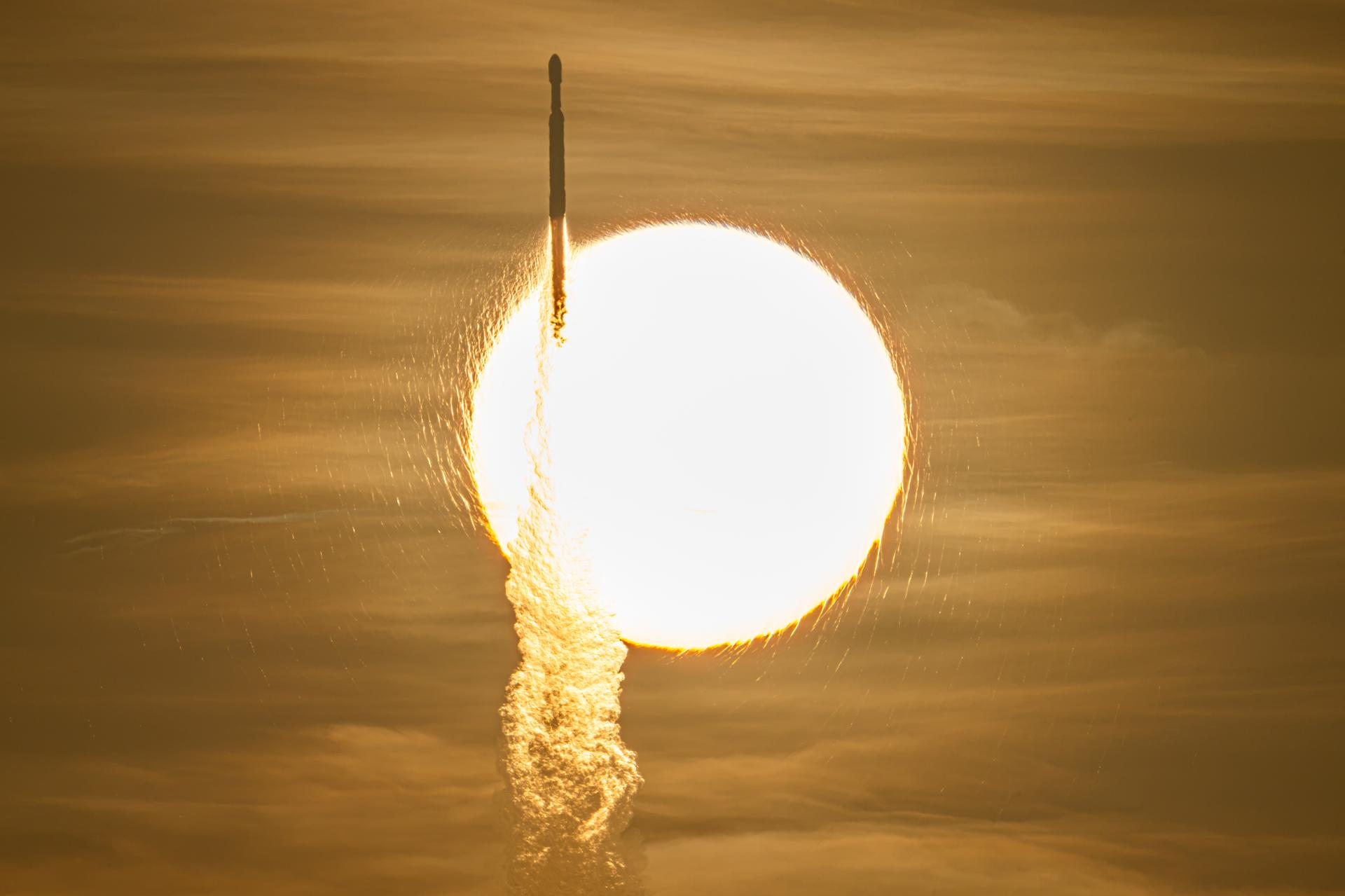
A SpaceX Falcon Heavy rocket with NASA’s Nancy Grace Roman Telescope on board is seen transiting the sun during launch from Launch Complex 39A, Sunday, Aug. 30, 2026, at NASA’s Kennedy Space Center in Florida.
NASA/John Kraus

Now on a three-month, million-mile journey to its final orbit, NASA’s Nancy Grace Roman Space Telescope will soon reveal the universe’s darkest secrets. The mission launched at 7:26 a.m. EDT Sunday aboard a SpaceX Falcon Heavy rocket from Launch Complex 39A at the agency’s Kennedy Space Center in Florida.

Roman pairs a large field of view with crisp infrared vision to explore vast swaths of the sky and probe deeply into cosmic history. This flagship mission will help astronomers explore dark matter, dark energy, and worlds outside of our solar system, known as exoplanets. Its surveys will support a broad range of research extending far beyond the mission’s main science goals.

“Roman is exactly the kind of success story we want to see across NASA,” said NASA Administrator Jared Isaacman. “Delivered ahead of schedule and on budget, this mission reflects more than a decade of dedication from the NASA workforce and our industry partners. Now, Roman will give us a new atlas of the universe, push the boundaries of discovery, and demonstrate what is possible when America’s space program pairs bold ambition with disciplined execution.”

The ground control team at NASA’s Goddard Space Flight Center in Greenbelt, Maryland, began receiving telemetry data from Roman seven minutes after launch. The Falcon Heavy rocket performed as expected, separating from the observatory 31 minutes into the flight. After separating from the center core, the rocket’s boosters safely returned to the launch site for refurbishment.

“Roman will be a discovery machine that will bring us closer than ever before to answering humanity’s most profound questions about our cosmic history,” said Nicky Fox, associate administrator for the Science Mission Directorate at NASA Headquarters in Washington. “With its large field of view and fast survey speeds, Roman will usher us into a new era of discovery and make the invisible visible, setting the foundation for humanity’s search for life beyond our solar system.”

During launch and early orbit, Roman uses the Near Space Network’s ground stations and relay satellites to exchange tracking, telemetry, and command data with ground controllers. About 70 minutes after launch, the Deep Space Network takes over communications and guides Roman toward the second Sun-Earth Lagrange point, or L2, about one million miles from Earth. Roman connects to that network through the Canberra Deep Space Communication Complex in Australia first. Approximately six hours later it will transfer to the Madrid Deep Space Communication Complex in Spain and then to the Goldstone Deep Space Communication Complex in California, ensuring continuous contact with Roman throughout its journey.

The Roman team also confirmed successful deployment of the observatory’s solar panels and lower instrument sun shade an hour and 23 minutes after launch. Within the upcoming days, Roman’s high-gain antenna and visor-like deployable aperture cover will deploy, ground controllers will initiate the first of two-mid-course corrections, and the Coronagraph Instrument will power on. This instrument will demonstrate the technology that future missions like NASA’s Habitable Worlds Observatory concept could use to image Earth-like planets in the search for life in the universe. Roman’s Coronagraph will take a giant step in that direction by snapping pictures of Jupiter-like planets.

A few weeks into Roman’s voyage, its primary instrument, the Wide Field Instrument, will activate. This 300-megapixel infrared camera has 18 4K detectors, each about the size of a saltine cracker. These detectors collect photons of light that will be decoded into crisp cosmic panoramas. Thanks to the observatory’s rigid design and stable optical performance, it will rapidly scan the sky without needing substantial time between separate observations. The Roman telescope is designed to survey the universe a thousand times faster than NASA’s Hubble Space Telescope.

Throughout the rest of Roman’s three-month commissioning period, scientists will run the instruments through a series of calibrations and tests. NASA anticipates releasing Roman’s first images by early 2027.

Roman will send back 1.4 terabytes of data every day, the highest data rate of any NASA astrophysics mission, so far. Machine learning, artificial intelligence, and citizen scientists will help sift through it and flag significant findings, which astronomers can then study.

“We’ve never been able to view the universe with eyes like Roman’s before,” said Julie McEnery, Roman’s senior project scientist at NASA Goddard. “There’s no telling what more we’ll know and have seen by this time next year.”

Roman is the fourth primary mission NASA has launched on a Falcon Heavy rocket. Earlier this year, the agency’s Launch Services Program worked with SpaceX to accelerate the launch date to accommodate the space telescope’s early completion.

The telescope is managed at NASA Goddard with participation by the agency’s Jet Propulsion Laboratory in Southern California; Caltech/IPAC in Pasadena, California; the Space Telescope Science Institute in Baltimore; and a team of scientists from various research institutions. The primary industrial partners are BAE Systems Inc., L3Harris Technologies, and Teledyne Scientific & Imaging. Contributions to Roman also are made by ESA, JAXA, the French space agency CNES (Centre National d’Études Spatiales), and the Max Planck Institute for Astronomy in Germany.

To learn more about the Roman mission, visit:

https://www.nasa.gov/roman

-end-

George Alderman / Alise Fisher
Headquarters, Washington
202-358-1600
george.a.alderman@nasa.gov / alise.m.fisher@nasa.gov

Claire Andreoli
Goddard Space Flight Center, Greenbelt, Md.
202-286-1940
claire.andreoli@nasa.gov

Source: Goddard Space Flight Center – NASA

Filed under: Science & Space — NASA — Centers & Facilities

Post navigation

Previous: LIVE: SpaceX launches NASA’s Nancy Grace Roman Space Telescope on Falcon Heavy (Full launch)
Next: NASA Deep Space Network’s New Goldstone Antenna Goes Online

More from Science & Space — NASA — Centers & Facilities

Science & Space — NASA — Centers & Facilities

How 2 US, European Satellites Are Studying Hurricanes During El Niño

Published September 9, 2026 · 5 min read
Science & Space — NASA — Centers & Facilities

NASA’s Hubble, Webb Find Far-out Solar System Objects ‘Remember’ Past

Published September 8, 2026 · 5 min read
Science & Space — NASA — Centers & Facilities

NASA Rocket Takes First Multi-Point Look Inside Radio-Disrupting Clouds

Published September 2, 2026 · 5 min read
Science & Space — NASA — Centers & Facilities

NASA Astronaut Jonny Kim Departs Agency to Continue Military Service

Published August 27, 2026 · 4 min read
Science & Space — NASA — Centers & Facilities

NASA Ames’ Contributions to Roman’s Mission

Published August 25, 2026 · 6 min read
Science & Space — NASA — Centers & Facilities

NASA Ames Experts Available for Roman Space Telescope Interviews 

Published August 25, 2026 · 2 min read
Science & Space — NASA — Centers & Facilities

NASA’s Pandora Mission Begins Study of Exoplanets, Host Stars

Published August 25, 2026 · 5 min read
Science & Space — NASA — Centers & Facilities

Galactic Gems Glisten in New Gallery From NASA’s Chandra

Published August 25, 2026 · 12 min read
Science & Space — NASA — Centers & Facilities

Starstruck: NASA Research Shows How Sun’s Ancient History Shaped Earth

Published August 24, 2026 · 7 min read
Science & Space — NASA — Centers & Facilities

NASA Data Feeds River Forecasts as Snow Drought Effects Linger

Published August 20, 2026 · 6 min read
Science & Space — NASA — Centers & Facilities

Human-Related Microbes May Survive Moon’s South Pole, NASA Finds

Published August 19, 2026 · 6 min read
Science & Space — NASA — Centers & Facilities

NASA’s LRO Images Falcon 9 Crater on Moon, Learns New Details

Published August 18, 2026 · 5 min read
Science & Space — NASA — Centers & Facilities

NASA Glenn’s Legacy Forged Through Decades of Flight Research

Published August 18, 2026 · 7 min read
Science & Space — NASA — Centers & Facilities

NASA Challenge Tests Wheel Designs for Moon Base Mobility

Published August 17, 2026 · 5 min read
Science & Space — NASA — Centers & Facilities

Hubble Solves Merger Mystery From Milky Way’s Early Years

Published August 17, 2026 · 6 min read
Science & Space — NASA — Centers & Facilities

NASA’s COFFIES Uses AI to Predict Storm-Causing Active Regions on Sun 

Published August 14, 2026 · 7 min read
Science & Space — NASA — Centers & Facilities

For West Virginia Engineer, Home Is Where the Heart Is… and NASA, Too

Published August 13, 2026 · 5 min read
Science & Space — NASA — Centers & Facilities

NASA Upgrades Vertical Motion Simulator for Modern Mission Needs

Published August 12, 2026 · 3 min read
Science & Space — NASA — Centers & Facilities

NASA Completes Astronaut-Deployed Science Instrument for Lunar Surface

Published August 11, 2026 · 6 min read
Science & Space — NASA — Centers & Facilities

Lion Nebula Roars to Life With NASA’s Webb

Published August 10, 2026 · 5 min read
Science & Space — NASA — Centers & Facilities

NASA’s Lunar Development and Test Facility Prepares Artemis Hardware for Moon 

Published August 7, 2026 · 3 min read
Science & Space — NASA — Centers & Facilities

NASA’s Perseverance Rover Watches Earth Vanish Behind Martian Moon

Published August 5, 2026 · 5 min read
Science & Space — NASA — Centers & Facilities

NASA Will Attempt to Observe Rocket Part’s Lunar Impact

Published August 4, 2026 · 3 min read
Science & Space — NASA — Centers & Facilities

NASA’s PUNCH Sharpens Solar Storm Forecasting in First Test

Published August 4, 2026 · 4 min read
Science & Space — NASA — Centers & Facilities

NASA Provides Updates on Moon Base Cargo Landers, Tech Demonstrations

Published August 4, 2026 · 7 min read
Science & Space — NASA — Centers & Facilities

Louisiana Students Loft Payloads from NASA Balloon Facility in Texas

Published August 3, 2026 · 4 min read
Science & Space — NASA — Centers & Facilities

NASA Awards Contract for Construction Services in California

Published August 3, 2026 · 2 min read
Science & Space — NASA — Centers & Facilities

NASA Pushes New Wing Design to Find Structural Limits

Published August 3, 2026 · 4 min read
Science & Space — NASA — Centers & Facilities

NASA Uses Subscale Aircraft to Accelerate Flight Innovation

Published August 3, 2026 · 5 min read
Science & Space — NASA — Centers & Facilities

NASA Jets Turn Red, White, and Blue

Published August 3, 2026 · 3 min read
Science & Space — NASA — Centers & Facilities

NASA Study Points to Smoother Air Taxi Rides

Published August 3, 2026 · 3 min read
Science & Space — NASA — Centers & Facilities

NASA Photographer Captures Images from F-18 Over Washington

Published August 3, 2026 · 3 min read
Science & Space — NASA — Centers & Facilities

A Day of Flight Testing at NASA Armstrong

Published August 3, 2026 · 5 min read
Science & Space — NASA — Centers & Facilities

This is How NASA Flight Tests New Technology

Published August 3, 2026 · 4 min read
Science & Space — NASA — Centers & Facilities

NASA’s Experimental Fabrication Branch Fuels Aircraft Innovation

Published August 3, 2026 · 3 min read
Science & Space — NASA — Centers & Facilities

NASA, USGS Scientists Go Rock Hounding in California’s High Desert

Published August 3, 2026 · 5 min read
Science & Space — NASA — Centers & Facilities

NASA, SpaceX Advance Wind Tunnel Tests for Starship Rocket 

Published August 3, 2026 · 5 min read
Science & Space — NASA — Centers & Facilities

NASA to Host Florida Event Celebrating American Air, Space Leadership

Published July 31, 2026 · 2 min read
Science & Space — NASA — Centers & Facilities

NASA Awards 2026 Innovative Technology Concepts

Published July 29, 2026 · 4 min read
Science & Space — NASA — Centers & Facilities

NASA Sets Coverage for August Northern Hemisphere Total Solar Eclipse

Published July 29, 2026 · 2 min read

Search

Recent Posts
  • Gasoline and diesel prices soar in Germany | DW News
  • NASA Ames Stars of the Month: September 2026
  • Merz pledges fast fuel price relief for Germans | DW News
  • More ‘BAD S**T WILL HAPPEN’ if we don’t act: Naomi Klein & Astra Taylor EXPOSE ‘End Times Fascism’
  • ‘I have questions…’: Nicolle reacts to Kash Patel’s WEIRD defense of creepy new policy
  • CO Dem running for Congress: ‘They are ripping apart the American dream’
  • ‘The FBI would be investigating!’: Fmr. CIA officer exposes SEVERITY of Jared Kushner’s meddling
  • Booker FLAMES Kash Patel: ‘You are a MOCKERY!’
  • Senators HAMMER Kash Patel on FBI departures, Epstein probes, leadership | MS NOW Highlights
  • ‘NOT the people I interviewed’: Trump DEJECTED after conservative Supreme Court rules against him
Categories
  • Florida (110)
    • Jacksonville (20)
    • Miami (62)
    • Orlando (17)
    • Tampa (11)
  • Health (1)
  • New York (69)
    • New York City (69)
  • Science (65)
    • Health & Medical Research (10)
    • U.S. Geological Survey (16)
    • U.S. National Science Foundation (39)
  • Science & Space (206)
    • NASA — Centers & Facilities (57)
    • NASA — JPL & Near-Earth Objects (4)
    • NASA — News, Missions & Technology (114)
    • NASA — Photos & Visual Records (31)
  • Trump (477)
  • U.S. Civil Service (160)
    • Cabinet — Department of Agriculture (8)
    • Independent Agencies — Commodity Futures Trading Commission (17)
    • Independent Agencies — Consumer Financial Protection Bureau (10)
    • Independent Agencies — Consumer Product Safety Commission (22)
    • Independent Agencies — Equal Employment Opportunity Commission (32)
    • Independent Agencies — Federal Reserve Board (1)
    • Independent Agencies — Federal Trade Commission (26)
    • Independent Agencies — National Labor Relations Board (20)
    • Independent Agencies — Securities and Exchange Commission (24)
  • U.S. Government (11)
    • DOJ — National (7)
    • DOJ — U.S. Attorneys (5)
    • GAO — News & Analysis (27)
    • GAO — Reports & Decisions (88)
    • Department of Justice (10)
    • Government Accountability Office (1)
  • U.S. News (994)
  • U.S. Veterans (163)
    • Benefits (23)
    • Disabled Veterans (10)
    • Employment (10)
    • Health & Care (41)
    • News (79)
  • Washington (170)
    • Washington (87)
      • Seattle (57)
      • Spokane (30)
  • World News (800)

Recent Comments

No recent comments.

Archives
  • September 2026 (956)
  • August 2026 (1879)
  • July 2026 (15)
  • June 2026 (7)
  • May 2026 (1)
  • April 2026 (4)
  • March 2026 (1)
  • January 2026 (3)
  • November 2025 (1)
  • August 2025 (1)
  • July 2025 (1)
  • April 2025 (2)

Thirstier News is a service of Thirstier, a DBA of Immix Tachyon Synergy Network LLC.

© 2026 Thirstier. Thirstier Theme is an original theme from Thirstier.