
Skip to content
Thirstier News November 5, 2026
Home
Thirstier News
  • ABC Live
  • Al Jazeera
  • CBS Live
  • Contact
  • France 24
  • Live News
  • NBC Live
Popular Tags
  • YouTube
  • U.S. News
  • World News
  • MS NOW
  • PBS NewsHour
  • Al Jazeera English
  • DW News
Science & Space — NASA — Centers & Facilities

NASA’s LRO Images Falcon 9 Crater on Moon, Learns New Details

Published August 18, 2026 · 5 min read
· By Thirstier News

3 min read

NASA’s LRO Images Falcon 9 Crater on Moon, Learns New Details

NASA Science Editorial Team

Aug 18, 2026
Article
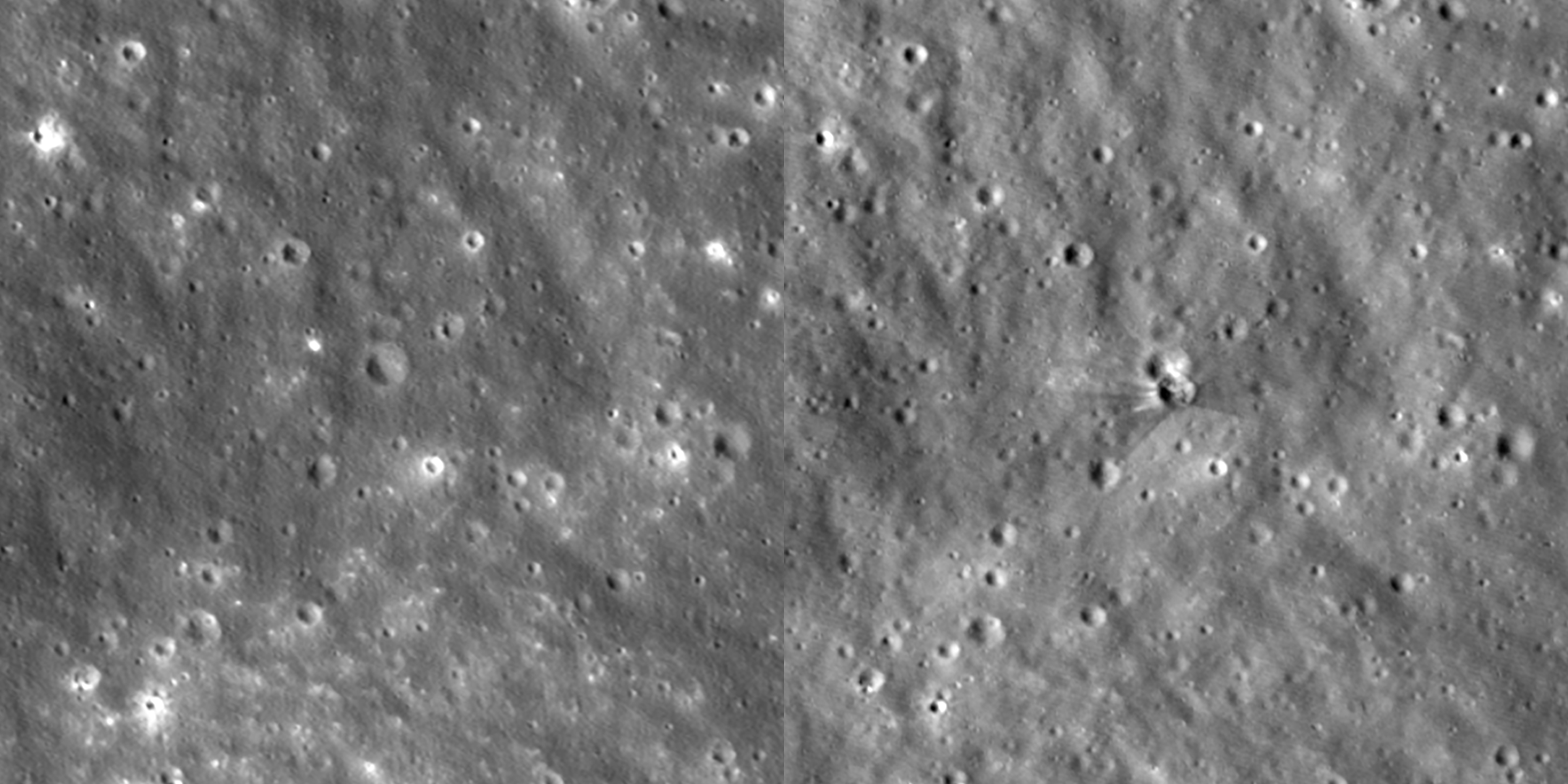
This is an animated before-and-after view of the crater formed after a Falcon 9 upper stage struck the Moon’s surface on Aug. 5, 2026. These images were taken between Aug. 11 and 12 by the Narrow-Angle Camera on NASA’s Lunar Reconnaissance Orbiter. These images are enlarged three times from the original, with north facing up, and they cover an area about a quarter of a mile wide.
NASA Goddard/Intuitive Machines

Between Aug. 11 and 12, NASA’s Lunar Reconnaissance Orbiter (LRO) captured a series of images of a new crater on the Moon. The crater formed on Aug. 5, when a SpaceX Falcon 9 upper stage impacted the surface following its January 2025 launch of the Firefly Blue Ghost 1 mission.

To capture imagery of the impact, engineers tilted the spacecraft so its cameras would point toward the crater each time LRO passed about 60 miles above the Moon, traveling 1 mile per second. The orbiter circles the Moon from pole to pole every two hours, while the Moon slowly rotates underneath it. To photograph a specific spot, the spacecraft must wait until that location turns into view, which took six days in this case.

Getting the pointing right was only half the challenge; timing had to be accurate as well. If the camera snapped even 10 seconds too early or too late, the target would drift off-center by 10 miles.

An artist concept video showing NASA’s Lunar Reconnaissance Orbiter circling the Moon.
NASA’s Goddard Space Flight Center Conceptual Image Lab

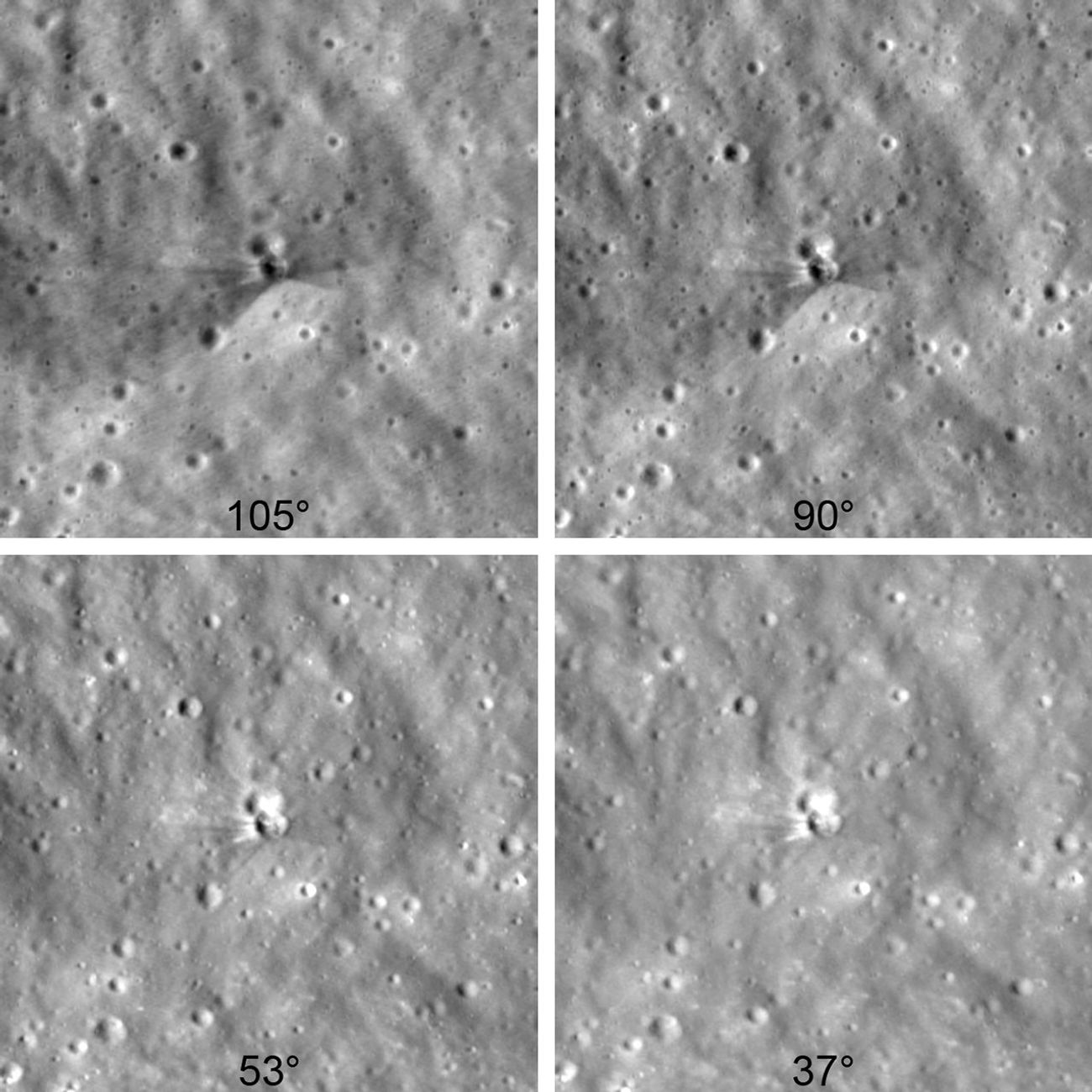
Because of the variety of viewing angles, scientists could see the crater under multiple lighting conditions that revealed unique features. In images where the crater rim stood out, scientists measured its 60‑foot width. Scientists also determined the crater is less than 10 feet deep based on the length of its shadow.

To capture these details, LRO used its Narrow-Angle Camera, which can spot features as small as 3 feet wide.

Collected between Aug. 11 and 12 by NASA’s Lunar Reconnaissance Orbiter, six days after a Falcon 9 upper-stage booster impacted the Moon, these images were taken from different viewing angles, bringing out different features. The darker area that fans around the crater in the upper-left image is rougher than the surroundings, as this surface material has been altered over a long time by solar wind, galactic cosmic rays, and micrometeorite impacts. The brighter rays and splotch above the crater in the lower-right image is fresher material that was excavated from deeper below the surface. The pictures are arranged in the order they were taken, starting at the top left and moving toward the bottom right, with the lighting angle from the Sun gradually changing from one image to the next. Each image is enlarged two times and shows an area of the Moon about 1,000 feet wide.
NASA Goddard/Intuitive Machines

The images above show bright and dark rays stretching out from the crater. The darker streaks are made of surface dust and rocks altered over a long time by solar wind, galactic cosmic rays, and micrometeorite impacts. This weathered material was excavated by the collision from 1.5 feet into the lunar surface. The brighter streaks near the crater rim are made of fresh material excavated from deeper underground.

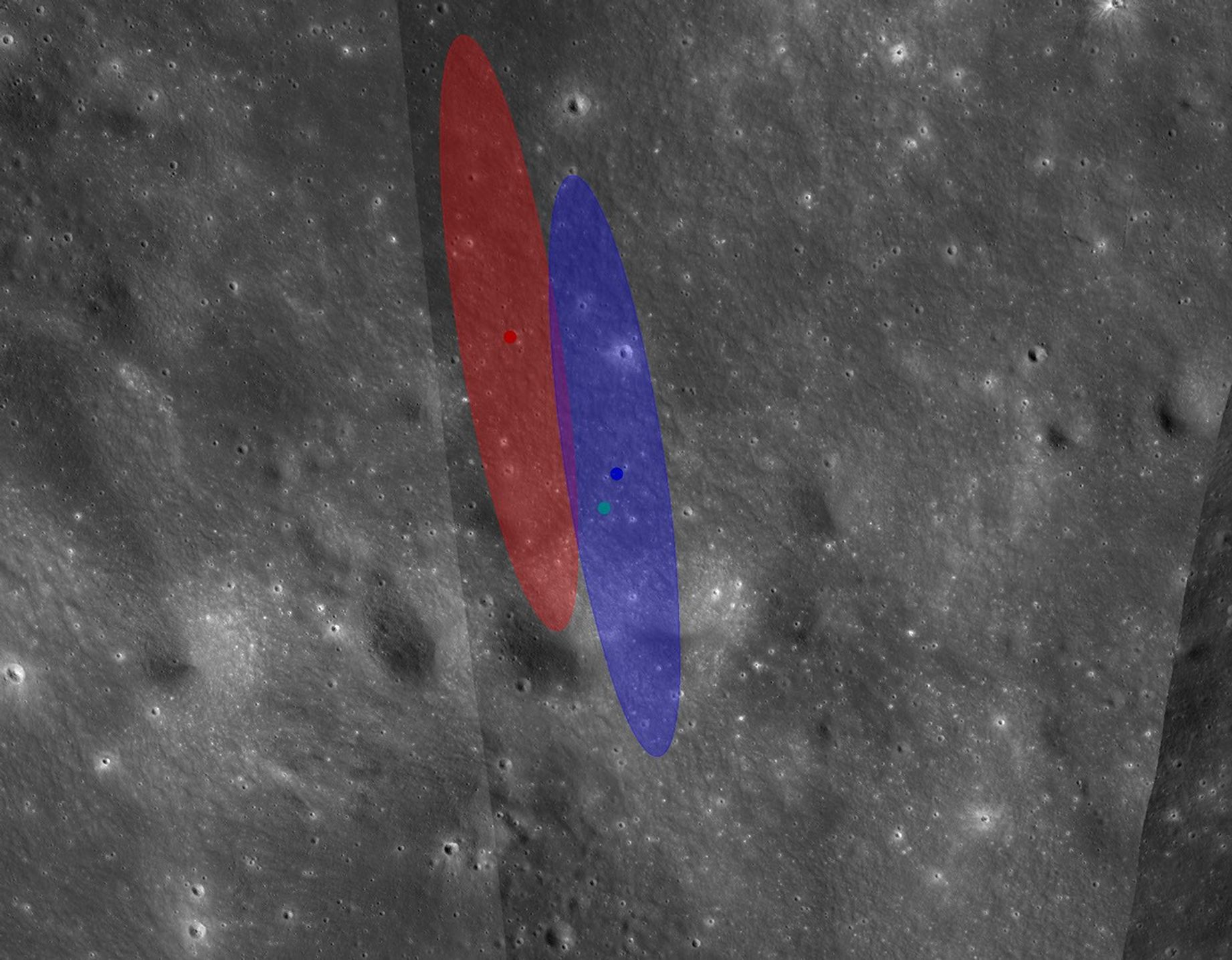
This image from NASA’s Lunar Reconnaissance Orbiter shows two oval regions where the Falcon 9 upper stage was likely to impact the Moon, based on calculations by engineers with NASA’s Center for Near Earth Object Studies. Both ellipses are 2.1 miles long and 0.4 miles wide. Both predictions use the same booster-trajectory calculations, but only the blue ellipse takes into account the lunar terrain (vs. a smooth sphere). The red and blue dots show predicted impact locations, whereas the cyan dot shows the actual impact site.
NASA/JPL-Caltech

Finding the impact site took global coordination among experts and hobbyists. Independent astronomers first identified the rocket’s trajectory using publicly available data. NASA’s Center for Near Earth Object Studies, which tracks natural objects that could pose hazards to Earth for the agency’s Planetary Defense program, used this opportunity to test and validate tools and techniques for predicting impacts.

Based at NASA’s Jet Propulsion Laboratory in Southern California, the center incrementally refined the trajectory until identifying the location of impact, which it provided to the Republic of Korea for their Korea Pathfinder Lunar Orbiter (Danuri) team. The team used the high-resolution LUTI camera on Danuri a few hours later to image the crater, finding the prediction was accurate to about 0.6 miles. 

After capturing images of the crater, the Danuri mission sent coordinates to NASA’s LRO team to help refine their follow-up imaging sequence. Comparing their new crater images with the pre-impact images, the LRO team updated the crater center coordinates: 19.4759°N, 266.7138°E, 511 meters elevation.

About the Author

NASA Science Editorial Team

Share

Details

Last Updated

Aug 18, 2026

Related Terms

  • Earth’s Moon
  • Commercial Space
  • Craters
  • Goddard Space Flight Center
  • Humans in Space
  • Lunar Reconnaissance Orbiter (LRO)
  • Missions
  • NASA Centers & Facilities
  • NASA Directorates
  • Planetary Defense
  • Planetary Defense Coordination Office
  • Planetary Science
  • Planetary Science Division
  • Science Mission Directorate
  • The Solar System

Explore More

3 min read

NASA Student Aviation Challenge Focuses on Nation’s Infrastructure

NASA’s next Gateways to Blue Skies competition invites collegiate teams to imagine innovative new ways…

Article


4 hours ago

6 min read

NASA Glenn’s Legacy Forged Through Decades of Flight Research

Many of NASA’s most important aerospace breakthroughs that began in the laboratory were ultimately proven in the…

Article


8 hours ago

5 min read

NASA Mission Studies Air Pollution Over Ethiopia

A NASA-funded air pollution monitoring network has provided one of the most detailed long-term views…

Article


1 day ago

Keep Exploring

Discover More Topics From NASA

Missions


Humans in Space


Climate Change


Solar System


Source: Goddard Space Flight Center – NASA

Source: Goddard Space Flight Center – NASA. Review credited third-party material before publication.

Filed under: Science & Space — NASA — Centers & Facilities

Post navigation

Previous: NASA Student Aviation Challenge Focuses on Nation’s Infrastructure
Next: SEC Charges Former Executives With Fraud in Connection With $1.9 Billion Collapse of Subprime Auto Lender Tricolor

More from Science & Space — NASA — Centers & Facilities

Science & Space — NASA — Centers & Facilities

NASA’s Hubble Spies Spiral’s Edge

Published October 16, 2026 · 2 min read
Science & Space — NASA — Centers & Facilities

Rigorous Analysis Confirms NASA’s Artemis II Heat Shield Performance 

Published October 15, 2026 · 6 min read
Science & Space — NASA — Centers & Facilities

NASA Develops Batteries to Power Humanity’s Return to Moon

Published October 14, 2026 · 5 min read
Science & Space — NASA — Centers & Facilities

NASA to Conduct Flyover, Engage NFL Fans at MetLife Stadium

Published October 10, 2026 · 2 min read
Science & Space — NASA — Centers & Facilities

NASA’s SSPICY Mission to Demonstrate In-Space Inspection Technologies

Published October 8, 2026 · 3 min read
Science & Space — NASA — Centers & Facilities

NASA’s SPHEREx Telescope Sees Menagerie of Brown Dwarfs

Published October 8, 2026 · 5 min read
Science & Space — NASA — Centers & Facilities

Webb Measures Distance to Farthest Fast Radio Burst, Suggesting Origin

Published October 8, 2026 · 5 min read
Science & Space — NASA — Centers & Facilities

NASA Advances LISA Mission Contributions With New Test Telescope

Published October 8, 2026 · 4 min read
Science & Space — NASA — Centers & Facilities

NASA Glenn Invites Phase 1 Proposals for Aerospace Power Systems Laboratory

Published October 6, 2026 · 2 min read
Science & Space — NASA — Centers & Facilities

Suspected Second-generation Planet Solves NASA Hubble Cold Case

Published October 5, 2026 · 5 min read
Science & Space — NASA — Centers & Facilities

NASA Campaign Explores Clouds Spawned by Wildfires

Published October 2, 2026 · 7 min read
Science & Space — NASA — Centers & Facilities

NASA Awards Enterprise Logistics Support Services Agreements

Published October 1, 2026 · 2 min read
Science & Space — NASA — Centers & Facilities

NASA Awards Contract to Develop 5G Communications for Moon

Published September 30, 2026 · 1 min read
Science & Space — NASA — Centers & Facilities

NASA Adds Blue Origin New Glenn 9×4 to Launch Services Contract

Published September 29, 2026 · 1 min read
Science & Space — NASA — Centers & Facilities

NASA Highlights Lessons Learned From Swift Boost Mission

Published September 28, 2026 · 6 min read
Science & Space — NASA — Centers & Facilities

Meet NASA’s Artemis II Crew During Houston Public Event

Published September 28, 2026 · 2 min read
Science & Space — NASA — Centers & Facilities

Reliable Robots: Meet Johnson’s Dexterous Robotics Team

Published September 28, 2026 · 5 min read
Science & Space — NASA — Centers & Facilities

Uncovering the Valleys Hidden Below Greenland’s Ice

Published September 28, 2026 · 4 min read
Science & Space — NASA — Centers & Facilities

NASA Tests Dual Mode Propulsion CubeSat Ahead of Launch

Published September 25, 2026 · 4 min read
Science & Space — NASA — Centers & Facilities

NASA Unveils Winning Designs for Mars Space Food Systems Challenge 

Published September 24, 2026 · 4 min read
Science & Space — NASA — Centers & Facilities

US-India Satellite Captures Time-lapse Video of Volcanic Eruption

Published September 24, 2026 · 5 min read
Science & Space — NASA — Centers & Facilities

NASA Aircraft to Make Low-Altitude Research Flights Over Colorado

Published September 23, 2026 · 2 min read
Science & Space — NASA — Centers & Facilities

NASA’s Hubble Seeks Lensed Supernova, Marks 200,000 Orbits

Published September 23, 2026 · 2 min read
Science & Space — NASA — Centers & Facilities

Johnson Space Center Sparks Curiosity at Houston’s 33rd Annual Japan Festival  

Published September 21, 2026 · 3 min read
Science & Space — NASA — Centers & Facilities

NASA’s Moon Orbiter Spots New, ‘Once-in-Century’ Moon Crater

Published September 16, 2026 · 4 min read
Science & Space — NASA — Centers & Facilities

How 2 US, European Satellites Are Studying Hurricanes During El Niño

Published September 9, 2026 · 5 min read
Science & Space — NASA — Centers & Facilities

NASA’s Hubble, Webb Find Far-out Solar System Objects ‘Remember’ Past

Published September 8, 2026 · 5 min read
Science & Space — NASA — Centers & Facilities

NASA Rocket Takes First Multi-Point Look Inside Radio-Disrupting Clouds

Published September 2, 2026 · 5 min read
Science & Space — NASA — Centers & Facilities

NASA’s Dark Universe-Seeking Nancy Grace Roman Space Telescope Launches

Published August 30, 2026 · 5 min read
Science & Space — NASA — Centers & Facilities

NASA Astronaut Jonny Kim Departs Agency to Continue Military Service

Published August 27, 2026 · 4 min read
Science & Space — NASA — Centers & Facilities

NASA Ames’ Contributions to Roman’s Mission

Published August 25, 2026 · 6 min read
Science & Space — NASA — Centers & Facilities

NASA Ames Experts Available for Roman Space Telescope Interviews 

Published August 25, 2026 · 2 min read
Science & Space — NASA — Centers & Facilities

NASA’s Pandora Mission Begins Study of Exoplanets, Host Stars

Published August 25, 2026 · 5 min read
Science & Space — NASA — Centers & Facilities

Galactic Gems Glisten in New Gallery From NASA’s Chandra

Published August 25, 2026 · 12 min read
Science & Space — NASA — Centers & Facilities

Starstruck: NASA Research Shows How Sun’s Ancient History Shaped Earth

Published August 24, 2026 · 7 min read
Science & Space — NASA — Centers & Facilities

NASA Data Feeds River Forecasts as Snow Drought Effects Linger

Published August 20, 2026 · 6 min read
Science & Space — NASA — Centers & Facilities

Human-Related Microbes May Survive Moon’s South Pole, NASA Finds

Published August 19, 2026 · 6 min read
Science & Space — NASA — Centers & Facilities

NASA Glenn’s Legacy Forged Through Decades of Flight Research

Published August 18, 2026 · 7 min read
Science & Space — NASA — Centers & Facilities

NASA Challenge Tests Wheel Designs for Moon Base Mobility

Published August 17, 2026 · 5 min read
Science & Space — NASA — Centers & Facilities

Hubble Solves Merger Mystery From Milky Way’s Early Years

Published August 17, 2026 · 6 min read

Search

Recent Posts
  • Why Trump’s midterm blues mean short-term gain, long-term pain for China
  • Shipping crews caught in the crossfire of the Hormuz conflict | DW News
  • LIVE: French students, workers, pensioners protest in Marseille
  • LIVE: Protests in France as trade unions hold nationwide strikes
  • Joshua Wong’s friend says jailed Hong Kong activist reading books, learning guitar inside prison
  • Blue wave sets up possible IMPEACHMENT of Trump’s attorney general, Todd Blanche
  • Over 300,000 tarantulas seized in Peru | DW News
  • The Last Word with Lawrence O’Donnell – Nov. 4 | Audio Only
  • Vance blames Iran war for GOP midterms loss, Trump brags about WH ballroom | MS NOW Highlights
  • Hope and faith in the American dream behind blue surge in Latino vote in Texas
Categories
  • Florida (110)
    • Jacksonville (20)
    • Miami (62)
    • Orlando (17)
    • Tampa (11)
  • Health (1)
  • New York (69)
    • New York City (69)
  • Science (85)
    • Health & Medical Research (10)
    • U.S. Geological Survey (18)
    • U.S. National Science Foundation (57)
  • Science & Space (364)
    • NASA — Centers & Facilities (82)
    • NASA — JPL & Near-Earth Objects (4)
    • NASA — News, Missions & Technology (242)
    • NASA — Photos & Visual Records (36)
  • Trump (1146)
  • U.S. Civil Service (245)
    • Cabinet — Department of Agriculture (8)
    • Independent Agencies — Commodity Futures Trading Commission (19)
    • Independent Agencies — Consumer Financial Protection Bureau (12)
    • Independent Agencies — Consumer Product Safety Commission (32)
    • Independent Agencies — Equal Employment Opportunity Commission (64)
    • Independent Agencies — Federal Reserve Board (1)
    • Independent Agencies — Federal Trade Commission (46)
    • Independent Agencies — National Labor Relations Board (22)
    • Independent Agencies — Securities and Exchange Commission (41)
  • U.S. Government (11)
    • DOJ — National (8)
    • DOJ — U.S. Attorneys (10)
    • GAO — News & Analysis (43)
    • GAO — Reports & Decisions (158)
    • Department of Justice (10)
    • Government Accountability Office (1)
  • U.S. News (2483)
  • U.S. Veterans (255)
    • Benefits (25)
    • Disabled Veterans (10)
    • Employment (10)
    • Health & Care (64)
    • News (146)
  • Washington (233)
    • Washington (87)
      • Seattle (57)
      • Spokane (30)
  • World News (1942)

Recent Comments

No recent comments.

Archives
  • November 2026 (218)
  • October 2026 (1794)
  • September 2026 (2072)
  • August 2026 (1879)
  • July 2026 (17)
  • June 2026 (8)
  • May 2026 (1)
  • April 2026 (6)
  • March 2026 (1)
  • January 2026 (3)
  • December 2025 (1)
  • November 2025 (1)

Thirstier News is a service of Thirstier, a DBA of Immix Tachyon Synergy Network LLC.

© 2026 Thirstier. Thirstier Theme is an original theme from Thirstier.