Skip to content
Thirstier News October 19, 2026
Home
Thirstier News
  • ABC Live
  • Al Jazeera
  • CBS Live
  • Contact
  • France 24
  • Live News
  • NBC Live
Popular Tags
  • YouTube
  • U.S. News
  • World News
  • MS NOW
  • PBS NewsHour
  • Al Jazeera English
  • DW News
Science & Space — NASA — Centers & Facilities

Rigorous Analysis Confirms NASA’s Artemis II Heat Shield Performance 

Published October 15, 2026 · 6 min read
· By Thirstier News
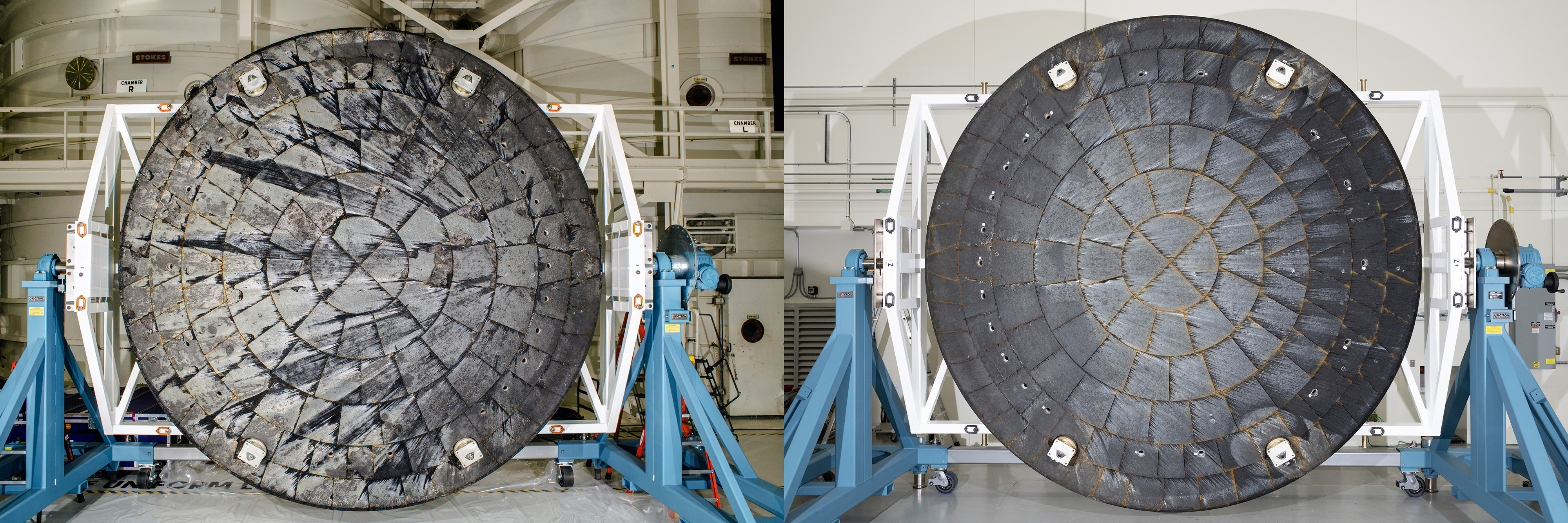
A post‑mission comparison of the Orion spacecraft heat shields from Artemis I (left) and Artemis II (right) are shown after removal from their crew modules. Both heat shields are seen rotated for inspection inside the Operations and Checkout Building at NASA’s Kennedy Space Center in Florida.
NASA

NASA’s Artemis II mission sent four astronauts around the Moon and brought them safely back to Earth, laying a foundation for crewed flights to the Moon’s surface.

Additional engineering data analysis of the Orion spacecraft’s heat shield confirmed initial data showing the heat shield performed as expected.  

In particular, NASA measured whether the thermal protection system effectively safeguarded the crew and Orion systems as the spacecraft reentered Earth’s atmosphere. This test flight was the first time astronauts flew aboard Orion. 

Orion reached a maximum velocity of 39 times the speed of sound and experienced external temperatures exceeding 4,000 degrees Fahrenheit at its peak, all while the four astronauts inside Orion stayed relatively cool with a cabin temperature in the mid-70 degree Fahrenheit range during their return to Earth from the Moon.  

After NASA’s thorough analysis of Artemis I heat shield findings, informed by extensive arc jet material testing at NASA’s Ames Research Center in California’s Silicon Valley, the agency modified Orion’s reentry trajectory for Artemis II by shortening the maximum downrange distance the spacecraft could fly between when it entered Earth’s atmosphere and splashed down in the Pacific Ocean. Analysis prior to the mission showed that limiting downrange distance would limit how long the spacecraft’s heat shield spent in the temperature range at which the Artemis I heat shield phenomenon occurred.  

Shortly after Artemis II splashdown on April 10, 2026, U.S. Navy divers captured underwater imagery of the Orion spacecraft’s heat shield.
US Navy

The spacecraft reentered with precision, entering within only 192 feet of its targeted entry interface, and successfully splashed down only 0.59 miles from the predicted landing site off the coast of San Diego. Initial inspections of the thermal protection system, including diver imagery of the spacecraft’s heat shield taken just after splashdown and further inspections on the recovery ship, found it performed as expected, with a significant reduction in the amount of cracks and char loss as compared to Artemis I.  

Upon the spacecraft’s return to NASA’s Kennedy Space Center in Florida after the Moon mission, thermal protection system experts began additional examination of the heat shield, made of 186 unique blocks of an ablative material called Avcoat. The heat shield was then transported to NASA’s Marshall Space Flight Center in Huntsville, Alabama, where work on sample extraction and internal x-ray scans began in August to provide further engineering insight into the system and behavior of the material.

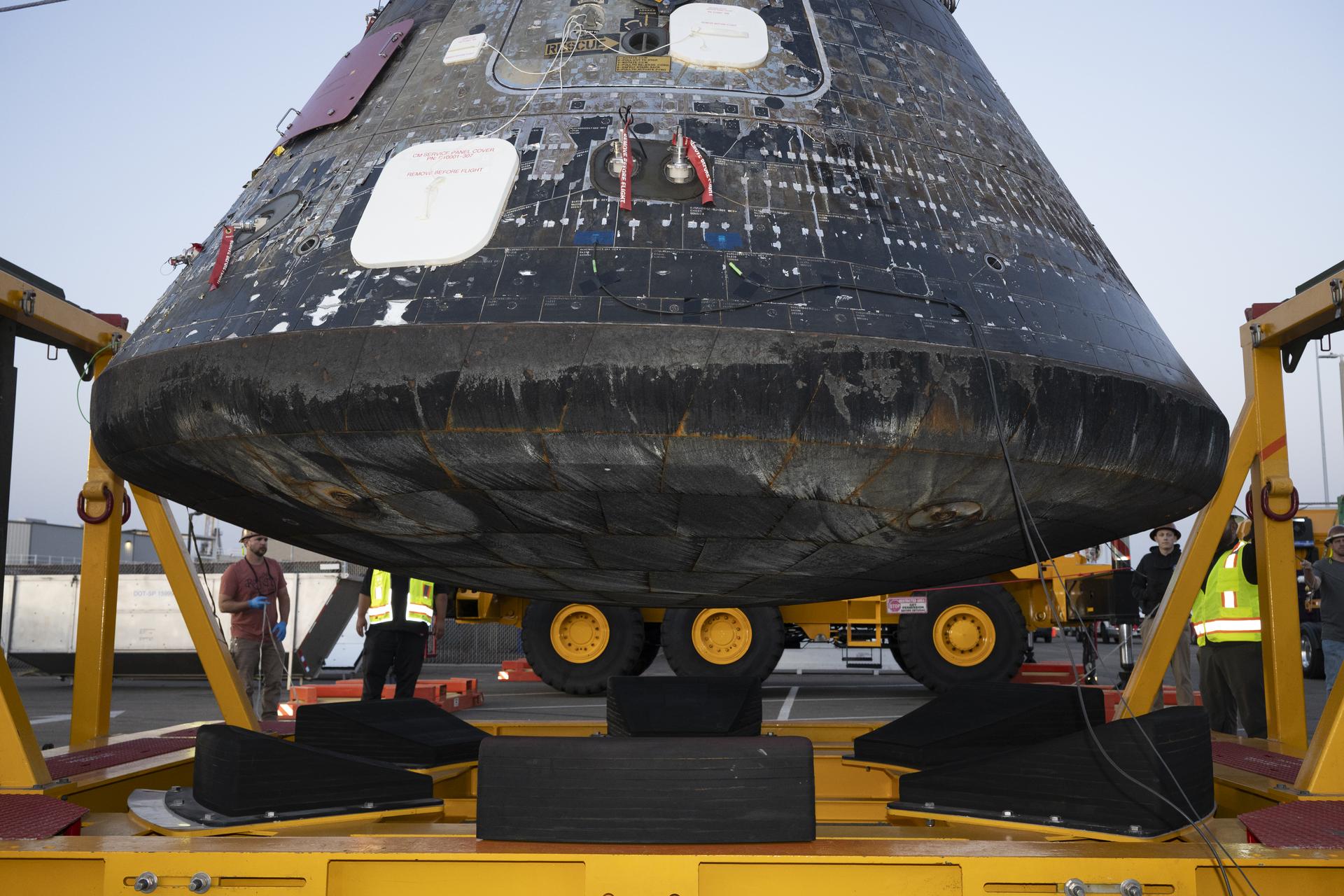
The Artemis II Orion crew module after being offloaded from the well deck of USS John P. Murtha at Naval Base San Diego and lifted from the Orion Recovery Cradle Assembly on April 18, 2026. The gray area, as seen on the edge where the spacecraft’s heat shield and the backshell meet, is from recovery operations.
NASA/Kevin Davis

A thorough post-flight assessment review found that Orion’s aerodynamic and aerothermal performance, including the heat shield and backshell thermal protection system, was in line with engineering predictions based on pre-flight analyses and ground testing. The shorter allowable down range during entry reduced the cracking and char loss experienced on the Artemis II heat shield relative to the Artemis I heat shield by a factor of ten, proving the effectiveness of the trajectory modification. Engineers found only nine spots of char loss of varying sizes on the Artemis II heat shield dish, compared to 103 during Artemis I. 

The analysis also showed that Orion’s robust heat shield design showed consistency from Artemis I to Artemis II, evident by the performance of system features such as the seams between the heat shield Avcoat blocks and the Avcoat surrounding the heat shield compression pad separation bolts. 

Post-flight inspection of Orion’s backshell, the protective cover on the sloped sides of the crew module made up of 1,300 ceramic tiles, showed expected performance across the crew module surface. Visual inspections indicated backshell features designed to seal and protect penetrations such as windows, vents, thrusters, and the side hatch also met expectations, with no signs of overheating observed. 

The team also performed post-flight laser scans of the heat shield surface and is comparing this data to pre-flight measurements to determine material recession, which will then be compared to analysis predictions. Engineers are continuing with heat shield sample extraction at NASA Marshall and subsequent material test and assessment and thermal analysis, to support long-term heat shield development, manufacturing efforts, and data capture. 

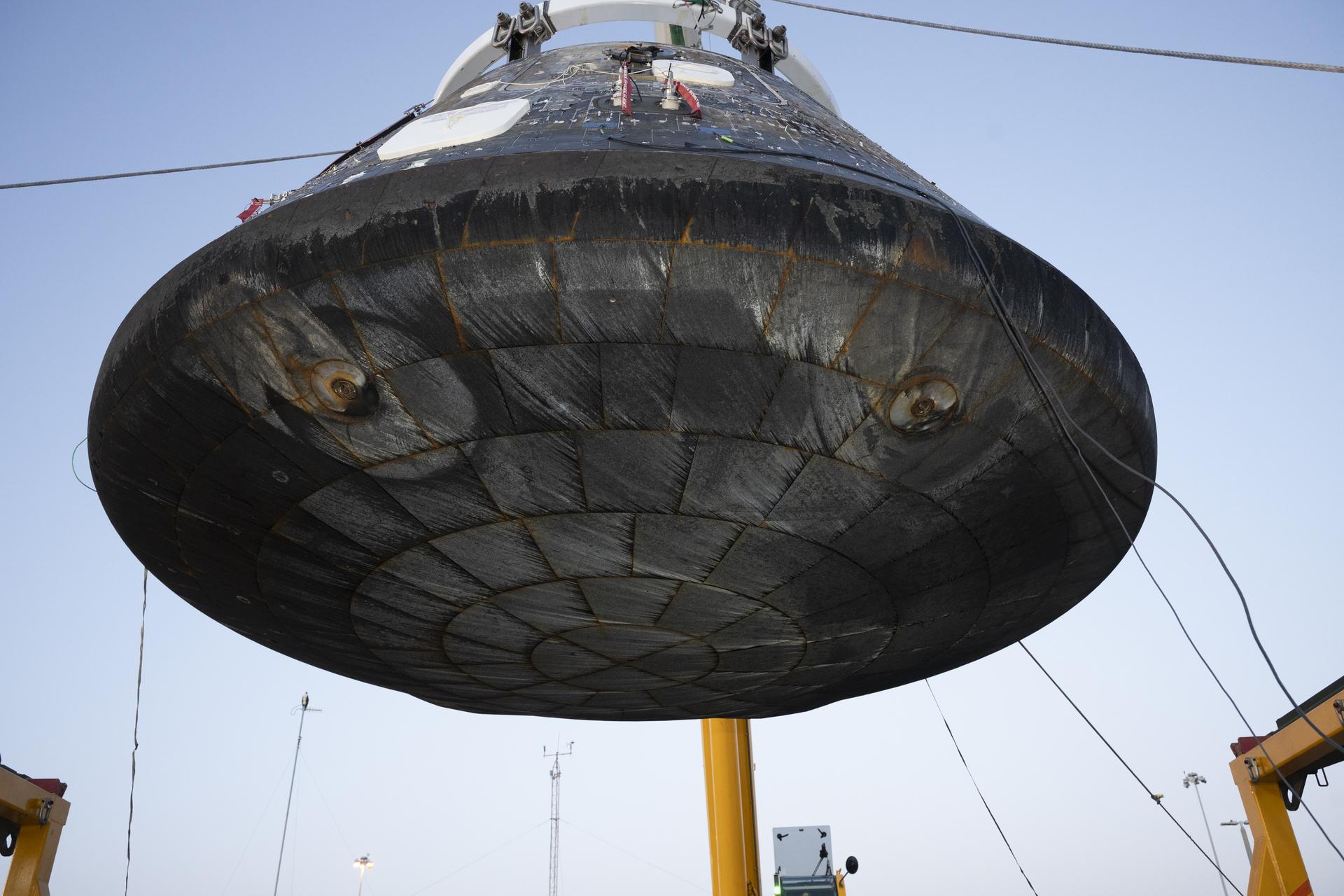
The Artemis II Orion crew module is lifted from its recovery fixture for inspection and engineering imagery after being offloaded from the USS John P. Murtha at Naval Base San Diego on April 18, 2026. The recessed areas, or smaller concentric circles, seen on the heat shield are associated with the separation bolts that connect the crew module with the service module. The larger circular patterns are formed due to compression pad material used within this location of the spacecraft, creating flow disturbances caused by extreme aerodynamic and thermal airflow during reentry. This causes increased heating locally and therefore Avcoat ablator thickness is increased in these areas by design.
NASA/Kevin Davis

Orion’s performance and the team’s analysis on Artemis II reflect system robustness, capability to support crew, and critical insights gathered that will enhance the Artemis III mission and beyond. Following the extensive Artemis I heat shield investigation, upgrades were made to the heat shield design for Artemis III to achieve uniformity and consistent permeability of the Avcoat blocks. Technicians attached the heat shield for the Artemis III Orion crew module at NASA Kennedy in early July, and the Orion crew and service modules were joined at the end of July. The spacecraft has since been successfully powered up for the first time, enabling engineers to check all connection lines between the two modules are working as planned.

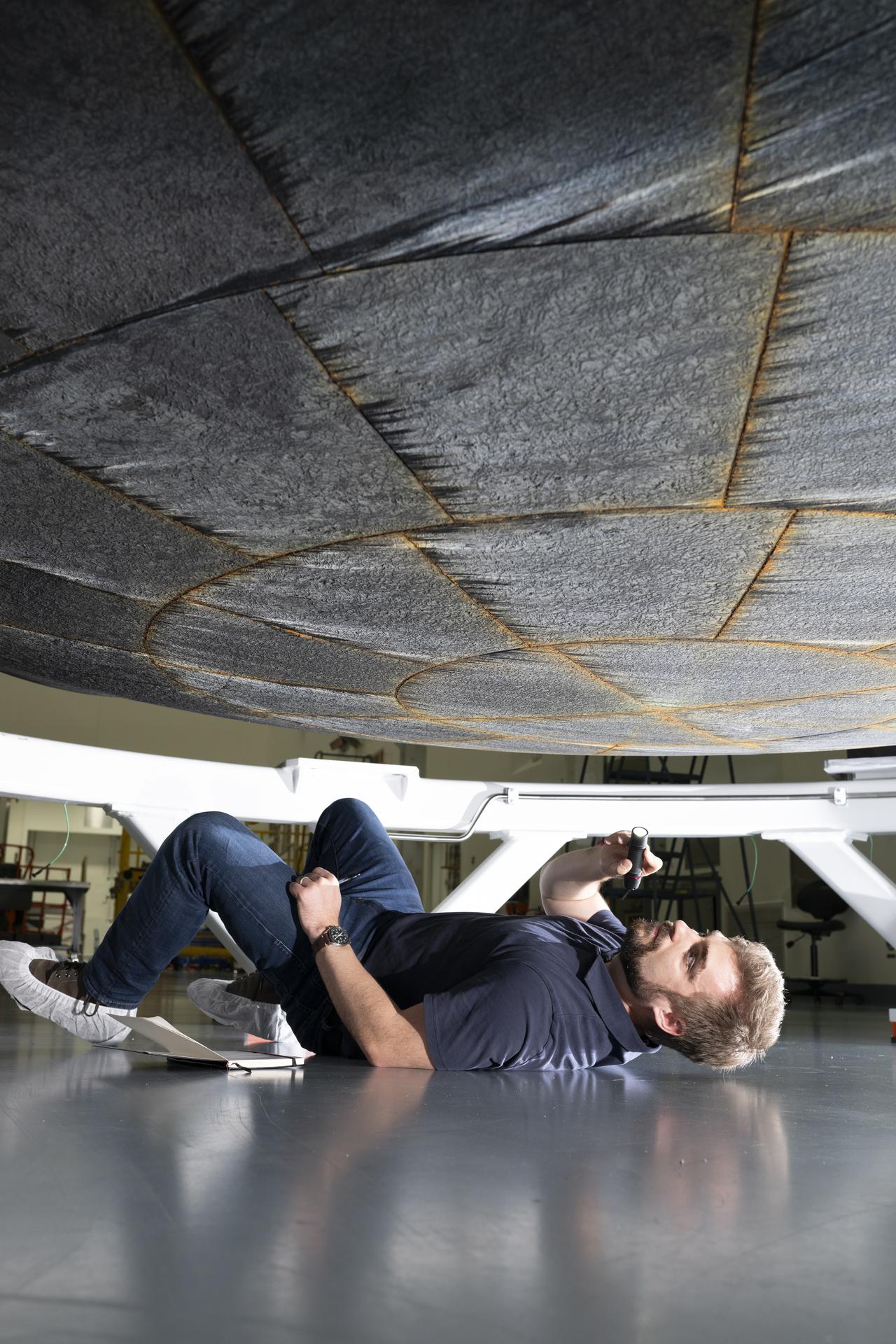
An engineer from NASA’s Ames Research Center inspects the Artemis II Orion heat shield at NASA Kennedy’s Multi-Purpose Payload Facility on April 30, 2026, prior to its removal from the crew module. The orange tint seen between Avcoat tiles is an expected effect of the silicone used to fill the gaps between the blocks. The silicone gap filler contains iron oxide, which gives it a red appearance after enduring reentry. 
NASA/Kevin Davis

NASA continues to advance toward Artemis III as teams ready the Orion spacecraft for next year’s mission in low Earth orbit. NASA will launch the SLS (Space Launch System) rocket and Orion spacecraft with NASA astronauts Randy Bresnik, Frank Rubio, Andre Douglas, and ESA (European Space Agency) Luca Parmitano, to rendezvous with human lander test articles from Blue Origin and SpaceX to demonstrate critical systems and operations needed for future lunar landings, beginning with Artemis IV in 2028.


Source: Kennedy Space Center – NASA

Filed under: Science & Space — NASA — Centers & Facilities

Post navigation

Previous: FTC Sends More than $9.8 Million to Consumers Harmed by Walmart’s Failure to Stop Scammers that Used its Wire Transfer Services to Take Millions from Customers
Next: WATCH LIVE: DOJ and Missouri Sen. Schmitt hold news conference on violent crime reduction

More from Science & Space — NASA — Centers & Facilities

Science & Space — NASA — Centers & Facilities

NASA’s Hubble Spies Spiral’s Edge

Published October 16, 2026 · 2 min read
Science & Space — NASA — Centers & Facilities

NASA Develops Batteries to Power Humanity’s Return to Moon

Published October 14, 2026 · 5 min read
Science & Space — NASA — Centers & Facilities

NASA to Conduct Flyover, Engage NFL Fans at MetLife Stadium

Published October 10, 2026 · 2 min read
Science & Space — NASA — Centers & Facilities

NASA’s SSPICY Mission to Demonstrate In-Space Inspection Technologies

Published October 8, 2026 · 3 min read
Science & Space — NASA — Centers & Facilities

NASA’s SPHEREx Telescope Sees Menagerie of Brown Dwarfs

Published October 8, 2026 · 5 min read
Science & Space — NASA — Centers & Facilities

Webb Measures Distance to Farthest Fast Radio Burst, Suggesting Origin

Published October 8, 2026 · 5 min read
Science & Space — NASA — Centers & Facilities

NASA Advances LISA Mission Contributions With New Test Telescope

Published October 8, 2026 · 4 min read
Science & Space — NASA — Centers & Facilities

NASA Glenn Invites Phase 1 Proposals for Aerospace Power Systems Laboratory

Published October 6, 2026 · 2 min read
Science & Space — NASA — Centers & Facilities

Suspected Second-generation Planet Solves NASA Hubble Cold Case

Published October 5, 2026 · 5 min read
Science & Space — NASA — Centers & Facilities

NASA Campaign Explores Clouds Spawned by Wildfires

Published October 2, 2026 · 7 min read
Science & Space — NASA — Centers & Facilities

NASA Awards Enterprise Logistics Support Services Agreements

Published October 1, 2026 · 2 min read
Science & Space — NASA — Centers & Facilities

NASA Awards Contract to Develop 5G Communications for Moon

Published September 30, 2026 · 1 min read
Science & Space — NASA — Centers & Facilities

NASA Adds Blue Origin New Glenn 9×4 to Launch Services Contract

Published September 29, 2026 · 1 min read
Science & Space — NASA — Centers & Facilities

NASA Highlights Lessons Learned From Swift Boost Mission

Published September 28, 2026 · 6 min read
Science & Space — NASA — Centers & Facilities

Meet NASA’s Artemis II Crew During Houston Public Event

Published September 28, 2026 · 2 min read
Science & Space — NASA — Centers & Facilities

Reliable Robots: Meet Johnson’s Dexterous Robotics Team

Published September 28, 2026 · 5 min read
Science & Space — NASA — Centers & Facilities

Uncovering the Valleys Hidden Below Greenland’s Ice

Published September 28, 2026 · 4 min read
Science & Space — NASA — Centers & Facilities

NASA Tests Dual Mode Propulsion CubeSat Ahead of Launch

Published September 25, 2026 · 4 min read
Science & Space — NASA — Centers & Facilities

NASA Unveils Winning Designs for Mars Space Food Systems Challenge 

Published September 24, 2026 · 4 min read
Science & Space — NASA — Centers & Facilities

US-India Satellite Captures Time-lapse Video of Volcanic Eruption

Published September 24, 2026 · 5 min read
Science & Space — NASA — Centers & Facilities

NASA Aircraft to Make Low-Altitude Research Flights Over Colorado

Published September 23, 2026 · 2 min read
Science & Space — NASA — Centers & Facilities

NASA’s Hubble Seeks Lensed Supernova, Marks 200,000 Orbits

Published September 23, 2026 · 2 min read
Science & Space — NASA — Centers & Facilities

Johnson Space Center Sparks Curiosity at Houston’s 33rd Annual Japan Festival  

Published September 21, 2026 · 3 min read
Science & Space — NASA — Centers & Facilities

NASA’s Moon Orbiter Spots New, ‘Once-in-Century’ Moon Crater

Published September 16, 2026 · 4 min read
Science & Space — NASA — Centers & Facilities

How 2 US, European Satellites Are Studying Hurricanes During El Niño

Published September 9, 2026 · 5 min read
Science & Space — NASA — Centers & Facilities

NASA’s Hubble, Webb Find Far-out Solar System Objects ‘Remember’ Past

Published September 8, 2026 · 5 min read
Science & Space — NASA — Centers & Facilities

NASA Rocket Takes First Multi-Point Look Inside Radio-Disrupting Clouds

Published September 2, 2026 · 5 min read
Science & Space — NASA — Centers & Facilities

NASA’s Dark Universe-Seeking Nancy Grace Roman Space Telescope Launches

Published August 30, 2026 · 5 min read
Science & Space — NASA — Centers & Facilities

NASA Astronaut Jonny Kim Departs Agency to Continue Military Service

Published August 27, 2026 · 4 min read
Science & Space — NASA — Centers & Facilities

NASA Ames’ Contributions to Roman’s Mission

Published August 25, 2026 · 6 min read
Science & Space — NASA — Centers & Facilities

NASA Ames Experts Available for Roman Space Telescope Interviews 

Published August 25, 2026 · 2 min read
Science & Space — NASA — Centers & Facilities

NASA’s Pandora Mission Begins Study of Exoplanets, Host Stars

Published August 25, 2026 · 5 min read
Science & Space — NASA — Centers & Facilities

Galactic Gems Glisten in New Gallery From NASA’s Chandra

Published August 25, 2026 · 12 min read
Science & Space — NASA — Centers & Facilities

Starstruck: NASA Research Shows How Sun’s Ancient History Shaped Earth

Published August 24, 2026 · 7 min read
Science & Space — NASA — Centers & Facilities

NASA Data Feeds River Forecasts as Snow Drought Effects Linger

Published August 20, 2026 · 6 min read
Science & Space — NASA — Centers & Facilities

Human-Related Microbes May Survive Moon’s South Pole, NASA Finds

Published August 19, 2026 · 6 min read
Science & Space — NASA — Centers & Facilities

NASA’s LRO Images Falcon 9 Crater on Moon, Learns New Details

Published August 18, 2026 · 5 min read
Science & Space — NASA — Centers & Facilities

NASA Glenn’s Legacy Forged Through Decades of Flight Research

Published August 18, 2026 · 7 min read
Science & Space — NASA — Centers & Facilities

NASA Challenge Tests Wheel Designs for Moon Base Mobility

Published August 17, 2026 · 5 min read
Science & Space — NASA — Centers & Facilities

Hubble Solves Merger Mystery From Milky Way’s Early Years

Published August 17, 2026 · 6 min read

Search

Recent Posts
  • LIVE: Global Security Forum in Doha, Qatar
  • Supporters stage mass rallies for Brazil’s presidential candidates
  • Carney says 4 service members killed and dozens injured in fire at Alberta military base
  • Small plane crashes on to a California roadway; no serious injuries
  • French president avoids curfews, distinguishes protesters from looters | DW News
  • Michigan Senate race heats up | All In with Chris Hayes Weekly Highlights
  • Settler Violence in the West Bank: Who Is Being Targeted?
  • Is corruption becoming the GOP’s midterm problem?
  • Pete Hegseth’s Pentagon: Public Executions, Faith and Fallout
  •  Trump’s Approval HITS NEW LOW as the Midterm Clock Runs Down
Categories
  • Florida (110)
    • Jacksonville (20)
    • Miami (62)
    • Orlando (17)
    • Tampa (11)
  • Health (1)
  • New York (69)
    • New York City (69)
  • Science (85)
    • Health & Medical Research (10)
    • U.S. Geological Survey (18)
    • U.S. National Science Foundation (57)
  • Science & Space (364)
    • NASA — Centers & Facilities (82)
    • NASA — JPL & Near-Earth Objects (4)
    • NASA — News, Missions & Technology (242)
    • NASA — Photos & Visual Records (36)
  • Trump (926)
  • U.S. Civil Service (245)
    • Cabinet — Department of Agriculture (8)
    • Independent Agencies — Commodity Futures Trading Commission (19)
    • Independent Agencies — Consumer Financial Protection Bureau (12)
    • Independent Agencies — Consumer Product Safety Commission (32)
    • Independent Agencies — Equal Employment Opportunity Commission (64)
    • Independent Agencies — Federal Reserve Board (1)
    • Independent Agencies — Federal Trade Commission (46)
    • Independent Agencies — National Labor Relations Board (22)
    • Independent Agencies — Securities and Exchange Commission (41)
  • U.S. Government (11)
    • DOJ — National (8)
    • DOJ — U.S. Attorneys (10)
    • GAO — News & Analysis (43)
    • GAO — Reports & Decisions (158)
    • Department of Justice (10)
    • Government Accountability Office (1)
  • U.S. News (1943)
  • U.S. Veterans (255)
    • Benefits (25)
    • Disabled Veterans (10)
    • Employment (10)
    • Health & Care (64)
    • News (146)
  • Washington (233)
    • Washington (87)
      • Seattle (57)
      • Spokane (30)
  • World News (1623)

Recent Comments

No recent comments.

Archives
  • October 2026 (1153)
  • September 2026 (2072)
  • August 2026 (1879)
  • July 2026 (17)
  • June 2026 (8)
  • May 2026 (1)
  • April 2026 (6)
  • March 2026 (1)
  • January 2026 (3)
  • December 2025 (1)
  • November 2025 (1)
  • August 2025 (1)

Thirstier News is a service of Thirstier, a DBA of Immix Tachyon Synergy Network LLC.

© 2026 Thirstier. Thirstier Theme is an original theme from Thirstier.