
Skip to content
Thirstier News November 5, 2026
Home
Thirstier News
  • ABC Live
  • Al Jazeera
  • CBS Live
  • Contact
  • France 24
  • Live News
  • NBC Live
Popular Tags
  • YouTube
  • U.S. News
  • World News
  • MS NOW
  • PBS NewsHour
  • Al Jazeera English
  • DW News
Science & Space — NASA — Centers & Facilities

NASA Completes Astronaut-Deployed Science Instrument for Lunar Surface

Published August 11, 2026 · 6 min read
· By Thirstier News

5 min read

NASA Completes Astronaut-Deployed Science Instrument for Lunar Surface

NASA Science Editorial Team

Aug 11, 2026
Article
The fully-integrated LEMS (Lunar Environment Monitoring Station) ready for environmental testing. A small suitcase-size instrument suite built at NASA Goddard, LEMS is designed to carry out continuous, long-term monitoring of the seismic environment at the Moon, including surface motion caused by moonquakes and meteorite impacts in the lunar south polar region.
NASA Goddard

NASA has declared “wrenches down” on the first completed payload designed for Artemis astronauts to deploy on the Moon’s surface. Engineers working on NASA’s Lunar Environment Monitoring Station, or LEMS, have completed hardware development and testing and the payload is ready for its permanent home near the lunar South Pole. With the hardware complete, LEMS is ready to support one of the Artemis program’s core goals: enabling sustained lunar science and exploration.

The LEMS instrument package contains two highly sensitive seismometers that will monitor ground vibrations from moonquakes and meteorite impacts, providing scientists with insights into the Moon’s interior and the seismic hazards astronauts might encounter at the surface. Its modular design allows the system to be adapted or expanded to host new instruments in the future, creating a reusable platform that can evolve as scientific priorities grow.

The payload will remain in a clean room at NASA’s Goddard Space Flight Center in Greenbelt, Maryland, where it was built, until it is assigned to an Artemis mission for deployment to the lunar surface.

“The completion of the LEMS scientific instrument is a major step in a new era of lunar surface science. Innovative science experiments will uncover, measure, and reveal the Moon’s secrets while astronauts open new frontiers for discovery,” said Joel Kearns, deputy associate administrator for exploration, Science Mission Directorate, NASA Headquarters in Washington. “And, behind the scenes, countless teams across NASA and our partners are pushing the boundaries of what surface instruments can do, building the tools that will make future exploration possible and safer.”

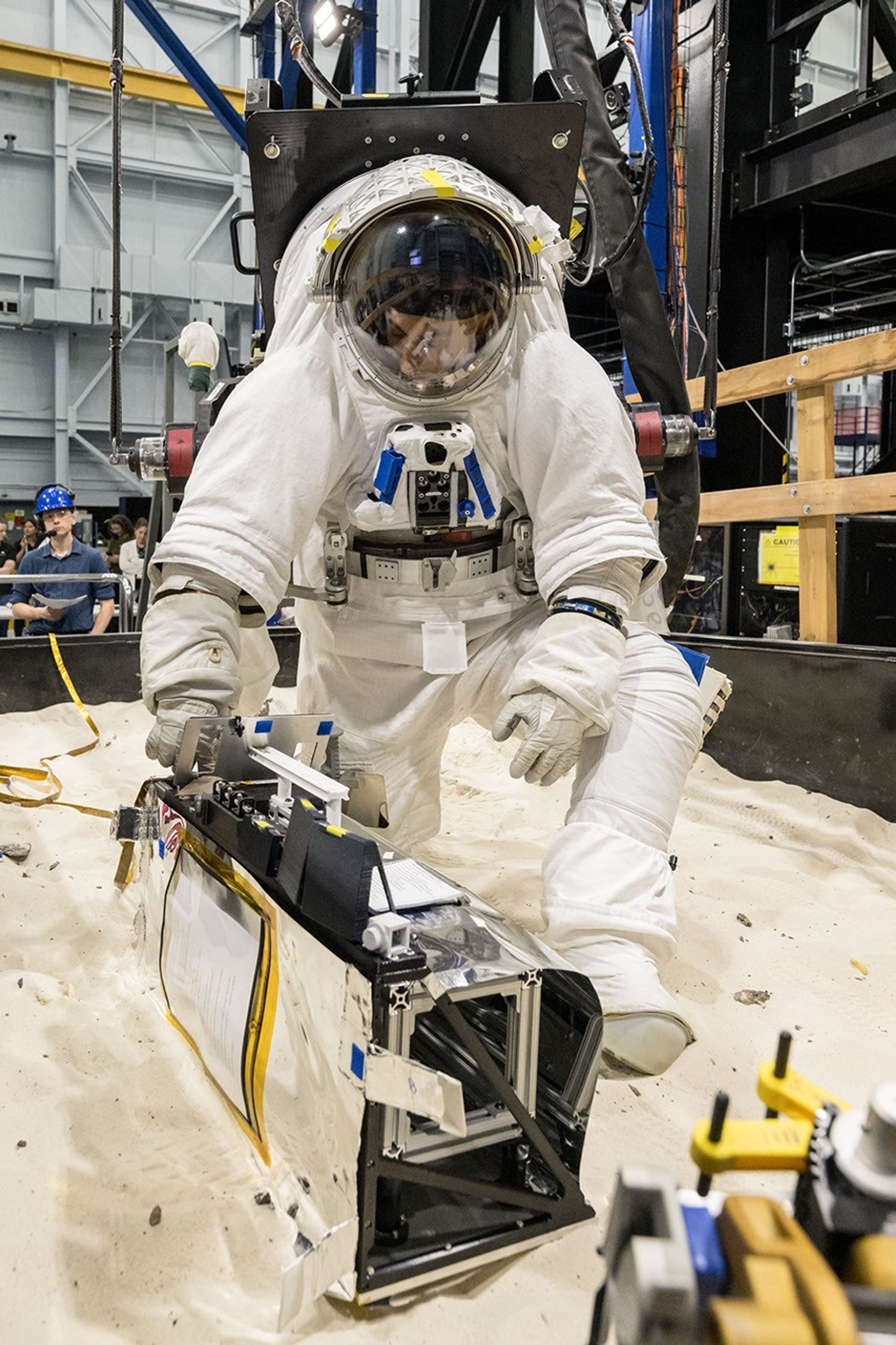
A scientist wearing NASA’s xEMU prototype space suit is testing the handling of a mockup version of NASA’s Lunar Environment Monitoring Station, or LEMS. The testing took place at the Active Response Gravity Offload System, a simulated reduced gravity environment at NASA’s Johnson Space Center in Houston.
NASA Johnson

The LEMS payload builds on a legacy of lunar seismic tracking. Apollo astronauts deployed a network of seismometers on the Moon’s nearside equatorial region between 1969 and 1972. Those instruments operated until 1977, recording about 13,000 moonquakes and other ground vibrations that helped scientists begin to understand the composition of the Moon’s interior. For decades, researchers have hoped to spread more seismometers, updated with new technologies, across the lunar surface.

Now, LEMS will carry the first seismometers to be deployed by future astronauts to listen for faint ground vibrations, collecting new clues to the Moon’s internal structure and ongoing seismic activity. The sensors will be the most compact, sensitive, and energy-efficient seismometers ever built for planetary exploration.

LEMS itself is about the size of a small suitcase, weighing 11 pounds in the Moon’s low-gravity environment. It will carry not just these seismic sensors, but everything it needs to function independently of humans after deployment. LEMS is built to manage its own power production via a lightweight, flexible solar array that conforms to the shape of the LEMS unit. It also will manage its operational activities to ensure continuous data collection based on a preset plan, and monthly data transmission to Earth. The payload will do all this while maintaining a stable internal temperature throughout the massive day-to-night temperature swings of the South Pole region.

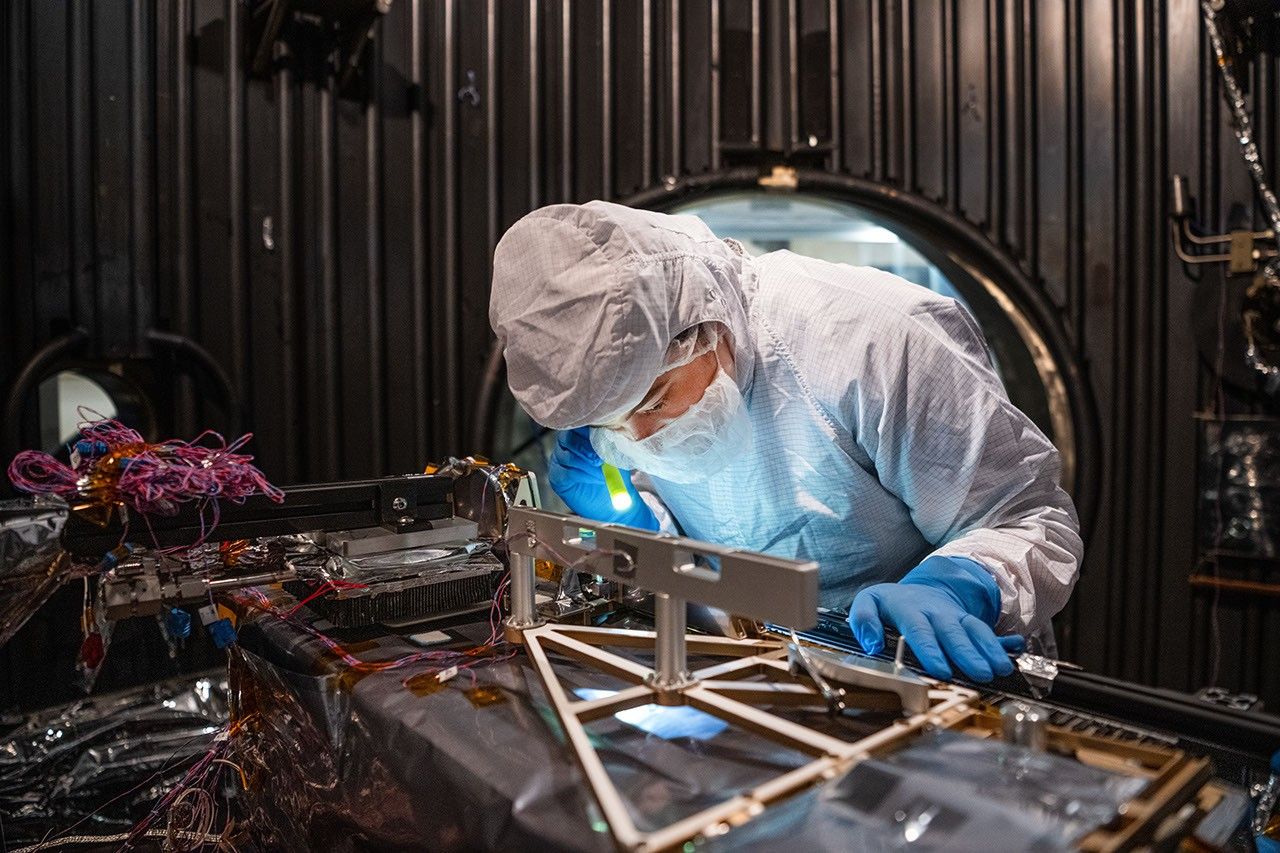
Mechanical Engineer Brie Ludwig inspects the Lunar Environment Monitoring Station (LEMS) in preparation for testing in a thermal vacuum chamber at Goddard Space Flight Center in Greenbelt, Maryland, on March 31, 2026. LEMS is a compact, autonomous, and self-sustaining seismometer suite designed to carry out continuous, long-term monitoring of the lunar seismic environment at the South Polar region.
NASA/Denny Henry

“When we conceived of LEMS, we weren’t just thinking about the next mission, we were thinking about the next generation of lunar exploration,” said Mehdi Benna, a University of Maryland Baltimore County scientist who leads LEMS from NASA Goddard. “Our vision was to create a scientific buoy for the Moon. Like an ocean buoy on Earth, LEMS is designed to be easy to build, adaptable to different scientific objectives, and capable of operating independently for years.”

Before any surface science could happen, Benna and his team had to ensure that LEMS could survive the trip to the Moon and the harsh environment of its surface. Over the past five months, LEMS and its components have been subjected to a demanding series of environmental and operational tests. Engineers verified LEMS can endure the violent shaking of launch, the journey to the lunar surface, and the Moon’s temperature and radiation environment. The team also showed that the instrument package’s mechanical and electrical design is safe for astronaut handling.

The LEMS payload was built to operate through the lunar night, which lasts two Earth weeks, without external power assistance or a heat source. Past lunar surface instruments relied on radioisotope heaters for warmth and power. But LEMS instead will withstand temperatures that dip to minus 400 degrees Fahrenheit in some areas by using advanced insulation materials, low-thermal-conductivity cables that minimize heat loss, and a thermal regulator that conducts heat away during the day to prevent overheating and helps retain heat at night.

These innovations reduce mass and power needs, setting the stage for lighter, energy-efficient instruments that can operate continuously at future Artemis landing sites and the NASA-led Moon Base.

The LEMS payload is led by University of Maryland Baltimore County and University of Maryland College Park. Technical implementation is led by NASA Goddard. The University of Arizona, in partnership with Silicon Audio, Inc., supplied LEMS’ two state-of-the-art seismometers. Morehead State University in Kentucky provided LEMS’ telecommunication system and will operate the instrument on the surface. Washington University in St. Louis will manage the instrument’s data processing and dissemination to the larger scientific community.

Explore More

4 min read

NASA Telescopes Create Colorful ‘Craft’ From Nearby Nebula

Article


5 hours ago

4 min read

Building the Moon Base: NASA Stories at the Ion  

As NASA prepares to return astronauts to the lunar surface for longer stays and increasingly complex operations, building the Moon Base will…

Article


6 hours ago

5 min read

NASA Shares Station Research Today Supporting Moon, Mars Tomorrow

The International Space Station has been busy throughout 2026, as it continues to be a…

Article


7 hours ago


Source: Goddard Space Flight Center – NASA

Source: Goddard Space Flight Center – NASA. Review credited third-party material before publication.

Filed under: Science & Space — NASA — Centers & Facilities

Post navigation

Previous: We CARE Vet Fair connects Georgia Veterans to life-changing support
Next: New York Woman Pleads Guilty to Smuggling Illegal Aliens from Canada

More from Science & Space — NASA — Centers & Facilities

Science & Space — NASA — Centers & Facilities

NASA’s Hubble Spies Spiral’s Edge

Published October 16, 2026 · 2 min read
Science & Space — NASA — Centers & Facilities

Rigorous Analysis Confirms NASA’s Artemis II Heat Shield Performance 

Published October 15, 2026 · 6 min read
Science & Space — NASA — Centers & Facilities

NASA Develops Batteries to Power Humanity’s Return to Moon

Published October 14, 2026 · 5 min read
Science & Space — NASA — Centers & Facilities

NASA to Conduct Flyover, Engage NFL Fans at MetLife Stadium

Published October 10, 2026 · 2 min read
Science & Space — NASA — Centers & Facilities

NASA’s SSPICY Mission to Demonstrate In-Space Inspection Technologies

Published October 8, 2026 · 3 min read
Science & Space — NASA — Centers & Facilities

NASA’s SPHEREx Telescope Sees Menagerie of Brown Dwarfs

Published October 8, 2026 · 5 min read
Science & Space — NASA — Centers & Facilities

Webb Measures Distance to Farthest Fast Radio Burst, Suggesting Origin

Published October 8, 2026 · 5 min read
Science & Space — NASA — Centers & Facilities

NASA Advances LISA Mission Contributions With New Test Telescope

Published October 8, 2026 · 4 min read
Science & Space — NASA — Centers & Facilities

NASA Glenn Invites Phase 1 Proposals for Aerospace Power Systems Laboratory

Published October 6, 2026 · 2 min read
Science & Space — NASA — Centers & Facilities

Suspected Second-generation Planet Solves NASA Hubble Cold Case

Published October 5, 2026 · 5 min read
Science & Space — NASA — Centers & Facilities

NASA Campaign Explores Clouds Spawned by Wildfires

Published October 2, 2026 · 7 min read
Science & Space — NASA — Centers & Facilities

NASA Awards Enterprise Logistics Support Services Agreements

Published October 1, 2026 · 2 min read
Science & Space — NASA — Centers & Facilities

NASA Awards Contract to Develop 5G Communications for Moon

Published September 30, 2026 · 1 min read
Science & Space — NASA — Centers & Facilities

NASA Adds Blue Origin New Glenn 9×4 to Launch Services Contract

Published September 29, 2026 · 1 min read
Science & Space — NASA — Centers & Facilities

NASA Highlights Lessons Learned From Swift Boost Mission

Published September 28, 2026 · 6 min read
Science & Space — NASA — Centers & Facilities

Meet NASA’s Artemis II Crew During Houston Public Event

Published September 28, 2026 · 2 min read
Science & Space — NASA — Centers & Facilities

Reliable Robots: Meet Johnson’s Dexterous Robotics Team

Published September 28, 2026 · 5 min read
Science & Space — NASA — Centers & Facilities

Uncovering the Valleys Hidden Below Greenland’s Ice

Published September 28, 2026 · 4 min read
Science & Space — NASA — Centers & Facilities

NASA Tests Dual Mode Propulsion CubeSat Ahead of Launch

Published September 25, 2026 · 4 min read
Science & Space — NASA — Centers & Facilities

NASA Unveils Winning Designs for Mars Space Food Systems Challenge 

Published September 24, 2026 · 4 min read
Science & Space — NASA — Centers & Facilities

US-India Satellite Captures Time-lapse Video of Volcanic Eruption

Published September 24, 2026 · 5 min read
Science & Space — NASA — Centers & Facilities

NASA Aircraft to Make Low-Altitude Research Flights Over Colorado

Published September 23, 2026 · 2 min read
Science & Space — NASA — Centers & Facilities

NASA’s Hubble Seeks Lensed Supernova, Marks 200,000 Orbits

Published September 23, 2026 · 2 min read
Science & Space — NASA — Centers & Facilities

Johnson Space Center Sparks Curiosity at Houston’s 33rd Annual Japan Festival  

Published September 21, 2026 · 3 min read
Science & Space — NASA — Centers & Facilities

NASA’s Moon Orbiter Spots New, ‘Once-in-Century’ Moon Crater

Published September 16, 2026 · 4 min read
Science & Space — NASA — Centers & Facilities

How 2 US, European Satellites Are Studying Hurricanes During El Niño

Published September 9, 2026 · 5 min read
Science & Space — NASA — Centers & Facilities

NASA’s Hubble, Webb Find Far-out Solar System Objects ‘Remember’ Past

Published September 8, 2026 · 5 min read
Science & Space — NASA — Centers & Facilities

NASA Rocket Takes First Multi-Point Look Inside Radio-Disrupting Clouds

Published September 2, 2026 · 5 min read
Science & Space — NASA — Centers & Facilities

NASA’s Dark Universe-Seeking Nancy Grace Roman Space Telescope Launches

Published August 30, 2026 · 5 min read
Science & Space — NASA — Centers & Facilities

NASA Astronaut Jonny Kim Departs Agency to Continue Military Service

Published August 27, 2026 · 4 min read
Science & Space — NASA — Centers & Facilities

NASA Ames’ Contributions to Roman’s Mission

Published August 25, 2026 · 6 min read
Science & Space — NASA — Centers & Facilities

NASA Ames Experts Available for Roman Space Telescope Interviews 

Published August 25, 2026 · 2 min read
Science & Space — NASA — Centers & Facilities

NASA’s Pandora Mission Begins Study of Exoplanets, Host Stars

Published August 25, 2026 · 5 min read
Science & Space — NASA — Centers & Facilities

Galactic Gems Glisten in New Gallery From NASA’s Chandra

Published August 25, 2026 · 12 min read
Science & Space — NASA — Centers & Facilities

Starstruck: NASA Research Shows How Sun’s Ancient History Shaped Earth

Published August 24, 2026 · 7 min read
Science & Space — NASA — Centers & Facilities

NASA Data Feeds River Forecasts as Snow Drought Effects Linger

Published August 20, 2026 · 6 min read
Science & Space — NASA — Centers & Facilities

Human-Related Microbes May Survive Moon’s South Pole, NASA Finds

Published August 19, 2026 · 6 min read
Science & Space — NASA — Centers & Facilities

NASA’s LRO Images Falcon 9 Crater on Moon, Learns New Details

Published August 18, 2026 · 5 min read
Science & Space — NASA — Centers & Facilities

NASA Glenn’s Legacy Forged Through Decades of Flight Research

Published August 18, 2026 · 7 min read
Science & Space — NASA — Centers & Facilities

NASA Challenge Tests Wheel Designs for Moon Base Mobility

Published August 17, 2026 · 5 min read

Search

Recent Posts
  • Why Trump’s midterm blues mean short-term gain, long-term pain for China
  • Shipping crews caught in the crossfire of the Hormuz conflict | DW News
  • LIVE: French students, workers, pensioners protest in Marseille
  • LIVE: Protests in France as trade unions hold nationwide strikes
  • Joshua Wong’s friend says jailed Hong Kong activist reading books, learning guitar inside prison
  • Blue wave sets up possible IMPEACHMENT of Trump’s attorney general, Todd Blanche
  • Over 300,000 tarantulas seized in Peru | DW News
  • The Last Word with Lawrence O’Donnell – Nov. 4 | Audio Only
  • Vance blames Iran war for GOP midterms loss, Trump brags about WH ballroom | MS NOW Highlights
  • Hope and faith in the American dream behind blue surge in Latino vote in Texas
Categories
  • Florida (110)
    • Jacksonville (20)
    • Miami (62)
    • Orlando (17)
    • Tampa (11)
  • Health (1)
  • New York (69)
    • New York City (69)
  • Science (85)
    • Health & Medical Research (10)
    • U.S. Geological Survey (18)
    • U.S. National Science Foundation (57)
  • Science & Space (364)
    • NASA — Centers & Facilities (82)
    • NASA — JPL & Near-Earth Objects (4)
    • NASA — News, Missions & Technology (242)
    • NASA — Photos & Visual Records (36)
  • Trump (1146)
  • U.S. Civil Service (245)
    • Cabinet — Department of Agriculture (8)
    • Independent Agencies — Commodity Futures Trading Commission (19)
    • Independent Agencies — Consumer Financial Protection Bureau (12)
    • Independent Agencies — Consumer Product Safety Commission (32)
    • Independent Agencies — Equal Employment Opportunity Commission (64)
    • Independent Agencies — Federal Reserve Board (1)
    • Independent Agencies — Federal Trade Commission (46)
    • Independent Agencies — National Labor Relations Board (22)
    • Independent Agencies — Securities and Exchange Commission (41)
  • U.S. Government (11)
    • DOJ — National (8)
    • DOJ — U.S. Attorneys (10)
    • GAO — News & Analysis (43)
    • GAO — Reports & Decisions (158)
    • Department of Justice (10)
    • Government Accountability Office (1)
  • U.S. News (2483)
  • U.S. Veterans (255)
    • Benefits (25)
    • Disabled Veterans (10)
    • Employment (10)
    • Health & Care (64)
    • News (146)
  • Washington (233)
    • Washington (87)
      • Seattle (57)
      • Spokane (30)
  • World News (1942)

Recent Comments

No recent comments.

Archives
  • November 2026 (218)
  • October 2026 (1794)
  • September 2026 (2072)
  • August 2026 (1879)
  • July 2026 (17)
  • June 2026 (8)
  • May 2026 (1)
  • April 2026 (6)
  • March 2026 (1)
  • January 2026 (3)
  • December 2025 (1)
  • November 2025 (1)

Thirstier News is a service of Thirstier, a DBA of Immix Tachyon Synergy Network LLC.

© 2026 Thirstier. Thirstier Theme is an original theme from Thirstier.